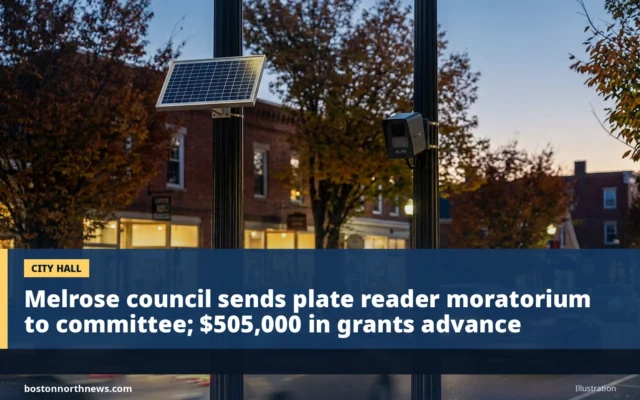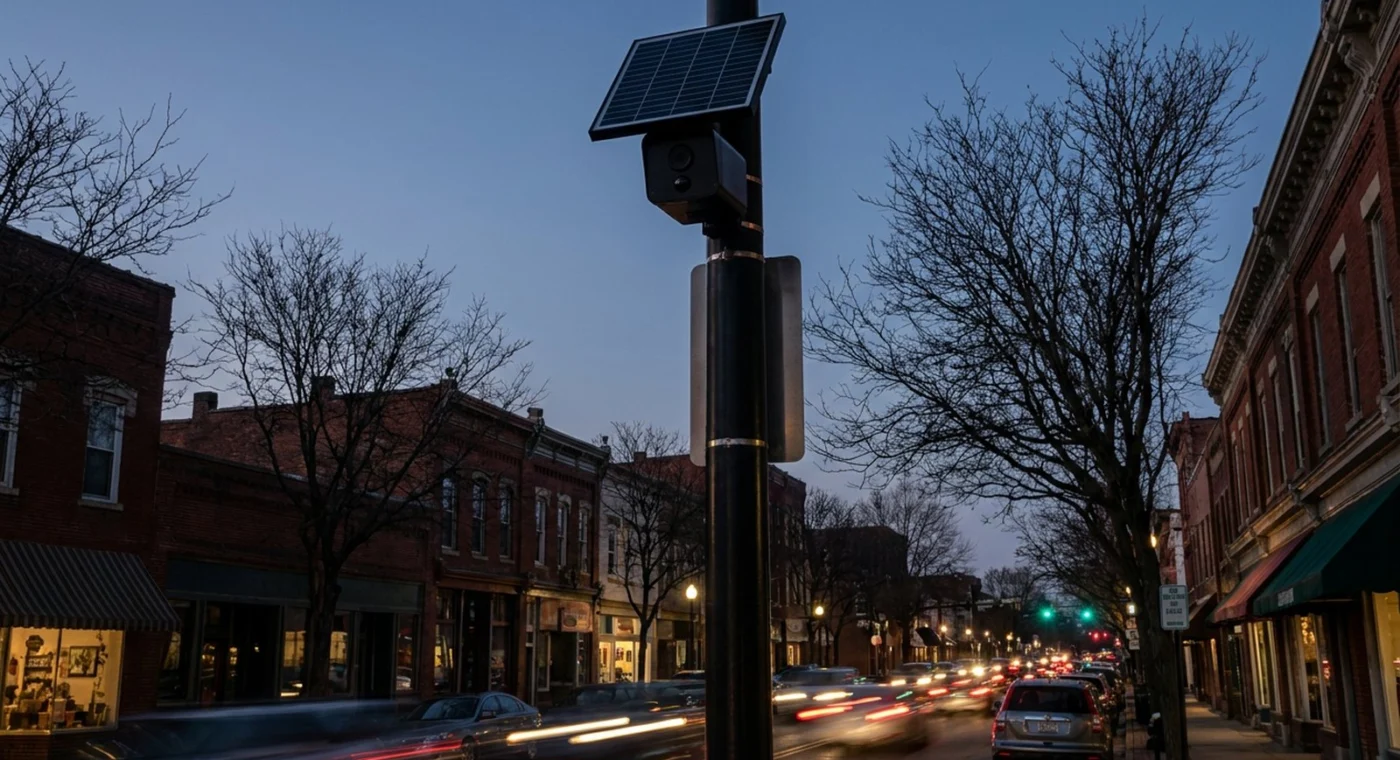
Five of Melrose’s 11 city councilors have filed an ordinance that would bar the city, including its Police Department, from using automated license plate readers or the data they produce until the state passes a law regulating the technology and the council votes to lift the ban. The measure is on the agenda for the City Council’s regular meeting on Monday, November 16 at 7:45 p.m. in the council chamber at City Hall, 562 Main Street.
The ordinance is sponsored by Councilor Devin Romanul and co-sponsored by Councilors Elizabeth Kowal, Maya Jamaleddine, Kimberly Vandiver and Ryan Williams, according to the agenda the city published on November 12. It is listed under new business as a filing by members of the council. The agenda does not say whether the council will debate it Monday or send it to a committee first.
The filing comes a month after a special council meeting on October 15 at which Police Chief Kevin Faller said he would not suspend the city’s three Flock Safety plate cameras on Main Street, residents and representatives of the ACLU of Massachusetts asked that they come down, and a memo from Mayor Jen Grigoraitis said she had told the chief she would prefer to put the technology on hold. That meeting, at which the chief said the city pays $3,000 a year for the cameras, is reported here. The council took no vote that night.
What the ordinance would do
The five-page text in the meeting packet would replace Chapter 84 of the Melrose Revised Ordinances, now a reserved chapter, with one titled “License Plate Readers, Moratorium on Use by Public Agencies.” Its central sentence is short: “the City shall not use any license plate reader or any license plate reader data.” The definitions make that broad. “City” covers the mayor, every agency, officer and employee and any contractor acting for them, “including but not limited to the Melrose Police Department.” “Use” means to “purchase, acquire, install, operate, activate, access, query, search, possess, retain, or obtain” a reader or its data, “whether directly or through any third party.”
Three more clauses close the routes around that sentence. A city agency could not ask another municipality, a state agency or the federal government to run a plate reader or search plate data on its behalf. The city could not spend money on plate readers or their data, and the text specifies that this includes grant funds and money from any other source. And no contract, memorandum of understanding, data-sharing agreement, pilot program or trial, “whether paid or unpaid,” could authorize what the chapter prohibits.
On what is already in place, the ordinance says no agreement signed before its effective date exempts the city from complying. It states as city policy that prohibited readers “shall not remain installed or operational on City-owned property or infrastructure” and that a vendor should not keep data collected for the city after its agreement ends, except as the law requires. It does not order the deletion of records that have to be kept under a court order, a litigation hold or the state public records law, and it names audit files that document who accessed plate data as records to be preserved. The text does not name Flock or any other company.
What it would still allow
The chapter carves out automated traffic enforcement systems, which it defines as cameras used only to detect a specific traffic violation and issue a citation, such as school bus stop-arm cameras, red light cameras or speed cameras, where state law expressly authorizes them. The exemption has conditions. The system could record plate data only when it detects the violation, the data could be used only to enforce that violation and “not used for any other purpose, including but not limited to criminal investigation, immigration enforcement, location tracking” or comparison with a hot list, and the vendor could not fold the data into a network open to its other customers. A system that breaks those conditions would count as a prohibited plate reader.
The text also says that receiving plate reader data by mistake or without asking for it would not be a violation on its own, as long as the data is not then searched or used.
How it would end
The sponsors call the measure a moratorium, “not a permanent prohibition.” The findings section says Massachusetts has “no comprehensive statewide law regulating the investigative use of license plate readers by police or other public agencies,” and quotes the Supreme Judicial Court’s 2020 decision in Commonwealth v. McCarthy: “With enough cameras in enough locations, the historic location data from an ALPR system in Massachusetts would invade a reasonable expectation of privacy and would constitute a search for constitutional purposes.”
If the Legislature passes a comprehensive law, the council would have to hold a public meeting within 60 days of its effective date to decide whether it protects Melrose residents well enough. The ordinance lists eight things the council would weigh, among them whether the state law limits what the readers can be used for, sets “short and enforceable” limits on keeping data not tied to a criminal investigation, restricts sharing with private companies, out-of-state agencies and federal agencies, requires a judge’s authorization to search historical data, requires audit logs and independent audits, requires public reporting, and requires public notice and local approval before an agency acquires readers. The moratorium would stay in force until the council votes to amend or repeal the chapter. Missing the 60-day deadline would not end it.
For enforcement, the text says a city employee who violates the chapter “may be subject to discipline,” preserves the right to seek a court order, and cites Section 3-2 of the city charter. It would take effect on passage and approval under the charter.
Tax classification hearing: December 7
The mayor’s one order on the agenda concerns the fiscal 2027 tax classification. In a memo dated October 29, Chief Assessor Sarah MacLellan asks the council to set the classification hearing and final vote for Monday, December 7. That is the annual vote on the residential factor, which decides how much of the tax levy each class of property carries. The Board of Assessors will supply the data before the hearing, the memo says; no rates or values are in Monday’s packet. Separately, applications for the city’s tax relief fund for older and disabled homeowners are due January 15, as reported here.
Memorial Hall: two trustees and $100,000 for stage lights
The mayor is asking the council to confirm two appointments to the Soldiers and Sailors Memorial Building Trustees, both to seats left by resignations. Joanne Lattanzi would finish the term of Jason Webb, which runs to the end of February 2028. Her letter and resume describe a recently retired marketing executive with 30 years in financial services. Elizabeth Larcano would replace Lou Izzi for a term running to the end of February 2030. Her resume describes a deputy general counsel with 20 years of experience, and her statement of interest recalls playing on the Memorial Hall stage with the Melrose Symphony Orchestra as a Melrose High School student.
Under unfinished business is the acceptance of a $100,000 earmark in the state’s fiscal 2027 budget for stage light replacement and other capital improvements at Memorial Hall. In a memo dated October 9 the mayor wrote that the stage lighting system was installed more than 18 years ago, that the lighting board “can no longer be repaired or replaced” for lack of parts, and that about 90 percent of Memorial Hall rentals use the stage lights. The $100,000 figure rests on a lighting professional’s 2025 estimate and would cover new equipment, removal of the old fixtures, installation and electrical work by outside vendors. The memo credits state Rep. Lipper-Garabedian with securing the money.
Also Monday
The Melrose Retirement Board asks the council to accept a local option in the state pension law, Chapter 32, Section 20(4)(h), that raises the most the city treasurer and collector can be paid for serving as custodian of the retirement system’s funds from $1,500 a year to $3,000. The board voted to pay the $3,000 starting January 1, 2027 if the council accepts. The money comes from the retirement system’s expense fund.
National Grid petitions to install about 65 feet of underground conduit, two 4-inch concrete-encased lines, on East Emerson Road, running from pole 1623 to 681 Main Street. The council will also be asked to approve the minutes of its November 9 meeting.
How to watch and comment
The meeting airs live on MMTV, at mmtv3.org and on Comcast channels 3, 15 and 22 and Verizon channels 37, 38 and 39. Public comment is on the agenda, and the agenda carries a Zoom link for it. The agenda and the packet are on the city’s CivicClerk portal.