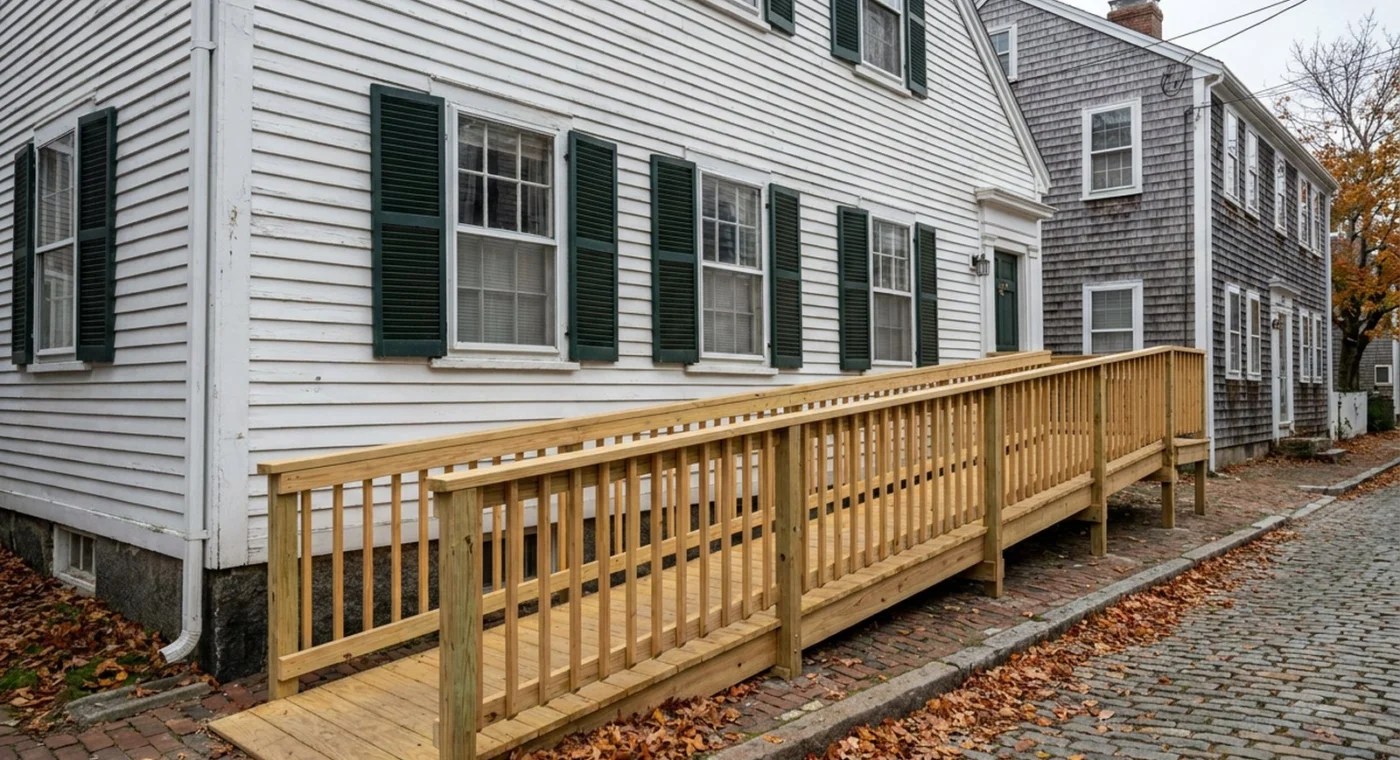
A Salem family that needs to push an addition into a side setback so a relative with a disability can sleep on the first floor now has to go before the Zoning Board of Appeals, on a video call that can draw a large audience, and explain why. A City Council committee agreed Monday, November 16 that the city should stop requiring that, and spent most of an hour working out how.
The Committee on Ordinances, Licenses and Legal Affairs took up a proposal from Ward 2 Councillor Andrew Smith to create an administrative review for reasonable accommodations under the zoning ordinance. City Solicitor James Wellock said Mayor Dominick Pangallo and city staff support the goal and offered a shorter route to it: one added clause in the zoning ordinance stating that the building commissioner may grant such accommodations herself. The committee voted to keep the matter in committee while the language is written and the calendar for a required public hearing is checked.
What Smith proposed
Smith said the idea came from residents. Under the current process, he said, a homeowner whose project is covered by the fair housing laws has to “show up and go to the ZBA, explain the disability publicly,” and face neighbors who may fight the request in that setting. That, he said, does not fit the spirit of the Fair Housing Act.
His draft would have a resident submit the request to a city reviewer, who would approve or deny it within a set time. A denial would come with written findings and could still go to the Zoning Board. He compared it to the council’s decision to hand requests for handicapped parking spaces to the Police Department. “It protects privacy and makes it a more streamlined process,” he said. The draft also waives fees for the review.
The solicitor’s shorter version
Wellock said Smith’s draft sets up an extensive process involving several departments and that the same result can be reached by clarifying the enforcement section of the zoning ordinance. Section 9.1.2 now bars a building permit unless the zoning ordinance is complied with, “except after written order from the Board of Appeals.” He would add words to this effect: “or pursuant to a reasonable accommodation for a person with a disability granted administratively by the building commissioner in accordance with applicable state and federal law.”
He said he believes the commissioner already has that authority, based on conversations with outside counsel and his predecessor, but that writing it down means “people now know where to go” and her authority is “in black and white as opposed to based on a legal opinion.” He did not have final language Monday; the idea, he said, came together in conversations that day.
Building Commissioner Stavroula Orfanos said ramps are already exempt from zoning relief. The change would matter for other work. Her example was an addition for a first-floor bedroom that sits five feet from the lot line where 15 feet is required. Today she has to deny the permit and send the owner to the Zoning Board. With the new clause, she said, she would review a plot plan and the stated need and issue the permit administratively.
Councillors pressed her on standards. She said each case would turn on what the applicant shows, whether the work could be placed elsewhere on the lot and whether there is a safety problem, such as Fire Department access between houses. “I would hope that I wouldn’t deny something that needed to be done for someone that needed accommodation,” she said. Wellock said the guideposts are an interactive process with the applicant and a requirement that the accommodation be reasonable.
Neighbors would not lose every avenue. A building permit has to be posted on the property, Wellock said, and an abutter can appeal its issuance to the Zoning Board. Permits are decided within 30 days under the building code, Orfanos said. She said she cannot waive a building permit fee and knows of no case in which one was waived. Smith said he included the fee waiver on principle and that it needs more discussion.
Historic districts
The one open disagreement was over the Historical Commission. Wellock said the commission keeps its authority in historic districts, that it has handled ramps in the past by working with owners on screening so they are less visible from the street, and that an owner could request that a hearing involving a person’s physical or mental condition be held in executive session. Smith, who lives in a historic district, requested a second opinion. Fair housing laws, he said, “supersede our local codes.” Wellock said he had not meant to suggest otherwise and would get back to him. Committee Chair Andrew Varela, the Ward 7 councillor, said his reading of the state historic districts law is that a commission can still regulate appearance and design so long as it does not discriminate.
Families and the zoning board chair
Jeremy Spittle of Woodbury Court told the committee that he and his wife renovated their home more than a year ago for their daughter, who has a disability, and received the zoning relief they requested. “The journey to get to that end point wasn’t always seamless, straightforward, and timely,” he said. He cited the Americans with Disabilities Act, Section 504 of the Rehabilitation Act and the federal and state fair housing laws, and said that if the simpler version is chosen, the city’s ADA coordinator should be part of the review.
Mandee Spittle, a member of the Commission on Disabilities, said the family’s house was built in 1830 and they did not want to leave their neighborhood for a single-level home elsewhere in the city. She also read a letter from a Derby Street neighborhood resident who is before the zoning boards now and wrote that the process has required her family “to publicly disclose sensitive personal medical information” to justify basic modifications.
The strongest endorsement came from Nina Vyedin, who chairs the Zoning Board of Appeals. She said the board has heard several such cases during her tenure and has another on its agenda Wednesday. Applicants must describe their needs to the board and to everyone watching, she said, and with a crowded agenda some wait months through continuances. Many hire a lawyer for multiple meetings, a cost she said matters more than any fee. She added that the legal standard for a variance was never a good fit for these requests and that approvals could be open to challenge. Administrative review “would make our lives and our schedules a lot easier,” she said, and “more importantly” help “the folks who are just trying to build a home to live in.”
What happens next
Because the fix amends the zoning ordinance, it needs a joint public hearing of the council and the Planning Board. Amanda Chiancola, the city’s deputy planning director, said other zoning amendments are in the pipeline, covering single-room occupancy or efficiency units and a Jefferson Avenue overlay district, and that the accommodation change could share a hearing with one of them. She cautioned against starting the statutory clock just before the December holidays.
Councillor at Large Ty Hapworth favored the simplest wording possible for residents who are not lawyers and suggested carrying the matter into January. Smith said it might be ready for the council’s December 3 meeting. Lisa Cammarata, the city’s human resources director and ADA coordinator, agreed at Smith’s request that the coordinator should be written into the review.
Smith moved to keep the matter in committee, Hapworth seconded, and Varela counted four hands in favor. Ward 6 Councillor Katelyn Holappa, a committee member, was absent. Council President Alice Merkl and Councillor at Large Kyle Davis attended, Ward 3 Councillor Jason Sydoriak joined by Zoom and Ward 4 Councillor Timothy Flynn arrived during the discussion.
No minutes have been posted. This report is drawn from Salem Access Television’s recording of the meeting and the posted agenda.