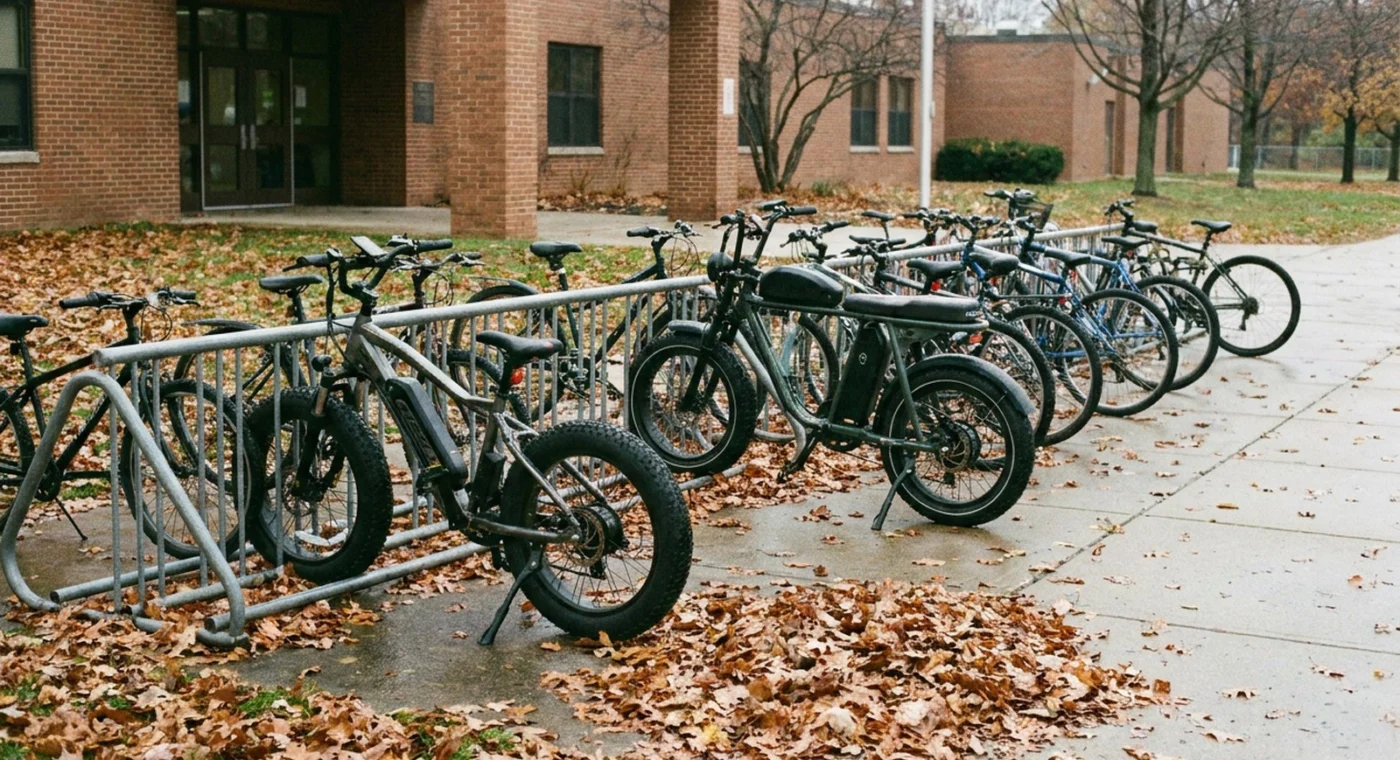
Throttle e-bikes, motorized scooters, electric skateboards and hoverboards are now banned from every Danvers Public Schools property. The School Committee adopted the policy on Monday, November 9, on a voice vote with no one opposed, and in the same meeting approved the Islamic Education School, a private school now in Revere, to operate at 152 and 160 Sylvan Street.
The two-hour meeting at Holten-Richmond Middle School also included recognition for two Thorpe Elementary School employees who put out a classroom fire on the third day of school, a frank exchange over why state test growth sags in the middle grades, a special education update and the first dates in next year’s budget calendar.
E-bikes: what is banned and what is not
Superintendent Daniel Bauer brought the policy back after the district’s lead school resource officer, Sergeant Smith, described the problem to the committee in October. Bauer said the text was reviewed by the district’s attorney and compared with policies in other districts.
The Salem News, which reported that the rule took effect immediately, quoted the policy as covering Class 2 electric bikes, motorized bikes and scooters, electric skateboards, hoverboards, electric unicycles and “other substantially similar motorized personal transportation devices, as determined by the Superintendent or designee.”
Traditional bicycles and Class 1 electric bikes, the kind that assist only while the rider pedals, are still allowed. They have to be dismounted and walked once on school property.
Police Chief James Lovell told the committee the difference between the classes is the throttle. “The class one is going to be pedal assist only, no throttle,” he said. Speeds are similar, but the instant acceleration of a throttle bike is where officers see the trouble, and some of what students ride now is “crossing over into almost the e-moto bikes,” a category he said the state has not yet classified.
Lovell said the school resource officer at the middle school checked the bike racks about two weeks before the meeting, found three bikes that would not comply, and called the parents, who came and took them home. He said Essex Tech was to vote on a similar policy that Thursday.
Asked whether a student could ride an e-bike to a friend’s house across the street, leave it there and walk to school, Lovell did not dispute it. “That is the unintended consequence,” he said. “I think it’s still a win.” The concern, he and Bauer said, is not only the school day but night football games and other events, with riders moving fast through crowded parking lots. The town cannot prohibit the bikes townwide, Lovell said, but the schools can control their own grounds.
Bauer said principals reported little e-bike use at the high school, some at the middle school and almost none at the elementary schools. Notice of the policy is going to all families, and principals will talk with students.
Islamic Education School approved for Sylvan Street
Under state law, a private school that enrolls children of compulsory school age needs the approval of the local school committee. The test, in General Laws Chapter 76, Section 1 and in the committee’s own policy on non-public schools, is whether instruction equals that of the public schools “in thoroughness and efficiency.” Bauer told the committee he used the same process the district followed in 2023 for Great Rock Christian Academy.
He said the school approached him in early October and submitted a packet of about 75 pages: curriculum by grade and subject, textbooks, assessment and grading practices, attendance and records policies, staff hiring standards and background checks, and occupancy and safety documents for the two Sylvan Street buildings. The calendar runs 184 days and roughly 991 to 1,046 instructional hours, more than the state requires of public schools. Bauer recommended approval.
The school’s principal told the committee it has about 70 students who come from Revere, Everett, Malden, Boston and as far as Littleton, and that it is seeking approval for kindergarten through grade 12. She agreed with the chair’s understanding that classes in Danvers would begin in the 2027-28 school year. Bauer said the school told him it had purchased the buildings; the principal spoke of moving “once we get the property.” The Salem News has reported that the school now teaches kindergarten through grade 6 and that the site will also house an Islamic center of the Association of Islamic Charitable Projects.
“What we’re asking today is just to be judged on the same academic standards as every private school in Massachusetts,” the principal said.
Committee members used their questions to spell out the limits of the vote. One asked Bauer to read the statute aloud for the audience. “We’re not voting on a building. We’re not doing anything for zoning,” the member said, adding that questions about traffic or zoning belong to other boards. Another said the vote “cannot be influenced by” religion.
The item drew most of the night’s public comment, which the committee takes only at the start of the meeting. Three people connected with the school spoke about its 30 years in Revere, its food drives and cleanups, and the fact that it costs Danvers taxpayers nothing. The chair of the district’s special education parent advisory council and another resident urged the committee to treat the application like any other; the resident called the opposition she had seen Islamophobia. One resident asked the committee to table the vote because, he said, people were only just learning of it, and another asked why a separate school was needed.
When a resident tried to speak during the discussion, Chair Sean Doherty declined. “This is not the place or the time,” he said, offering to talk with anyone afterward. The motion to approve passed on a voice vote with no one opposed; the Salem News described the vote as unanimous.
Thorpe staff honored for stopping a classroom fire
Thorpe Principal Brian Reilly described a fire in the school during the first week of classes in September. Fourth grade teacher Eileen Ganley and her students noticed something wrong in their classroom; she got the children out, closed the door, pulled the fire alarm and alerted the room next door. Reilly said he and a staff member he identified as Sean Powers reached the room to find flames coming from a light fixture. Powers ran for an extinguisher and put the fire out while Reilly called 911.
The building was empty in under a minute, Reilly said, and every student and staff member was accounted for twice in under four minutes. He said the Fire Department told him the outcome could have been far different without the two.
Test scores: growth holds in elementary, dips in grades 6 and 7
Curriculum directors Julie Posternack and Peter DiMauro summarized a subcommittee review of MCAS student growth percentiles, which compare each student’s progress with that of students statewide who had the same score the year before. In the elementary grades about 31 to 32 percent of students met or exceeded expectations in English, a figure Posternack called “rather discouraging,” but average growth was in the state’s moderate range for all students and for the subgroups shown. In grades 6 and 7 growth fell just below that range before recovering in grades 8 and 10.
One member, in a sixth or seventh year on the committee, said the same middle school drop shows up every year and asked whether light, unreviewed homework in the elementary grades leaves students unprepared. Posternack said research does not show that elementary homework raises achievement and that she would rather teachers spend their 45 minutes of daily preparation planning lessons. Bauer said the transition years are a district focus and pointed to the new math curriculum and common assessments now running from elementary through middle school.
Special education and the budget calendar
Student services administrators reported that three independent audits in two years pointed to the same needs: stronger leadership, more consistent programs and better training. The district now serves 155 students in four specialized in-district programs, has cut out-of-district placements from 81 to 75, is reviewing 17 more student profiles and has brought two students back to Danvers.
Bauer said the fiscal 2028 budget workshop is set for January 25 at 6 p.m., with subcommittee meetings and a public hearing to follow, and that the district is waiting for the Select Board’s budget goal. Fees for transportation, prekindergarten, athletics and Chromebook insurance will be reviewed. “Not saying fees will go up, but just to review,” he said.
Also
- The committee approved an overnight trip for the boys hockey team to the University of Massachusetts Amherst, December 4 to 6, with a campus tour, a UMass game and a scrimmage against Amherst Regional. Principal Alan Strauss said the boosters will pay for any family that cannot.
- Student representatives reported that the high school held a safety drill during a passing period that day, that “Mamma Mia” runs November 21 and 22, and that the high school open house is November 19.
- The town’s Human Rights and Inclusion Committee will hold its menorah lighting on Friday, December 4, at 5 p.m. at the library.
- The October 5 minutes and the consent agenda were approved. The committee next meets December 14.
The recording is here.