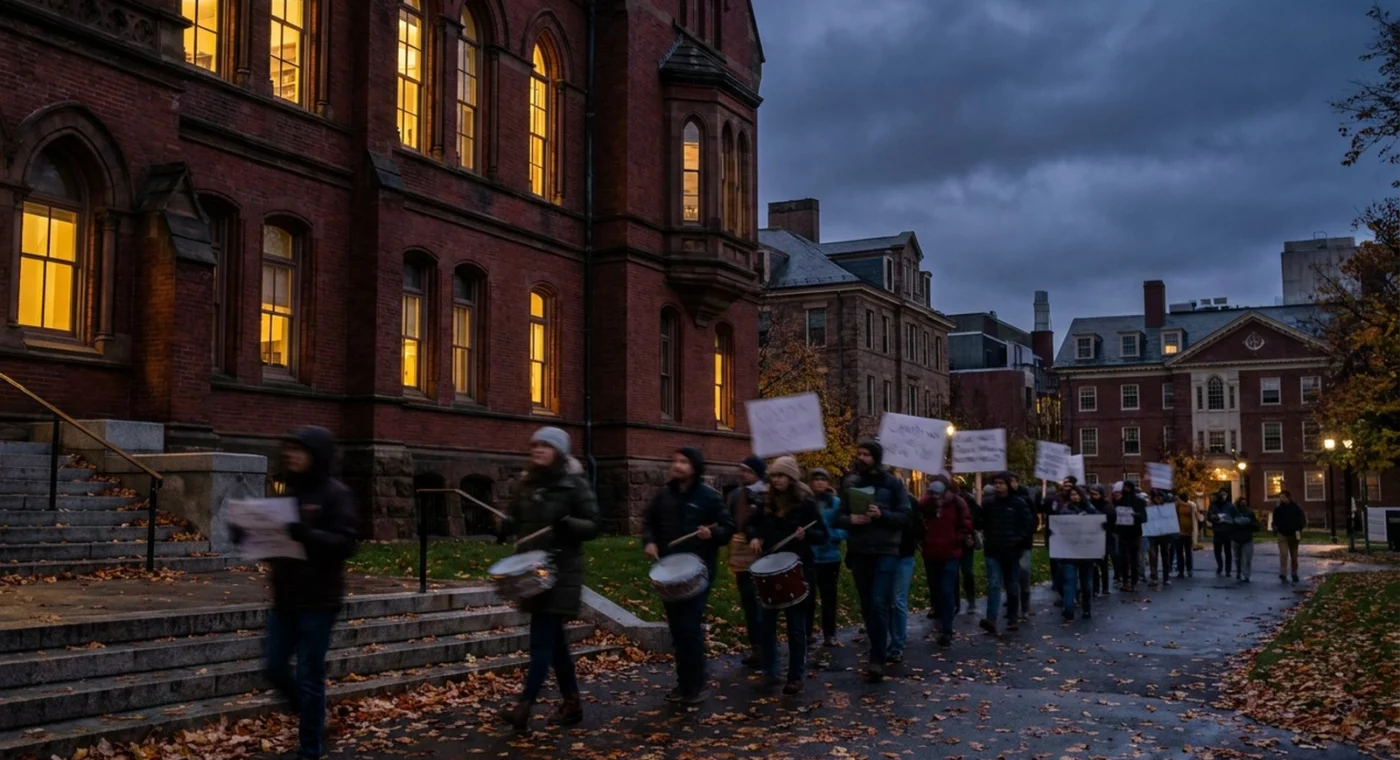
CAMBRIDGE. The second strike of the year by Harvard’s graduate student workers enters its third week on Tuesday with no contract, a bargaining calendar that stretches to mid-December, and a growing list of collateral damage on campus: a Sanders Theatre evening with Yo-Yo Ma and Stephen Colbert that ended after a fire alarm, a midterm exam drowned out by air horns, and a faculty meeting at which professors asked whether anyone from the faculty is at the bargaining table. Two other Harvard unions are lined up behind the strikers. This account is drawn from the Harvard Crimson’s reporting, Cambridge Day, and the statements Harvard has posted on its academic unionization site.
Who is striking and why
The Harvard Graduate Students Union-United Auto Workers represents more than 4,000 graduate and undergraduate student workers: teaching fellows, research assistants and hourly student employees. Its contract expired in June 2025. The union struck for 40 days in the spring of 2026, the longest walkout in its history, and ended that strike in June without an agreement. In October, 88 percent of voting members authorized a second strike, and when no deal was reached by an 11:59 p.m. deadline on Monday, October 26, members walked out at midnight. A noon rally at Zimmer Hall Plaza followed, with pickets across campus and a petition delivered to the administration.
The union’s three demands have not changed: higher wages and benefits, written protections for noncitizen workers, and an independent process for harassment and discrimination complaints. Its president is Denish Jaswal and its vice president Evan R. Lemire.
Harvard’s last full offer came at the October 22 bargaining session, the final one before the deadline and, by the university’s count, its third comprehensive proposal since talks began in early 2025. It would raise pay 6.1 percent on ratification and 3 percent a year after that, which Harvard says compounds to nearly 16 percent over the life of the contract. The union says 3 percent trails inflation and amounts to a pay cut, and Lemire told the Crimson the October 22 package “was substantively no different to the previous proposals.”
In an email to the Harvard community on the eve of the strike, Provost John F. Manning and Executive Vice President Meredith L. Weenick wrote that “another strike is unwarranted, particularly considering the agreement that exists” between the parties on key issues, and that “remaining differences can be resolved at the bargaining table.” The university’s labor relations office had warned in an October 2 letter to faculty that a second strike pursuing the same goals as the spring walkout would be an intermittent strike and not protected by federal labor law. Lemire called that claim “spurious,” citing a 2019 National Labor Relations Board decision he said defines an unprotected intermittent strike as a plan to strike, return and strike again: “Any suggestion that HGSU has ever made such a plan is false.”
The Sanders Theatre evening
On Thursday, November 5, Colbert and Ma were scheduled to appear together at Sanders Theatre for “Arts for Life’s Sake,” marking the 50th anniversary of Harvard’s Learning from Performers program. The union had asked both men beforehand to cancel in solidarity. They did not, and striking members set up outside with drums, horns and chants loud enough, Cambridge Day reported, that the speakers inside were hard to hear, Ma especially.
The program opened at 7 p.m. with a 1976 film clip of Ma as a Harvard undergraduate and a performance by the 11-member Crimson Cellos. About 7:35 p.m., after three audience questions, a fire alarm sounded and the hall was evacuated. The Cambridge Fire Department found no cause, and the event was called off for the night. The union said the alarm had nothing to do with its picket and that it did not know what set it off; members told Cambridge Day they were relieved no one inside had been at risk. Harvard first indicated the event would be rescheduled; at least one ticket holder then received a note from the Harvard Box Office saying it would not be. Harvard did not answer Cambridge Day’s request for comment.
The midterm
Eight days earlier, on October 29, the midterm in History of Science professor David S. Jones’s General Education course, “Biomedical Ethics and History,” was disrupted by megaphone chants and air horn blasts from striking workers outside Emerson Hall. Harvard’s unionization site describes picketers gathered on the Quincy Street side of the building from about 10 a.m. to noon that day. Harvard College Dean David J. Deming and Dean of Undergraduate Education Amanda Claybaugh issued a statement the same day affirming students’ “right to take their exams without disruption.”
At the Faculty of Arts and Sciences meeting on Tuesday, November 3, Jones played two audio clips of the noise. “This was not the usual picket,” he said. “This was a sonic assault.” He asked for “a stronger response” and said there is a line between free speech and harassment “or something worse.” FAS Dean Hopi E. Hoekstra spoke of “the tension that we feel between the rights of our students to take an exam uninterrupted” and the rights of union members, and said she would “continue to relay this urgency.” Deming addressed the strikers directly: “Please leave students alone and let them continue their studies.”
Anthropology professor Rowan K. Flad pressed from the other direction. Citing a November 2 union email to faculty that said no faculty member sits on the university’s bargaining team and that no new sessions had been scheduled since the strike began, he said there had been “insufficient urgency” from the administration and asked: “Is the University actually committed to good-faith negotiations at the bargaining table?” He said faculty and undergraduates “bear the brunt of the consequences.” University spokesperson Jason A. Newton declined to tell the Crimson whether any faculty serve on the bargaining team.
The rally at University Hall
Also on November 3, election day, more than 200 union members rallied outside University Hall and delivered a letter to Graduate School of Arts and Sciences Dean Emma Dench urging the deans to push the university toward a settlement. “Give us the conditions to keep doing it,” the letter ends. Harvard Law School professor Nikolas E. Bowie told the crowd that Harvard “will not promise its own students in writing” protection from federal agents, and said the university had removed 800 workers from the bargaining unit the day after the contract expired in June 2025 because “Donald Trump controls the labor board.” Harvard has defended that removal on the ground that students paid through research stipends are not employees under federal labor law.
Cambridge City Councillor Ayah A. Al-Zubi said elected officials were there to show they were watching Harvard’s conduct. State Rep. Mike L. Connolly, whose district covers most of Cambridge, said many of his constituents were on the picket line and that Harvard “absolutely can afford to do better.” Benjamin S. Ewen-Campen, a member of the separate Harvard Academic Workers-UAW who was elected to the Massachusetts House that same day, called Harvard “the richest institution in this country” and urged a return to the table. The co-presidents of the Harvard College Democrats said their group had signed the union’s petition.
Where bargaining stands
The two sides met on Thursday, November 5, their first session since the walkout began. Harvard’s posted update on that session says the university “remains committed to bargaining in good faith and reaching an agreement” but has “growing concerns” about the union’s conduct; the full statement could not be retrieved for this article because the university’s site refused the connection. Further sessions are scheduled for November 20, December 3 and December 17, which means the strike, if it lasts that long, would run through the end of the fall term.
Two more disputes sit behind this one. Harvard Academic Workers-UAW, which represents non-tenure-track teachers and researchers, has set a strike deadline of Tuesday, November 10. Harvard’s dining hall workers, represented by UNITE HERE Local 26, have passed a strike authorization vote of their own as their talks stalled.
The Cambridge Day account of the Sanders Theatre evening is here; the Crimson’s reports on the strike’s start and on the November 3 faculty meeting are here and here.