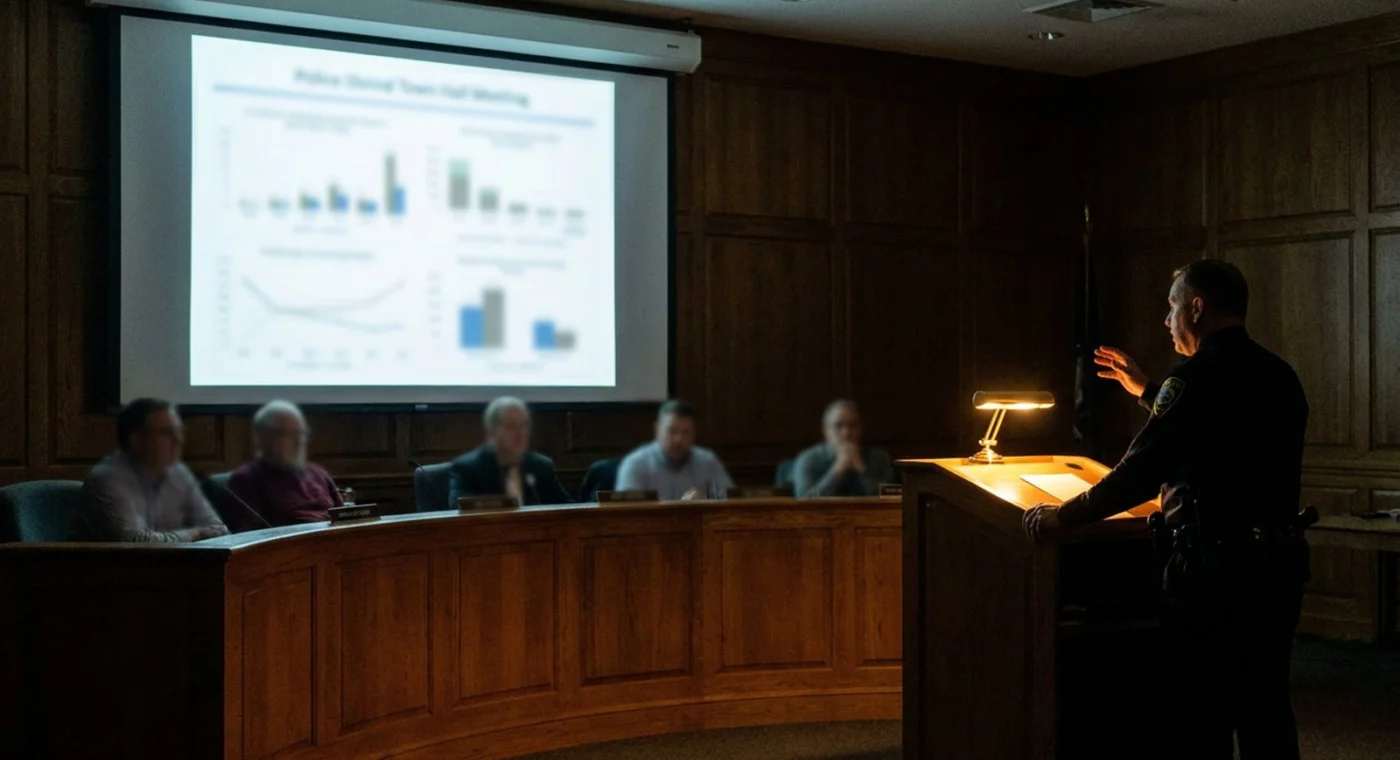
The Danvers Select Board voted 4-1 on Thursday, November 5 to continue its annual tax classification hearing to Tuesday, November 17, two days before it would otherwise have set how the fiscal 2027 property tax levy is split between homeowners and businesses. Two members said they wanted to hear the town’s fiscal outlook workshop on Saturday morning before picking a number. The hearing took up the last hour of a two and a half hour meeting that also included a 60-slide quarterly report from Police Chief James Lovell, who told the board that an outside staffing study recommends adding 11 officers over five budget years.
This account is drawn from the DCAT recording of the meeting. The town’s agenda and minutes were not available to us at the time of writing, and the board’s chair, who ran the meeting, is not identified by name in the recording. The members who spoke by name were Daniel Bennett, Maureen Bernard, Michael Bean and Gardner Trask.
The tax hearing: a $12.31 uniform rate, and a vote in two weeks
Assessor John LaBelle told the board that the purpose of the hearing is to adopt a residential factor, which determines what share of the levy each class of property pays. The levy is about $102 million against a total town valuation of about $8.3 billion, which produces a uniform rate of $12.31 per $1,000 if the board does nothing. State law lets the board shift part of the burden onto commercial, industrial and personal property by lowering the residential factor below one. Danvers has done that for more than 20 years, LaBelle said; residential property makes up about 79 percent of the town’s value and in recent years the shift has brought the residential share of the levy down to 67 or 68 percent.
Residential values rose a little over 3 percent this year, commercial about 2 percent, industrial about 3.5 percent and personal property about 7 percent. LaBelle said the personal property jump was driven mainly by Boston Gas and Verizon equipment and by an audit the town’s vendor did of business equipment, plus new equipment at the movie theater. Within the residential class, single-family values rose 3.4 percent, condominiums just under 3 percent, two-families about 3 percent, three-families 3.9 percent and larger apartment buildings 2.7 percent. The levy is up a little over 3 percent and, he said, “pretty close to our levy ceiling.” About a quarter of the year’s new growth came from two buildings, Maple Square and the new hotel on Endicott Street, which is about half built and alone accounted for about 12 percent of growth.
Bennett pushed back on a slide showing the average single-family tax bill over time. The 2010 average of $4,500 would be $7,072 in today’s dollars, he said, while last year’s bill was $7,780, meaning residential bills are rising faster than inflation. LaBelle and another member answered that the rate is set on property value, not on what owners earn. “This is a property tax. This is based on the value of your home, which increases unrelated to the cost of living,” the member said. Bennett replied that he was making a statement about affordability, not about the formula.
When LaBelle reached the slide asking the board to choose a factor, Bennett asked to wait. “We have a financial summit in two days. Does that have a bearing on this? Maybe, maybe not, but I don’t know what I don’t know,” he said. Bernard agreed. Trask argued for voting that night. The workshop is about long-term planning, he said, and “town meeting ordered the meal in May. Now we’re dividing the check.” He said nothing on Saturday would change how he would split it, but he would not stand in the way if a third member wanted to wait. Bean said he felt the same way as Bennett and Bernard. LaBelle said there is no state deadline the delay would miss; he needs the number in time to get tax bills to the printer in December, and the state’s approval of the split usually takes a few days.
Town Manager Jill Cahill told the board that procedurally it had to either close the hearing or continue it to a date certain if it wanted to take public comment at the next meeting. The motion to continue the hearing to November 17 passed 4-1, with Trask voting no. Cahill said the finance director, Rodney, will not be at the November 17 meeting but the assessor will, and asked members to send any questions for the finance director in advance. Three other annual votes tied to the hearing, including whether to adopt an open space discount, a residential exemption or a small commercial exemption, were also put off; LaBelle said the board has historically adopted none of them.
Police: 19,034 calls, 275 arrests and a study that says the department is 11 officers short
Lovell’s report covered January 1 through October 26. The department logged 19,034 calls for service in that period and 275 arrests, already more than all of last year, with another 10 to 12 arrests in the week before the meeting. Shoplifting led the arrest categories with 56, followed by domestic incidents at 53, warrants at 52, motor vehicle offenses at 30, trespassing at 23 and operating under the influence at 20. Target at the Liberty Tree Mall had 103 shoplifting incidents this year and Walmart 38; of the shoplifting cases, 56 ended in arrest, 35 in a summons and 49 were handled by the store or by a trespass notice. The busiest call locations were the Liberty Tree Mall stores, Market Basket, Costco, the DoubleTree and the Center for Addictive Behaviors on Middleton Road. Of those arrested, 160 were Danvers residents, 26 from Peabody, 16 from Lynn, 14 from Beverly and 11 from Salem; 28 were juveniles.
Traffic numbers were better. Bicycle crashes fell to seven from 21 last year, hit and runs to 97 from 113, crashes with injuries to 113 from 173 and rollovers to 11 from 14. Officers made 3,143 motor vehicle stops, already past last year’s 3,078. The town received a $38,040 federal fiscal 2027 roadway safety grant, of which $16,380 goes to distracted driving, seat belt and speed enforcement, $18,648 to crosswalk and pedestrian enforcement, $1,500 to helmets and about $1,500 to a summer bike rodeo. The money was authorized for spending on Monday, Lovell said, “so you will see more officers out on the street now.”
Youth complaints rose to 231 from 164 last year, with 42 of them at the mall. The department has impounded 17 e-bikes for 15 days each, issued 34 juvenile court summonses and made 28 juvenile arrests. A July 8 meeting with the district attorney’s office, juvenile probation, the schools and family service agencies led to home visits with Pathways Family Resource Center. At Lawrence Street Playground the department raised tree canopies to restore sight lines, chained the picnic tables and had the rear gate welded shut after padlocks and a post were defeated; a neighbor reported last week that the welds had been broken. Lovell said the School Committee votes Monday on a policy banning e-bikes, motorized scooters, electric skateboards and hoverboards from school property and requiring students to walk pedal bikes and class one e-bikes on the grounds. “We had to assign a cruiser to the high school for a week because there were kids on e-bikes chasing the school buses,” he said. Asked by a member whether the town could ban e-bikes from its roads altogether, he said no; the rail trail and a downtown bike shop depend on them and the Legislature is still working on enforcement guidance that had been expected in July.
On equipment, the department replaced its pistols in February with SIG P320 9 mm handguns fitted with red dot optics and lights, paid for with about $54,000 in federal drug seizure money at no cost to the town. Officers moved to load-bearing vests with name tags and “Danvers Police” lettering on the back, white for patrol and gold for supervisors, which Lovell said was prompted in part by recent federal operations in the area where agents’ vests “just say police. No one knows who they are.” The town meeting bylaw banning cryptocurrency kiosks, approved by the attorney general on July 24, has cleared every machine but one, which is unplugged at the Country Farm store while its bankrupt owner’s affairs are sorted out. Grants include $97,000 from the Department of Mental Health for a jail diversion clinician 24 hours a week and a pending Violence Against Women Act application with HAWK and Gloucester police for a shared domestic violence advocate.
The staffing study, delivered in August by Municipal Resourcing Inc., compared Danvers with 19 similar communities. The average department had 54 officers for a population of 28,590; Danvers has 47 sworn officers for a similar population, 1.6 per thousand residents against an average of 1.9, and each officer handles about 568 calls a year against an average of 450, which the study said is 23 percent more. The study recommended 11 additional patrol officers phased in as two in fiscal 2028, two in 2029, two in 2030, three in 2031 and two in 2032, a new 11 a.m. to 7 p.m. shift for peak hours, a community survey and a review of body-worn cameras. Lovell’s own version would use the 11 positions differently: an administrative lieutenant, a sergeant for body cameras and public records, a sergeant as property and evidence officer, two traffic cars, three patrol officers, two detectives and a community impact officer, at about $1.2 million in fiscal 2027 salaries before benefits, academy tuition of $3,600 and about $8,500 in equipment and screening per recruit. Two recruits graduate from the Lynnfield academy December 21; two sworn positions are vacant and two more retirements are expected in January. Body cameras would cost $400,000 to $600,000 over five years, mostly for cloud storage, and need language in the next police contract. “A lot of expensive stuff that we can’t afford right now,” Bean said after the presentation, “but somehow I guess we’ll have to claw our way through.”
Appointments, licenses and gifts
The board voted 5-0 to appoint Anz Ishfaq of Woburn, who runs Middlesex Notary and already serves as a constable in Stow and Watertown, as a civil constable in Danvers. The town can have up to 10 constables and has one. It appointed Terry Brown, a nine-year resident of Danvers Housing Authority housing and a longtime town electric division employee, as tenant representative on the Housing Authority board over a second applicant, Joyce Bartra-Hughes, who moved to the Tapestry on Holten Street four years ago from Cambridge; a third applicant withdrew. Members urged Bartra-Hughes to file a volunteer form with the town manager’s office.
The board accepted three gifts under Chapter 44, Section 53A of the General Laws: two memorial benches in memory of Marian and Neil Dunn, $870 toward two new trees, and a paver patio of about 470 square feet from the Friends of the Danvers Rail Trail, to be built along the trail just north of Maple Street beside Western Cycle. Paul McNulty, the group’s chair, said the money comes from the trail’s sponsors. Bennett used the item to ask why a crosswalk near Colonial Cleaners in the square was removed during the downtown repaving; Cahill said she would follow up and the question will go to the traffic advisory committee.
After a public hearing with no public comment, the board approved a class two wholesale dealer license for Upright Auto Group LLC at 2 Electronics Avenue, Unit 9, owned by Reda Askara and Yusof Muha, who said the business buys and sells only through auctions and other dealers and will keep no cars on the site. It also approved a first-time banner over High Street from November 30 to December 6 for Falcon Fest’s downtown tree lighting on December 5. Jocelyn Marchand, the group’s events director, said the event has grown beyond the tree lighting to include downtown restaurants.
Public comment: the senior center, police details and a crosswalk
Lois McKenzie, a Precinct 3 town meeting member who volunteers at the senior center, told the board the town-owned building has three dead trees, untended gardens and rotting window trim that may have reached the structure behind the great room window, and needs paint. “Neglecting these issues does not save the town money,” she said. She also asked the town to let retired officers work construction details, describing a town project that asked for five officers and got three who arrived halfway through the day. Town meeting member Bill Bates of Precinct 4 withdrew his earlier request to add citizens to the traffic advisory committee after hearing the lieutenant and the planning director argue it would make the committee less effective, then reported that a Danvers High freshman was nearly struck in the Maple Street and Burley Avenue crosswalk that morning when a second eastbound car went around one that had stopped. “It’s $9,000 we need for that blinking flashing light at Maple and Burley,” he said. A Precinct 1 member asked about a solar-lit tree at Pope’s Landing, liability signs at the Cherry and Elm Street lot, and the speed of traffic past the crossing guard at Maple Street by Forest Street.
Also at the meeting
Cahill reported that water main work on Wenham Street is complete, with milling Tuesday, November 10 and temporary winter paving Wednesday, November 11, both 7 a.m. to 3 p.m.; that the Park Street parking changes have been re-advertised and postcards sent, with enforcement to begin once signs go up; that the fiscal outlook workshop for the Select Board, School Committee and Finance Committee is Saturday, November 7 at 9 a.m. at the senior center, open to the public without public comment and streamed on DCAT; that the Planning Board’s hearings on the special town meeting zoning articles begin November 10; that an Endicott Street visioning open house is Thursday, November 12, 6 to 8 p.m. at the senior center; that the South Essex Sewer District will screen a documentary on sewer infrastructure Monday, November 9 at 6:30 p.m. at Danvers High School, with registration requested; and that town offices close Wednesday, November 11 for Veterans Day, with the 11 a.m. ceremony at the high school and trash and recycling delayed a day for the rest of the week. The DPW is looking for a resident’s tree to serve as the holiday tree in Danvers Square.
The town clerk said just over 12,500 voters cast ballots Tuesday, 57 percent of those registered, with a two-page ballot that meant more than 25,000 sheets were run through the tabulators; just over 2,000 people voted early in person, and about 4,200 of just over 5,000 mail ballots came back. The next election is in May. Bennett was congratulated on receiving the North Shore Realtors Association’s Life Member Award, the 19th since 1923. Bernard noted a state Alcoholic Beverages Control Commission decision on a local sale-to-minors violation that imposed a two-day suspension with one day held in abeyance for two years, and said she would press for the same two-year term the next time the board hears a repeat case. Members also received a letter about the condition of an MBTA bus stop, which Cahill said she would look into. The board meets next on Tuesday, November 17.