The Salem City Council’s regular meeting on Thursday, October 22 carried the heaviest policy agenda the body has seen this fall: a resolution demanding that the Commonwealth take over more of the cost and responsibility for homelessness and serious mental illness, a new ordinance that would let the city tag and remove property left unattended on public sidewalks for more than two hours, an ad hoc committee to redesign the official City Seal, a light shield ordinance recommended out of committee, and an outdoor dining waiver that keeps two Derby Street restaurants’ platforms in the street through the winter.
The clerk’s 13-page agenda, posted October 20, lists each item with the action the sponsoring councillor intended to move. Neither the minutes nor Salem Access Television’s recording of the meeting had been posted by November 4, so this story reports what was before the council and who was carrying it, not how the votes came out. We will report the votes when the record is available.
The homelessness resolution
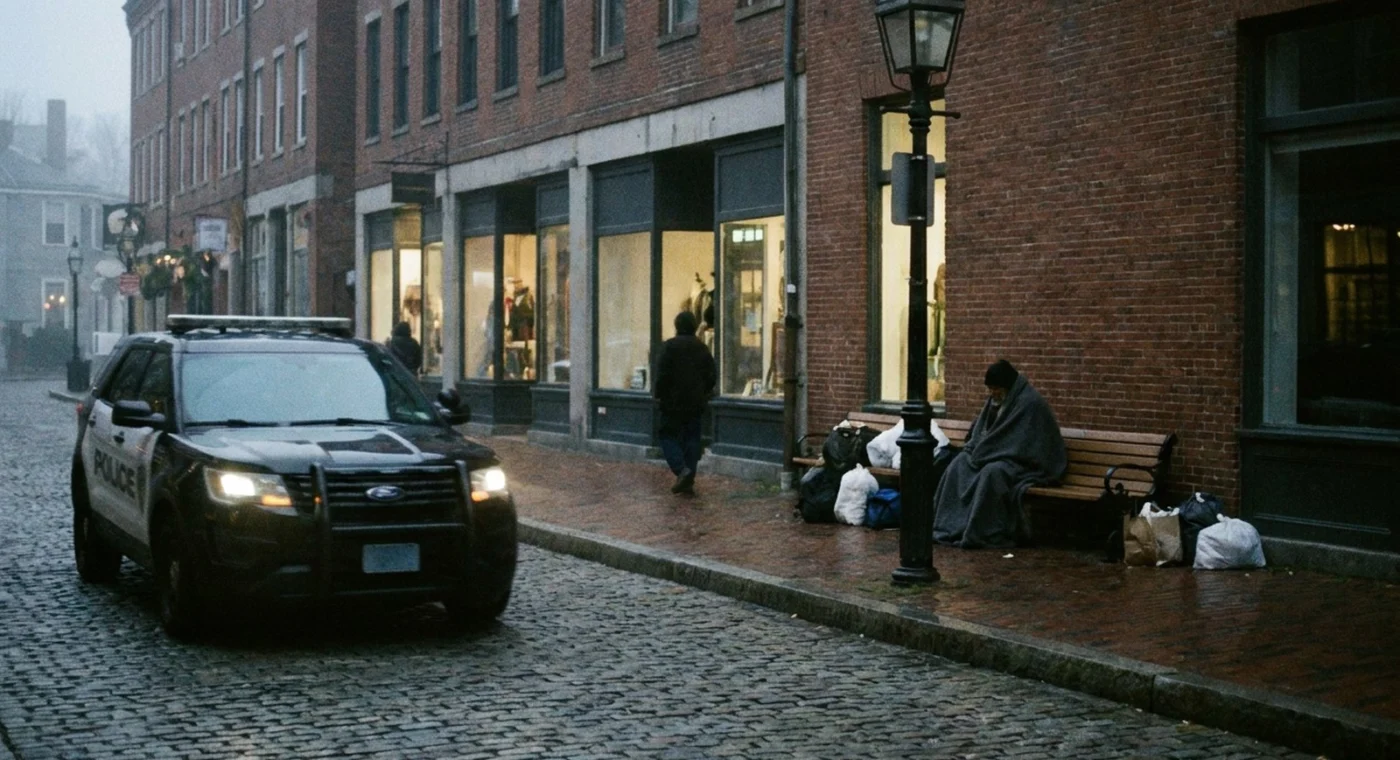
Councillor at Large Conrad Prosniewski was listed to move adoption, by roll call, of a “Resolution Calling Upon the Commonwealth of Massachusetts to Assume Greater Responsibility for Homelessness, Mental Health Treatment, and Equitable Municipal Participation.” Its premise is that the closing of state psychiatric hospitals, including Danvers State Hospital in 1992, “fundamentally changed the delivery of mental health services, without the development of sufficient community-based treatment and long-term residential care capacity,” and that cities like Salem, which run emergency shelters, serve people “extending well beyond their municipal boundaries” while most of the state’s 351 cities and towns do not.
The resolution asks Governor Maura Healey and the Legislature for five things: expand and fund state psychiatric treatment facilities and long-term residential care; create “a clear, timely, and legally appropriate process” for police and emergency responders to refer people in psychiatric crisis for evaluation and, where authorized, placement, “with full protection of individual civil rights and due process”; enact a mandatory statewide system requiring every municipality to contribute, either by operating or supporting shelters and supportive housing, by funding regional programs, or by paying into a state or regional homelessness fund “based upon a fair formula considering municipal population, financial capacity, and existing services”; set up a dedicated state funding stream for shelter host cities like Salem; and write a statewide strategy with standards for municipal participation and accountability.
The text says plainly that homelessness complicated by serious mental illness “cannot be adequately addressed through municipal ordinances, police intervention, emergency shelters, or local resources alone.” Copies are to go to the governor, the Senate president, the House speaker, the secretary of Health and Human Services and Salem’s legislative delegation.
The resolution arrived two weeks after the council sent Mayor Dominick Pangallo’s home rule petition for a short-term rental excise, with proceeds for a housing stability fund and a low-threshold shelter, to committee on October 8, and on the same agenda as a committee report that keeps proposed amendments to the city’s camping ordinance in committee.
Unattended property: two hours, then a tag
Ward 7 Councillor Andrew Varela was listed to move first passage of a new Section 24-33 of the city code, “Unattended property on public property.” It would make it unlawful to “store or leave property in or upon any public property, sidewalk, or right-of-way for a continuous period exceeding two hours when the owner or person responsible for the property is not present.”
The exceptions are property covered by a city permit or license; lawfully parked bicycles, scooters and strollers; trash and recycling set out for collection; property of the city, other governments and utilities; motor vehicles, trailers and boats; and campsites and camp materials, which stay under the existing camping section, 24-31. The city could post a notice on property left in violation stating that it will be removed if not taken within 24 hours and where it can be claimed. Property that blocks a sidewalk, entrance, hydrant or emergency access, or threatens health or safety, could be removed immediately with a notice posted at the spot. Trash, spoiled food and soiled or infested items could be thrown out at once; everything else would be held at least 30 days at a location the police chief designates and returned to anyone “who reasonably describes it.” The city would not have to resolve competing ownership claims. An ordinance needs two passages to become law.
A committee to redesign the seal
Varela was also listed to move adoption of an order creating a five-member Ad Hoc Committee on the City Seal: three councillors named by the council president, one of them chair, plus the city solicitor or a designee and the city clerk or a designee. The committee is charged with reviewing the existing seal and its legal description in Section 2-1 of the code, reviewing the City Seal Task Force’s November 10, 2025 findings, developing one or more proposed designs “that reflect Salem’s history, identity, values, and contemporary community,” running public forums or surveys, drafting the ordinance language for a new legal description, recommending rules that distinguish the official seal from city logos and branding, and planning the transition for documents, signage, vehicles and equipment that carry the current seal. Its report is due to the full council by May 27, 2027 unless extended, after which the committee dissolves.
The council adopted the task force’s recommendation on September 10, and a motion by Ward 4 Councillor Timothy Flynn to reconsider that vote failed on October 8. The order creates the body that would turn the recommendation into a design and an ordinance.
Light shield ordinance and camping ordinance
Varela, reporting for the Committee on Ordinances, Licenses and Legal Affairs, recommended a light shield ordinance: no outdoor floodlighting or decorative lighting except lighting designed to illuminate walks, driveways, outdoor living areas or recreational facilities, and temporary holiday lighting for no more than eight weeks a year. Permitted permanent lighting would have to be “continuous, indirect, and installed in a manner that will prevent direct light from shining onto any street or abutting property.” Municipal lighting is exempt, the building inspector enforces, and the fine is $25 for a first offense and $25 for each one after.
Councillor at Large Ty Hapworth, for the Committee on Public Health, Safety and the Environment, co-posted with the Committee of the Whole, reported that the committee had considered amendments to the camping ordinance and recommended the matter remain in committee.
Derby Street dining, a Cleveland Street parking change, a candle maker’s petition
Ward 1 Councillor Erin Turowski was listed to move an order waiving the December 7, 2023 outdoor dining policy’s requirement that platforms come out of the street, letting Regazza Restaurant Group, doing business as Bambolina at 288 Derby Street, and Hazel Deli LLC, doing business as Witchside Tavern at 283 Derby Street, keep their platforms on Derby Street from November 2026 through May 2027.
Ward 3 Councillor Jason Sydoriak was listed to move first passage of a traffic ordinance that repeals a 30-foot tow zone on the north side of Cleveland Street, 40 feet from Jefferson Avenue, and replaces it with a handicapped parking zone of the same dimensions.
Under petitions, Salem residents asked for professional repair of the Volunteers Bridge in the Forest River Conservation Area, which Varela was to move adopted or referred to the Committee on Government Services, and James Jenner, owner of Amelia’s Light Candle Company, proposed a small business and resident vendor ordinance, which was to go to the ordinances committee. Two taxi operator licenses were up for grant, and seven claims against the city, including one from Swampscott, one from Cambridge and one from Warwick, Rhode Island, were to be referred to the ordinances committee.
Hearing, appointment, money orders
The council held a hearing on a National Grid order to install one single-owned pole on Bridge Street at Flint Street, with Ward 2 Councillor Andrew Smith listed to move that it be granted. The mayor’s appointment of Natalie Iknaian of 12 Summit Avenue to the Beautification Committee, for a term ending October 22, 2029, was listed to be held under the rules on a motion by Ward 5 Councillor Lydia King, the customary first step for a new appointment. Councillor at Large Kyle Davis was listed to move two mayoral orders: $9,207.27 from the Retirement Stabilization Fund for a school department vacation and sick leave buyback, and acceptance of a $1,000 donation from Yuans Bistro Inc., doing business as Fantasy Island, to the Taxpayers Scholarship account.
The council’s next regular meeting is Thursday, November 12. A Committee of the Whole on the council’s rules and standing committees is set for Monday, November 9 at 6 p.m. The October 22 agenda is here. Our report on the October 8 meeting is here.