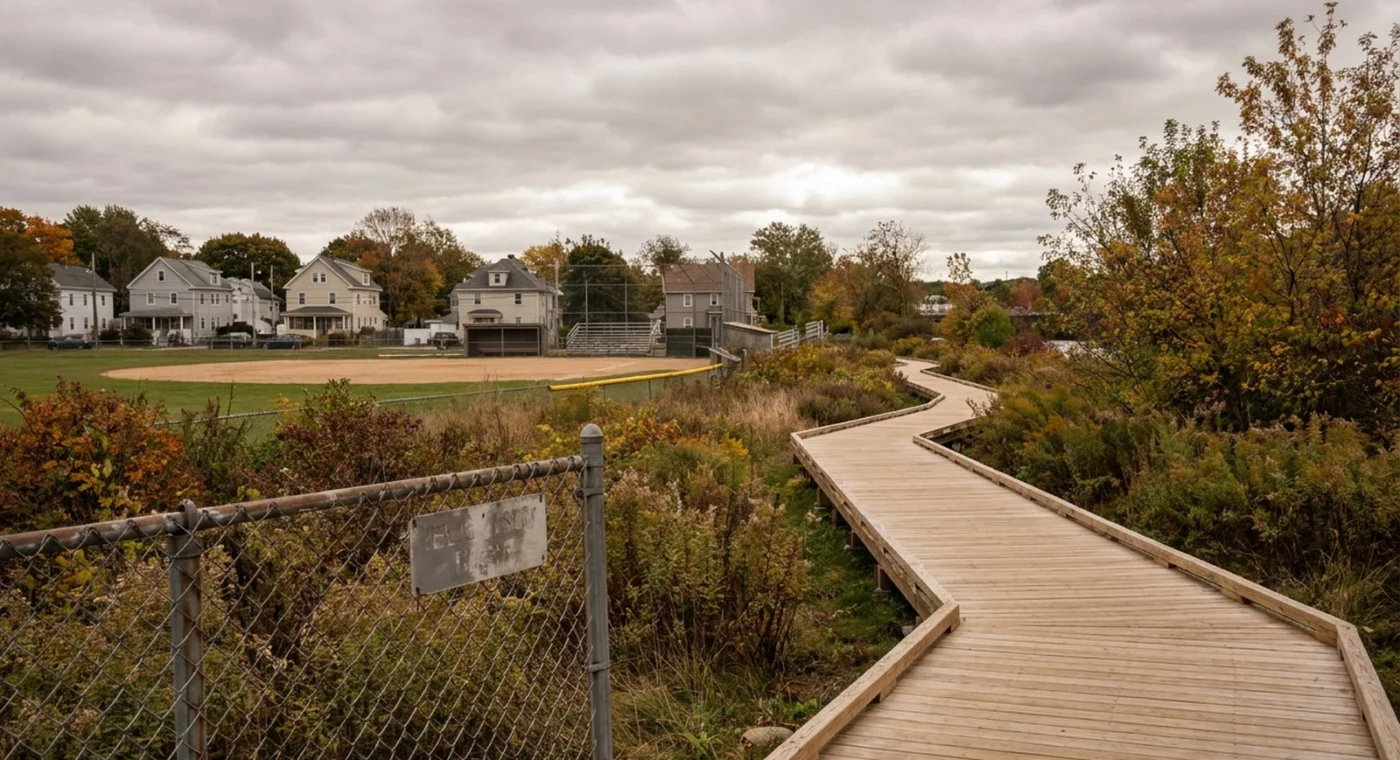
The Malden City Council on Tuesday, October 20 voted 10 to 1 to move $2,230,219.50 left over from the canceled Roosevelt Park revitalization project to the Malden River Works park, after an hour of debate in which Councillor at Large Karen Colon Hayes tried and failed to set aside $200,000 of it to plan the next phase at Roosevelt. The same night the council appropriated $266,174.60 in ride-share surcharge money for wheelchair ramps and accessible signals at nine intersections, sent $400,000 to the schools to meet the state’s net school spending minimum, ordained two new finance ordinances, granted two National Grid pole petitions with conditions, and heard the Climate Action and Sustainability Commission’s first annual progress report. The meeting ran from 7:13 p.m. into an executive session a little after 9:40 p.m.
Council President Amanda Linehan presided. Councillors Colon Hayes, Paul Condon, Peg Crowe, Michelle Luong, Carey McDonald, Ryan O’Malley, Jadeane Sica, Chris Simonelli, Ari Taylor and Stephen Winslow were present, with Simonelli and O’Malley out of the chamber for some roll calls. This account is from the Urban Media Arts recording and the agenda; the recording’s automatic captions are rough, and names of speakers we could not confirm against the record have been left out.
Roosevelt Park money to Malden River Works
Two papers from the Finance Committee repurposed the remains of the Roosevelt Park project: paper 393-26, $1,292,045 of cash appropriated in 2023, and paper 394-26, $938,174.50 of bond authorization from the same year, both redirected to Malden River Works under Chapter 44, Section 20. Finance Chair McDonald set up the vote: the original project, which would have turned the field to turf and rebuilt lighting, amenities and drainage, was canceled and replaced by a remediation-only project that is fully funded from a Section 108 loan. The council’s authority, he said, is to appropriate money to a project, “and when that project goes away, the authorization has expired.” The bond money in particular has to be spent on a substantially similar project or it can affect the city’s credit rating, and “we have probably delayed it longer than we should.” He said the committee reported the papers out favorably but “not all of one accord.”
Six written public comments were read into the record, and most of them were about these papers. John Shea of 37 Pierce Street opposed the transfer, writing that lead was found at Roosevelt Park in 2019, that part of the field was fenced off while “thousands of children and residents continue to use it,” and that the city instead raised more than $13 million for “waterfront property in an isolated commercial corridor.” He asked Colon Hayes to recuse herself over her role with the Mystic River Watershed Association, asked for a full accounting of River Works costs, and said nothing less than full soil replacement three feet down should satisfy the city. Marsha Manong of 296 Bryant Street, a member of the River Works steering committee, wrote that the project “was never intended to compete for funding against another community project” and that not letting residents speak at the Finance Committee meeting where the recommendation was made “is a clear example of silencing the voices of those most affected.” The Friends of Roosevelt Park wrote that the transfer is premature while contaminated soil is still being removed, and asked that money be set aside to restore the fenced-off outdoor classroom, which had raised beds, fruit trees and benches used by Salemwood School children and was to be named for a Salemwood student who died.
Taylor, the Ward 5 councillor, said remediation and restoration of the garden and outdoor classroom are funded and under way, and that “for the first time in seven years” the park will be fully open, after which a community process for a larger plan can begin. “Voting to move this money is not a vote against Roosevelt,” she said, adding that there is more than one group interested in the park and many felt shut out of the last conversation. Winslow, who sits on the River Works building committee, said plans for the boathouse and the DPW salt shed are “99 percent done” and about to go to bid, and that any delay would raise their cost and leave less for Roosevelt later. O’Malley said he supported the transfer but objected to what he called a coordinated effort over the years to shut community groups out of Finance Committee discussions.
Colon Hayes, who disclosed that she sits on the River Works steering committee and the Mystic River Watershed Association board, said the neighbors of Roosevelt Park “have consistently taken a back seat while other parks are updated” and proposed keeping $200,000, about 10 percent, as seed money for a comprehensive plan. Taylor answered that starting a plan “does not take $200,000 of seed money.” Simonelli said $200,000 “sounds like a lot of money” but is not at the scale of a park, noting the city spent $2.2 million at Kierstead Park, and urged a comprehensive plan over piecemeal spending. Office of Strategic Planning and Community Development Director Alex Pratt said moving borrowed money to a plan that does not exist “would continue to create arbitrage issues” with the IRS. The city treasurer, called down to the podium, said the paper could not be amended on the floor, that money cannot be reallocated “to a non-existent project,” and that anything not spent within three or four months would be a problem. McDonald added that the council can reduce an appropriation but cannot carve one out for a different purpose, and that he lives closer to the park than any other councillor and had always backed a grass plan for it. Colon Hayes withdrew the idea without making a motion. Both papers passed 10 to 1, Colon Hayes voting no.
ADA ramps, school spending, two ordinances
Paper 391-26 appropriates $266,174.60 from the state’s ride-share surcharge, two years’ worth, McDonald said, bundled with Community Development Block Grant and Chapter 90 money, for wheelchair ramps, sidewalks, traffic and pedestrian signals, push buttons and crosswalk markings at Cross, Bryant and Willow streets; Ferry and Belmont; Pleasant and Highland; Maplewood and Eastern; Medford and Commercial; Salem and Branch; Medford and Canal; Maple and Highland; and Eastern and Broadway. It passed 10 to 0. Paper 392-26 transfers $400,000 from group insurance to the school department so the city meets the state’s net school spending requirement; McDonald said the city’s switch in health plans saved money that still has to be counted toward the minimum, and that the finance team has new protocols after last year’s scare. It passed 11 to 0.
Two enrolled ordinances were ordained by voice vote: paper 385-26, creating a Solid Waste Enterprise Fund in the revenue chapter of the code, and paper 388-26, the Reserve and Stabilization Fund Framework. McDonald said the council should now expect proposals from the administration to seed the stabilization fund once free cash is certified. Two salary transfers from the mayor, $157,000 and $220,000 to police salaries, went to Finance on the consent agenda.
Climate report: 30 percent less municipal energy, $15.8 million in grants
The Climate Action and Sustainability Commission, a resident volunteer body created to oversee the September 2024 Climate Action Plan, delivered its first annual report. Its chair, an engineer and seven-year resident, the city’s sustainability and grants manager, and the commission’s vice chair walked through five goal areas. The city has cut municipal energy use 30 percent since 2016, added seven electric vehicles and four charging stations, and brought in $15.8 million for climate and energy projects since the plan was published, including a $1.95 million Green School Works grant for heat pumps at the Ferryway School. Residents completed more than 1,000 home energy assessments, 425 weatherization projects and 243 heat pump installations in 2025. The municipal electricity aggregation has avoided about 21 million pounds of carbon dioxide and saved residents more than $4 million against National Grid basic service over two years. The city earned a SolSmart Bronze designation, added seven bus shelters and more Bluebikes stations, held 13 farmers markets in 2025, planted more than 1,000 trees and its first pocket forest, made Forestdale Cemetery an arboretum, and is one of three Massachusetts cities with a $50,000 Bloomberg Youth Climate Action Fund award to be distributed to residents 15 to 24 for projects they pitched. McDonald noted that two thirds of Malden’s greenhouse gas emissions come from buildings and described a clean energy coach program in development to help renters and non-English speakers navigate incentives. The newsletter signup is at cityofmalden.org/greenmalden. O’Malley asked for baseline data from before the plan so trends can be tracked.
Two National Grid petitions
National Grid’s petition for one pole and 175 feet of underground conduit on Pearl Street at Medford Street, redrawn after Condon and the city engineer rejected an earlier “zigzag” design, was granted with the usual Dig Safe and sidewalk restoration conditions plus a third: no work on Fridays, after the mayor’s office relayed concerns from the Malden Islamic Center near 405 Pearl Street about its Friday prayer service. The utility said the three-week job is needed because its existing four-inch conduit is too small and the MWRA will not permit a replacement near its right of way.
The petition to relocate two poles on Lynn Street near Oliver Street, ahead of MWRA water work, drew a longer discussion after Winslow questioned whether one new pole location falls in the MBTA’s Northern Strand right of way rather than city property; the assessor’s office agreed the city may lack authority over that spot. An abutter at 551 Lynn Street asked about his triangular lot line, a tree planted a year ago and construction impacts. The council granted the petition with conditions that the property line and the MBTA right of way be confirmed in writing before a permit issues and that the sidewalk at the second pole stay accessible; O’Malley voted no. Winslow warned that the coming MWRA project will close Lynn Street between Oliver and Beach streets and reroute buses.
Zoning use table, snow storage, salary schedules
The council enrolled the Rules and Ordinance Committee’s split version of paper 327-26, 15 changes to the zoning use table that move uses from special permit to by right in various districts, by voice vote. Three uses the Planning Board wanted handled by site plan review, hotels and motels, fast food restaurants and supermarkets, remain in committee as paper 327A-26 because, Winslow said, the city has no site plan review regulations yet. The inclusionary zoning papers were not taken up; the committee had not reported them, and the council enrolled them a week later. Paper 415-26, an assistant department head salary schedule, was enrolled. Winslow’s paper 431-26, which would take union salary schedules out of the ordinances and have them come to the council as a communication with each collective bargaining agreement, went to Rules and Ordinance; McDonald said the council’s real check is appropriating the money. Paper 432-26, a snow storage section in the zoning code proposed by the building inspector after a property owner turned a vacant lot into “a snow farm” last winter, also went to committee, with O’Malley asking for an exemption for snow moved within the city.
Licenses, appointments, executive session
The council granted a livery company and driver license for Ana Santos Transport at 64 Linwood Street and renewed lodging house licenses for Metro North Housing Corp. at 115 Washington Street and 22 Charles Street and Cedar House LLC at 116 to 118 Cedar Street. It confirmed Karen Buck to the Public Works Commission, 10 to 0, and Heather Barry, Ben Gately, Julie Turner and Jane Ventrone to the newly organized Parks and Recreation Commission; Crowe said Turner and Ventrone are city employees whose unpaid service was researched and cleared. Winslow noted the Community Preservation Committee ordinance must now be amended to seat a Parks and Recreation member. The council then voted unanimously to enter executive session with counsel on the matter of Joel Jeannite v. Officer Patrick Kinnon, to consider legal representation and indemnification of the officer, and did not return.
In announcements, O’Malley said two new Dale Rogers sculptures were installed at Quigley Park, McDonald flagged the first Commercial Street Corridor Study meeting for the next evening, and Simonelli asked for a moment of silence for longtime resident Jimmy Stanley. The agenda is here and the recording is here. Our report on the October 27 meeting is here.