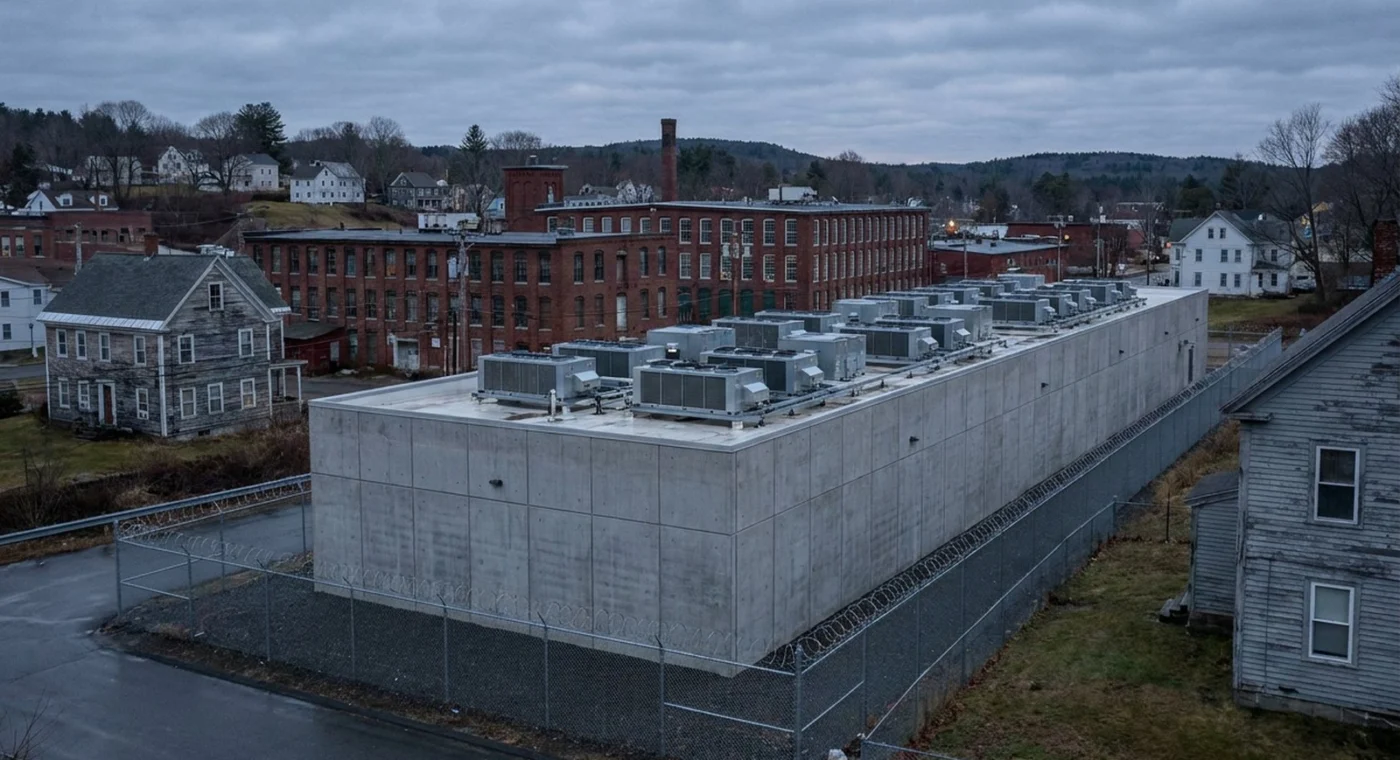
The Salem City Council on Thursday, October 8 gave second and final passage to a zoning amendment that defines data centers and lists them as not allowed in any district, after amending it to drop a two-megawatt power threshold recommended by the Planning Board and to exempt servers that are “accessory, incidental and subordinate” to a lawful principal use wholly at the same facility. The exemption does not cover a separate business selling data storage or server hosting to third parties.
Councillor at Large Ty Hapworth, who chaired the committee review, said the threshold was meant to keep hospital and university server rooms legal but that using a wattage figure to define a use “seems a little clunky” and that “no one wants to live next to even a 1.9-megawatt data center.” Ward 5 Councillor Lydia King said the ordinance is “effectively temporary” until the city writes a comprehensive one and argued for the simplest language with the fewest loopholes; she and Ward 3 Councillor Jason Sydoriak opposed the accessory-use sentence, with King describing how a warehouse operator could run a large in-house data center under it. Ward 6 Councillor Katelyn Holappa added the word “wholly” to block a company from leasing its own servers, and said the zoning officer told her the language prohibits what the council is worried about. Hapworth said the ordinance was reviewed by KP Law and outside counsel and that the city’s intent “is very, very clear.” The amendments and the ordinance passed on voice votes.
Short-term rental excise goes to committee
A home rule petition from Mayor Dominick Pangallo to impose an annual excise on short-term rentals, with the money going to a housing stability fund and a low-threshold shelter, went to the Administration and Finance Committee co-posted with the Committee of the Whole on a motion by Ward 2 Councillor Andrew Smith. Councillor at Large Kyle Davis said bed and breakfasts, inns and people who rent rooms in their primary residence would be exempt, and King said updated language from the mayor also exempts owners who rent out their home while they are away part of the year. Sydoriak said the $500 and $1,000 figures in the draft “look arbitrary” without data on how many units are affected, and Ward 4 Councillor Timothy Flynn said he would not support new fees on residents who “are struggling for money.” Hapworth recused himself. A Washington Square short-term rental operator told the council during public testimony that he let his certificate of fitness lapse three years ago “for science” and no one from the city ever followed up, and that illegal operators, not legal ones, should be the target.
Cameras, the seal and a video
The council approved five temporary police surveillance cameras on loan from the State Police for the Haunted Happenings season, at Essex and North, Essex and Barton, Federal Street at the Witch City Mall entrance, Boston and Proctor streets and North and Bridge streets. Ward 1 Councillor Erin Turowski relayed Police Chief Lucas Miller’s assurances that the cameras record conventional video only, with no plate readers, facial recognition or audio, that footage stays at the police station for 30 days and that no outside agency has access to the feed. Holappa said she would vote no without a written data retention policy and contracts, noting federal law enforcement is in Salem in October and the cameras could still be up through the midterm election; Smith said the city already has about 100 such cameras; Councillor at Large Conrad Prosniewski, a retired police officer, said “we have to put our trust in someplace.”
Flynn’s motion to reconsider the council’s September 10 vote adopting the City Seal Task Force’s recommendation failed on a voice vote; he said he wanted a full council present for “something of this importance.” During public testimony, Hancock Street resident Jeff Cohen said an anonymous 10-minute video viewed by thousands had singled out his wife, a longtime resident and small business owner, for comments she made about the seal at the city’s first AAPI flag raising, and that “she doesn’t feel as safe walking around the city.” Another resident urged keeping the seal and adding a QR code explaining the Sumatra trade it depicts.
Also at the meeting
- Joe Ferrari, Kathleen Walker and Jill El Ashkar were confirmed to the Taxpayer Relief Committee, 10 to 0, with terms to 2029; three reappointments to the Food Policy Council and Public Art Commission were confirmed 10 to 0.
- The council approved $155,534.14 in contractual vacation and sick leave buybacks for the retired city clerk and a retired fire department employee, raised the Horace Mann school decarbonization design appropriation from $250,000 to $500,000, and authorized the mayor to accept a $5 million Green School Works grant from the Massachusetts Clean Energy Center for the roof, HVAC, geothermal exchange and solar work; Davis said no borrowing is involved.
- A one-way traffic order for Dodge Street during October, creating ride-share zones, was adopted after King said the affected businesses agreed to try it; a parking zoning amendment received second passage 9 to 1 with Flynn opposed.
- The Chestnut Street block party on October 31 from 4:30 to 8 p.m. and the Boys and Girls Club’s 23rd Wild Turkey five-mile run on November 26 were granted. Turowski said the race drew about 2,000 runners last year.
- National Grid withdrew a Summit Avenue pole hearing; a hearing on a Bridge Street pole was set for October 22. The council will meet November 12 and December 3, the latter to set the tax rate.
Ward 7 Councillor Andrew Varela was absent. The recording is on Salem Access TV’s YouTube channel and the agenda is on the city’s Agenda Center. The council’s October 22 meeting had no recording or minutes posted as of November 3.