The Salem City Council and the Planning Board held a joint public hearing on Monday, October 19 on a zoning ordinance that would let property owners put small wind turbines on their roofs by right in every zoning district, then closed the hearing and referred the ordinance to the Planning Board for review and recommendation, each by unanimous voice vote. The hearing, held under Chapter 40A, Section 5 of the General Laws, ran from 6:00 to 7:21 p.m. in the council chamber, according to the minutes posted this week.
Council President Alice Merkl presided. Councilors Prosniewski, Sydoriak, Hapworth, Smith and Davis were absent and Councilor Andrew Varela joined remotely. Six Planning Board members attended: Chair Kirt Rieder, Vice Chair Sarah Tarbet, Zach Caunter, Helen Sides, Josh Turiel and Graham Wing, with Jonathan Berk, Elena Eimert and Tom Furey absent. Planner Claudia Cunningham of the Department of Planning and Community Development staffed the hearing.
What the ordinance does
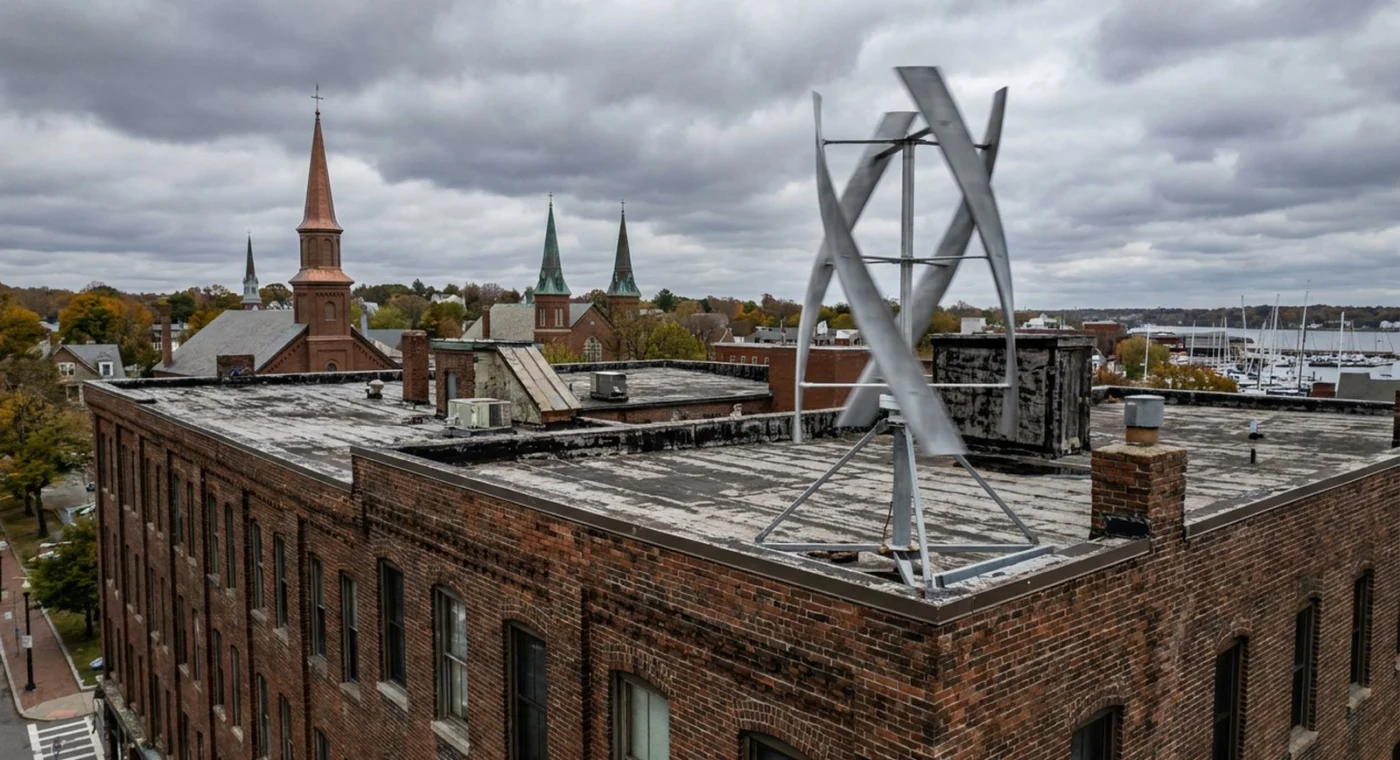
The ordinance adds “Wind Energy System, Roof-Mounted” to the accessory use table as a permitted use in all eleven districts, from the residential conservation and R1 districts through the business, industrial and North River Canal Corridor districts. It defines a roof-mounted system as an active wind system structurally mounted to a building, with a rated nameplate capacity of no more than 10 kilowatts per turbine and a height of up to 20 feet, and it amends the dimensional notes so that the building height limits apply to the turbines with an added allowance of five feet over the maximum height of the building. A fourth section carves the small systems out of Section 6.9, the existing wind energy facility rules written for larger installations. The agenda was amended before the hearing to correct a typographical error that had listed the height as “ten (20) feet.”
The sponsor’s case
Ward 5 Councilor Lydia King, the sponsor, told the two boards that the zoning ordinance has no language on rooftop wind for small commercial and residential buildings, and that wind produces power when solar does not, so the two work well together. She recalled the 2012 installation of three hybrid solar and wind turbines on the roof of the South Harbor Garage and a 2007 University of Massachusetts study of Salem’s wind resources that found the best sites around Winter Island and Forest River Park, with Castle Hill, Bertram Field near Salem Hospital and Mack Park also likely candidates. Rooftop wind is not cost effective everywhere in the city and is not popular in the United States, she said, but Salem is a viable candidate as a windy coastal community, and the specialized building code for new construction pushes developers toward carbon neutrality that some may not reach with solar alone. She listed the challenges: the cost advantage of solar, site-specific wind resources, noise and vibration, roof structure, battery storage and visibility. The ordinance would allow the systems by right with a 10-foot setback from front, side and rear lot lines, the five-foot height allowance, the 10-kilowatt cap and the 20-foot limit; the existing noise ordinance would govern sound, and in local historic districts an owner would apply to the Historical Commission for a certificate of appropriateness, as with rooftop solar.
Councilors’ questions
Varela called the ordinance a step in the right direction and said that even if wind is not a priority, residents should be allowed to put resiliency in their own hands. Ward 6 Councilor Katelyn Holappa said a resident of a flat-roofed house in an R2 district is interested but is already at the height maximum, and asked whether rooftop wind should be treated like the spires, towers, chimneys, antennae, ventilators and rooftop solar that are already allowed to exceed height limits; King said that language could be added. Ward 4 Councilor Timothy Flynn said the council needs to be careful because the ordinance will change the look of Salem, raised noise, roof stability in storms and neighborhood appearance, asked that the ordinance address noise directly even if the noise ordinance covers it, asked for input from Fire Prevention on battery storage and turbine placement, and said he would seek Ward 4 feedback before deciding. Ward 1 Councilor Erin Turowski raised permitting and structural integrity, asked whether installations would be monitored after they go up in a marine environment where things degrade quickly, and suggested a parallel ordinance setting standards, noting that one of the models in the presentation required annual inspections. King said she would look into coastal examples and questioned whether the zoning ordinance is the right place for inspection language, suggesting the Building Department or a separate ordinance. Varela said structural load would be handled through permitting, that state law governs renewable energy in historic districts, and that the state already has guidance on battery storage.
The Planning Board’s concerns
Turiel said several terms need better definition and that ambient noise standards should be included, and questioned whether the systems need regulating at all if they fall in the same category as chimneys. Sides said noise concerns her less, since many homes have added condensers, but that the technology is better suited to commercial properties and new construction with an integrated power plan; she asked why a mast or wall mount could not be used instead of a roof, said she does not like the idea of turbines on pitched roofs or more equipment on buildings in the historic districts, noted that the Historical Commission will not waive a project solely because it is for energy, and suggested a pilot program with state funding. King answered that roof mounting is the standard for smaller properties but that she is open to other options, that there is no money for a pilot now but the ordinance could be handled the way accessory dwelling units were a few years ago, and that the point of the definitions is to put restrictions in place. Wing and Tarbet both said five feet may be too limiting for buildings already at or over the height limit, Wing suggesting a special permit path for exceptions and Tarbet asking that the systems be part of site plan review, since the board has seen projects whose renewable energy plans were never fleshed out. Caunter raised structural soundness and damage to neighboring properties and asked why output is capped per turbine when equipment will get more efficient; King said the cap distinguishes residential units from large turbines and may be unnecessary if height and size are what concern people, and Caunter agreed that neighborhoods like Derby Street would want the smaller units.
Rieder, a supporter of wind and of quiet vertical-axis turbines, said a project in another city had foundered on the historic character of its site, that wind is often strongest at the edge of a building, that Minneapolis requires a setback of three times the device height rather than 10 feet, and that most of the examples in the presentation were taller than five feet, so the ordinance must say whether height is measured to the top of the turbine or the top of its frame. He asked that the record note that the tree ordinance and the Historical Commission rules still apply, after the Tree Commission observed two landowners recently removing protected trees, and said trees should not be cut to make room for wind generation. King said the 20-foot figure was meant as the total device height end to end and agreed that Section 2 should be rewritten to show the amended text in full.
Public comment
Josiah Guthrie of Essex Street, who brought the idea to Councilors King, Holappa, Varela and Davis, said wind technology has become viable but is not allowed in the city, that the industry has been working on the concerns raised, that newer turbine designs such as the Archimedes have improved what can be harvested, and that wind’s inverse relationship with solar makes battery systems cheaper and safer; when faced with climate challenges, he said, the city should reimagine what it means to preserve a neighborhood’s character. Steve Kapantais of Wisteria Street, speaking online, said he does not expect many towers on houses, that the Northeast is a low wind producer and the economics do not work now, that noise rules should address frequency as well as decibels because low frequencies travel farther, and that none of it works without batteries because wind is more prevalent in the evening.
King moved to close the hearing and to refer the ordinance to the Planning Board for review and recommendation; both motions carried. Caunter moved that the Planning Board close its hearing and adjourn, seconded by Turiel. The board’s recommendation returns to the council for a vote on the ordinance. The council’s regular meeting three days later is covered here.