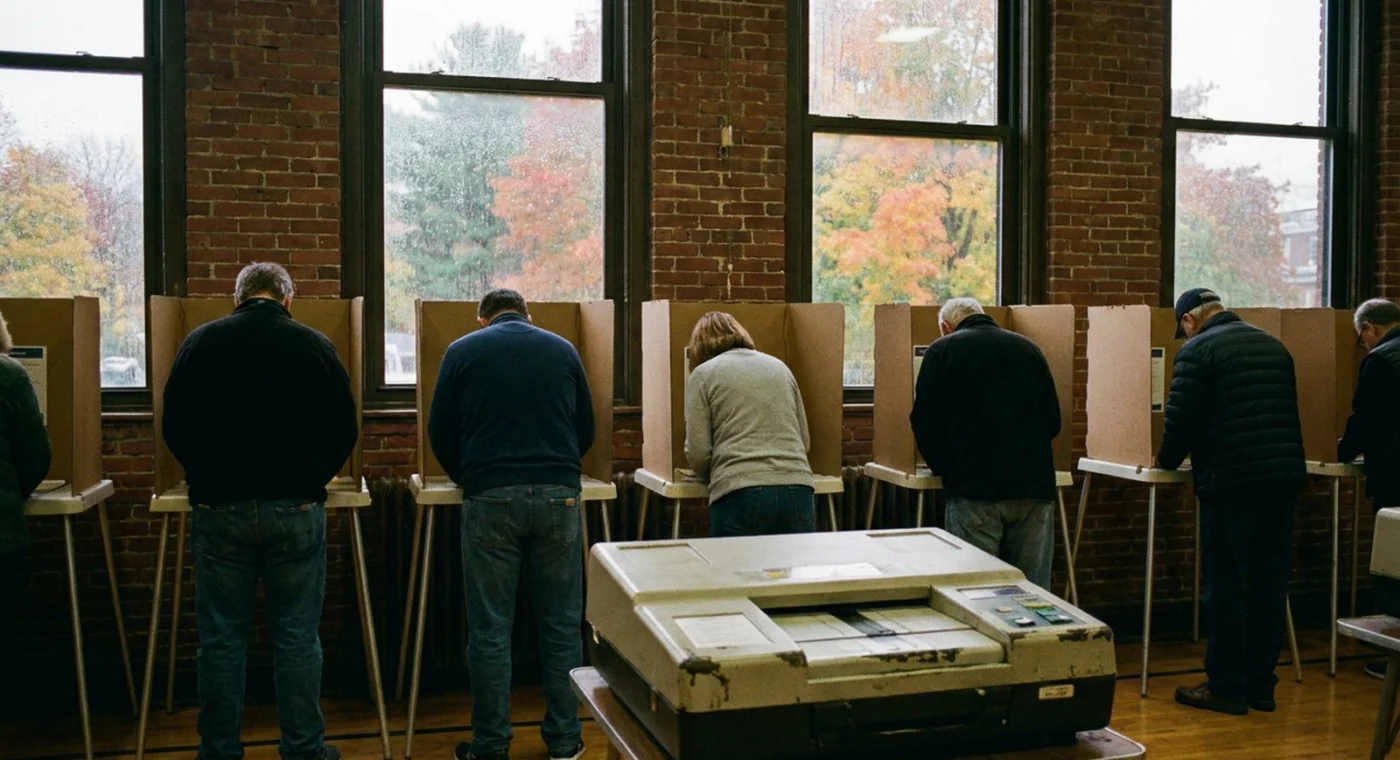
Salem voters cast 18,593 ballots in the November 3 state election, 49.8 percent of the city’s 37,406 registered voters, and gave Senator Edward J. Markey, Governor Maura Healey and Attorney General Andrea Joy Campbell roughly three quarters of the vote, according to the unofficial results the city clerk’s office posted on its election results page. The sheet, a scanned precinct table, also shows the city rejecting Question 5, the state revenue limit and rebate, 10,642 to 7,470, and defeating the proposed ban on retail marijuana sales, Question 8, by 14,763 to 3,310, a margin of more than four to one.
The results are unofficial until the clerk certifies them. They cover 14 precincts, two in each of the seven wards, and every contest on the Salem ballot from United States senator to register of probate, plus nine ballot questions. Salem’s ballot did not carry a tenth, non-binding question, which appeared in Melrose, Lynnfield and some other communities.
Turnout by precinct
Turnout ranged from 30.8 percent in Ward 1, Precinct 2 to 59.0 percent in Ward 1, Precinct 1, the sheet’s two extremes sitting in the same ward. Ward 2 ran at 54.0 and 53.0 percent, Ward 3 at 46.5 and 46.1, Ward 4 at 50.0 and 52.4, Ward 5 at 51.3 and 44.3, Ward 6 at 54.1 and 51.2, and Ward 7 at 43.3 and 54.1. The citywide figure of 49.79 percent compares with the 64.5 percent Melrose reported and the 34.5 percent Lynn reported for the same election.
Statewide offices
Markey received 13,695 votes in Salem, 73.7 percent of ballots cast, to 3,590 for John Deaton, 19.3 percent. The scan is hard to read in the rows for the two other candidates; Shiva Ayyadurai and Joe Tache together drew a little over 1,000 votes, about 360 and 660 respectively, with 27 write-ins and 252 blanks. Healey and Lieutenant Governor Kim Driscoll took 13,805 votes, 74.2 percent, to 4,016 for the Minogue and Oliver ticket and 574 for James and Kittredge, with 28 write-ins and 168 blanks. Campbell beat Michael C. Walsh 14,106 to 4,000. Secretary of State William Galvin outpolled Anne Brensley 14,984 to 3,151, Treasurer Deborah Goldberg beat Elizabeth Dionne 14,007 to 3,933, and Auditor Diana DiZoglio beat Al Ozonoff 15,181 to 1,875 with 1,443 blanks, the most of any statewide race.
Congress and the Governor’s Council
In the Sixth Congressional District, Dan Koh received 13,988 Salem votes to 4,059 for Micah Quinney Jones, 77.5 percent of the two-candidate vote, with 57 write-ins and 483 blanks. Koh’s Salem margin of 9,929 votes was by far the largest among the towns whose clerks have posted results; in Lynnfield the race was decided by 15 votes. For the Governor’s Council, Eunice Delice Zeigler received 13,749 votes to 3,673 for William Falcetano, with 1,140 blanks.
The Legislature and the county
Senator Joan Lovely, unopposed, received 15,612 votes, with 304 write-ins and 2,677 blanks. Representative Manny Cruz, unopposed, received 15,208 votes with 309 write-ins and 3,076 blanks. District Attorney Paul Tucker received 15,783 votes, the most of any candidate on the Salem ballot, with 272 write-ins and 2,535 blanks. Register of Probate Pamela Casey O’Brien received 15,132 votes with 267 write-ins and 3,140 blanks.
The ballot questions
Salem said yes to six of the nine binding questions. Question 1, extending the public records law to the Legislature and the governor’s office, passed 15,930 to 2,103, 88.3 percent, the strongest result on the ballot. Question 2, collective bargaining rights for Committee for Public Counsel Services staff, passed 13,554 to 4,301, 75.9 percent. Question 3, which would have replaced party primaries with a single state primary, failed 6,341 to 11,673, 35 to 65 percent. Question 4, election day voter registration, passed 12,360 to 5,723, 68.4 percent. Question 5 failed 7,470 to 10,642, 41 to 59 percent. Question 6, the natural resource conservation fund, passed 12,760 to 5,363, 70.4 percent. Question 7, allowing single-family homes on small lots, passed 11,136 to 6,755, 62.2 percent. Question 8, the ban on retail sales of adult-use marijuana, failed 3,310 to 14,763, 18 to 82 percent. Question 9, a referendum on the 2024 firearms law in which a yes vote kept the law, passed 14,198 to 4,112, 77.5 percent.
Ward 4, Precinct 2 was the only precinct to vote yes on Question 5, 703 to 640; that precinct, with Ward 4, Precinct 1 and Ward 3, Precinct 2, also gave the Republican statewide candidates their best Salem showings. No precinct voted yes on Question 8 or Question 3; the yes share on Question 3 was highest, at 39 percent, in Ward 3, Precinct 2 and Ward 1, Precinct 2.
Set against the neighbors
Salem’s 82 percent against the marijuana ban is second only to Somerville’s 88 percent among the seven communities whose results Boston North News has reported; Medford was 80 percent against, Melrose 79, Winthrop 76, Lynn 71 and Lynnfield 67. On Question 5, Salem’s 59 percent no sits between Medford’s 62 and Lynn and Winthrop, which both passed the question by 52 to 48, while Lynnfield passed it by 57 to 43. Salem’s 62 percent yes on the small-lot housing question is in line with Medford’s 62 and below Somerville’s 76; Lynnfield rejected it. The city also gave the Democratic ticket a larger share than any of those towns except Somerville.
What each question asked
Questions 1 through 8 were laws proposed by initiative petition: expanding the public records law, collective bargaining for Committee for Public Counsel Services employees, a single state primary in place of party primaries, election day registration, a change to the state revenue limit and the taxpayer rebate tied to it, a natural resource conservation fund, single-family homes on small lots, and a prohibition on the retail sale of adult-use marijuana. Question 9 was a referendum on the firearms law enacted in 2024, so a yes vote kept the law and a no vote would have repealed it.
What comes next
The clerk’s sheet is labeled unofficial and does not yet include the Federal Write-In Absentee Ballots and overseas ballots that may arrive after election day; the city’s Agenda Center lists a November 13 meeting “for the purpose of counting Federal Write-In Absentee Ballots (FWAB) and ballots mailed by voters” from abroad. Official results follow certification, and statewide outcomes are certified by the Secretary of the Commonwealth, which is why this report confines itself to how Salem voted. Several totals on the scan differ by a handful of votes between contests, which is common on election night tallies and will be reconciled in the certified return.
The city’s unofficial results are posted here as a PDF, and the clerk’s archive of results back to 1991 is here. The council’s most recent regular meeting is covered here.