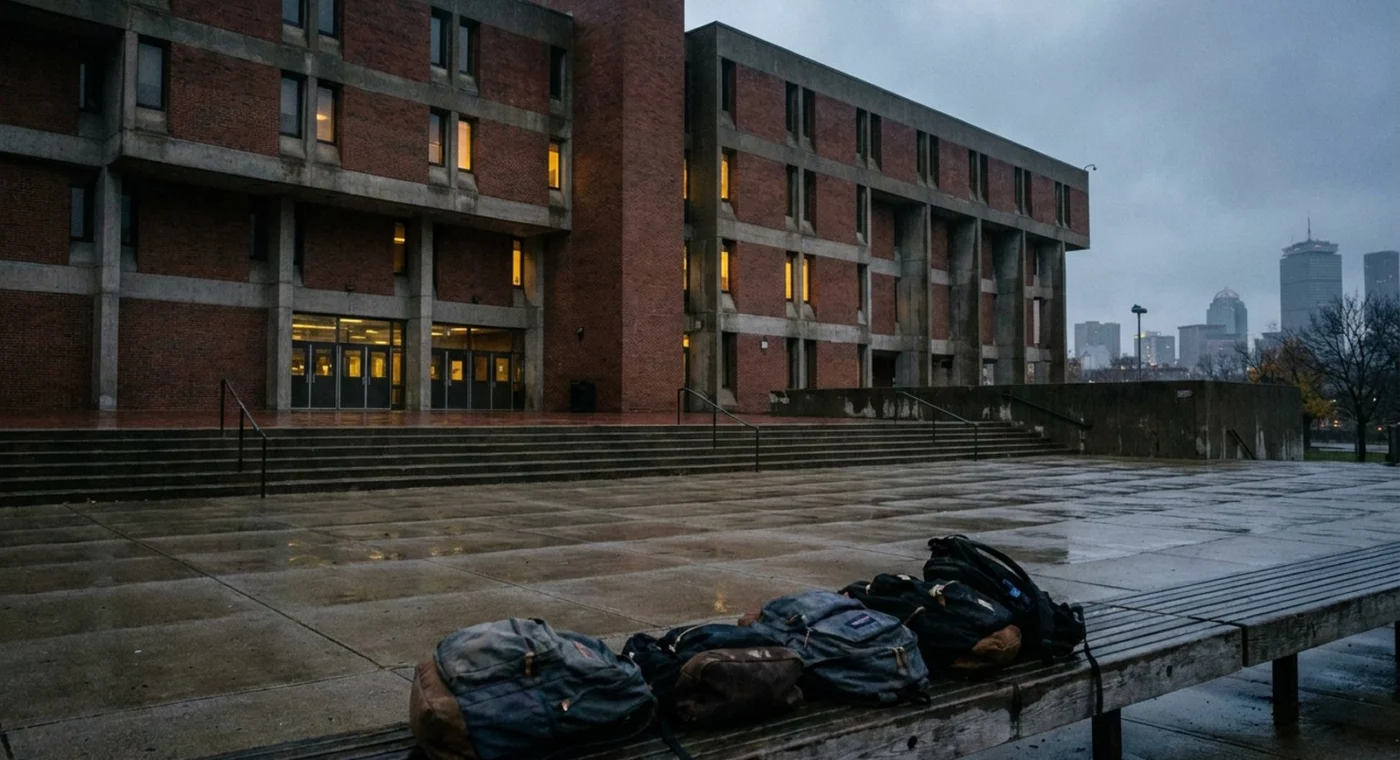
Boston Public Schools wants to close Charlestown High School at the end of the 2027-2028 school year and put a new secondary school in the building on Medford Street. The recommendation went to the Boston School Committee on Wednesday, November 4, as part of the district’s long-term facilities plan, and the committee expects to vote on it December 2.
If the committee approves, the school would close June 30, 2028. No new students would be assigned there starting next fall except siblings of current students, there would be no seventh grade in 2027-2028, and students now in grades 11 and 12 would graduate on schedule. Everyone else would get priority in the registration process for the 2028-2029 school year. The district says the BCYF Charlestown Community Center, which shares the site, would keep operating throughout.
Charlestown High is one of three schools the district proposes to close this year, along with the East Boston Early Education Center and Greater Egleston High School. The changes would bring the district to 97 schools, in line with a 2030 plan to run about 95.
The district’s case
The recommendation rests on enrollment. According to the district’s presentation and the closure page it posted for families, Charlestown High has lost 32 percent of its students in three years, falling from 820 in the 2023-2024 school year to 559 today. The drop is almost entirely among general education students, who are down more than 250 over that period, while the number of students with disabilities fell by eight. Students with disabilities now make up 45 percent of the school, a share the district says makes it hard to offer inclusive classes.
The classes behind the seniors are much smaller. There are 205 students in grade 12 this year, 65 in grade 9 and 48 in grade 7, so the district expects enrollment to keep falling as large classes graduate and small ones move up.
The building can hold 1,046 students and is 53 percent full. The district projects it would be 37 to 43 percent full by 2029-2030. Families are choosing the school at lower rates than other comprehensive secondary schools: over the past three years, 42 percent of incoming seventh graders ranked Charlestown High among their top three choices, against an average of 60 percent at comparable schools. Only 21 percent of the students who attend live in Charlestown.
The building itself is not the problem. The district rates it among the 30 percent of its secondary buildings that score a 3 or 4 on its building experience scale and can offer a full continuum of services. That is why the plan calls for a new “anchor secondary school” to take over the site, the same approach the district is using at the former South Boston High, which is becoming the home of Boston Green Academy. Several existing high schools will be evaluated for the move, and the superintendent’s team said it hopes to identify the incoming school by early spring.
Superintendent Mary Skipper told the committee the closures were “the hardest decisions I make as superintendent” and said they were not a judgment on the staff. In answer to a committee member, district officials said Charlestown High had been “held harmless” in the budget for years despite falling enrollment, meaning money was redirected from fuller schools to keep its programs whole, and that the fiscal 2027 budget was the first to begin unwinding that. The chief financial officer said she was happy to go through the school’s funding in detail at the committee’s November 18 meeting.
Asked how closing the school benefits the district, Skipper said BPS has high-quality seats to fill elsewhere and that shrinking enrollment shrinks a school’s budget with it, which erodes what the school can offer. Officials said students in the school’s applied behavior analysis program could move to established programs at other high schools, depending on where they live and what they want to study.
“Don’t replace us. Join us.”
Dozens of students, parents, teachers and alumni signed up to speak, and most of the public comment on a long night was about Charlestown.
Ajay Trivedi, the head of school, said district leaders told him last spring that closure was possible while they were working through another school’s facility problem, and promised a process this fall to talk about the school’s enrollment and future. “That process never happened,” he said. He said he received an apology from the chief of capital planning after he raised it the week before, but called the episode “a broken commitment preceding the proposed displacement of an entire school community.” He asked the committee to withhold approval of any plan built on moving students out, and said the school would welcome a new partner inside the existing school instead. “We include everyone. Don’t replace us. Join us,” he said, a line several students repeated after him.
A sophomore, Zoe Dennison, said she had attended more than ten schools and had been offered seats at Boston Latin School, Boston Latin Academy, Quincy and the O’Bryant but stayed at Charlestown because she felt she belonged there. The plan, she said, would displace the entire class of 2029 for its senior year. A senior who said he was an immigrant and a transgender man told the committee the school was the first of five high schools where he had not been bullied. Another senior, Jamal Laguerre, said teachers caught him when his grades slipped before he noticed himself. A student in the school’s transition program for students with disabilities said he had been at Charlestown nearly eight years and called the program the best in Boston.
Heather Campanella, a special educator in the school’s middle school academy and the parent of two students on individualized education programs, said the district itself had argued when it eliminated standalone middle schools that every forced transition costs students six to twelve months of progress. “You are imposing the exact educational disruption and loss that you promised our families in Charlestown you would prevent,” she said. A middle school math teacher said the superintendent’s office had asked Charlestown to pilot a redesign of grades 7 and 8 inside a 7-12 school, and that the school was the only one in the district doing that work. Another teacher said multilingual learners make up 32.9 percent of the school, many of them students who arrived without their parents.
Eric Berg, president of the Boston Teachers Union, said the three proposed closures affect 776 students and 193 educators. He asked the district to merge rather than close, to guarantee staff positions the way it has guaranteed East Boston Early Education Center students seats at the McKay, and to give the schools more than four weeks before a final vote in the middle of the holiday season. A former Charlestown teacher who built the school’s math curriculum for students with interrupted formal education said the district had dropped that program on the school in 2016 without trained staff, then disbanded it, and was about to repeat the mistake at the scale of a whole school.
What happens next
The district held a virtual community meeting for Charlestown High families on November 5 and has scheduled a second one for Monday, November 16, from 5:30 to 7 p.m., with interpretation. The link is to be sent to families. BPS is also collecting comments through an online survey on its closure page.
The School Committee will return to the facilities plan at its November 18 meeting, which the chair said would be the place for the academic and funding questions members raised. The district lists student voice webinars on November 17 from 6 to 7:30 p.m. and November 19 from 5:30 to 7:30 p.m.
The vote is scheduled for December 2. If it carries, Charlestown High School, which takes students from across the city under open enrollment, would graduate its last class in June 2028.