Matthew Poska spent five and a half years in the Nashua School District, 19 months as principal of Elm Street Middle School and four years in the central office, before Wilmington hired him. Two episodes from those years are documented well enough in public records to examine. Neither produced a finding against him. Both say something about the environment he managed in and how he described it afterward. Earlier parts of this series covered his career, the vote that chose him, his interview and his entry plan.
The English learner settlement
In July 2019 the U.S. Department of Justice opened an investigation into Nashua’s programs for English learners under the Equal Educational Opportunities Act of 1974. On May 24, 2021, before Poska joined the central office, the district signed a settlement agreement; the department’s announcement said its investigation had found “widespread failures” to give English learners the instruction and support they needed. The agreement required English as a second language instruction for every English learner, enough certified ESL teachers, and training for core-subject teachers and principals.
Poska became assistant superintendent for secondary education in August 2022. His resume lists, among his accomplishments there: “Member of the Leadership Team that worked with the U.S. Department of Justice to successfully complete a Settlement Agreement regarding the K-12 English Language Learner Program (2022 to 2025).”
The department’s own correspondence shows the road was not straight. On December 19, 2024, the Civil Rights Division and the U.S. Attorney for New Hampshire wrote to Superintendent Mario Andrade, ELL Director Robert Cioppa and district counsel that Nashua had “made some progress,” but “has not yet met all of the obligations and deadlines in the Agreement.” The letter listed areas where the district “has fallen short,” including professional development, sufficient service minutes for students based on proficiency level, timely identification of newly enrolled students, curriculum implementation, monitoring of English learners’ academic performance, and in-class coaching, and extended the agreement “through the end of the 2026-27 school year” so that “all EEOA violations are cured,” with a longitudinal study due to the government by August 15, 2027. Andrade told his board that month, according to the Nashua Ink Link, that the department had “recognized the tremendous amount of progress we made over the last three years, but there’s still unfinished work to do,” and that meeting the coaching requirement as written would take about eight more ELL coaches.
Five months later the picture changed. On May 12, 2025, Andrade told the Board of Education he had received a letter from the department saying the district had “satisfied its obligations” and that monitoring was concluded, with the reminder that the district “has an ongoing obligation to comply with the EEOA.” Andrade called it a move “from compliance to commitment” and said “the work is not done,” naming identification and placement, access to the core curriculum, staffing and professional development as areas still needing attention. Board members credited Andrade, who had inherited “kind of a mess,” in one member’s words, from prior leadership.
So the resume’s claim is accurate as to the outcome: the settlement was completed in 2025, during his tenure. It omits that the department had extended it five months earlier for noncompliance, and it does not describe his individual role beyond membership in the leadership team; the department addressed its letters to the superintendent, the ELL director and counsel, not to him. His portfolio was secondary education, and the district’s professional development for secondary teachers, which the 2024 letter faulted, fell under it according to his resume: “Coordinate professional development at the secondary level emphasizing ELL.”
The Elm Street questionnaire
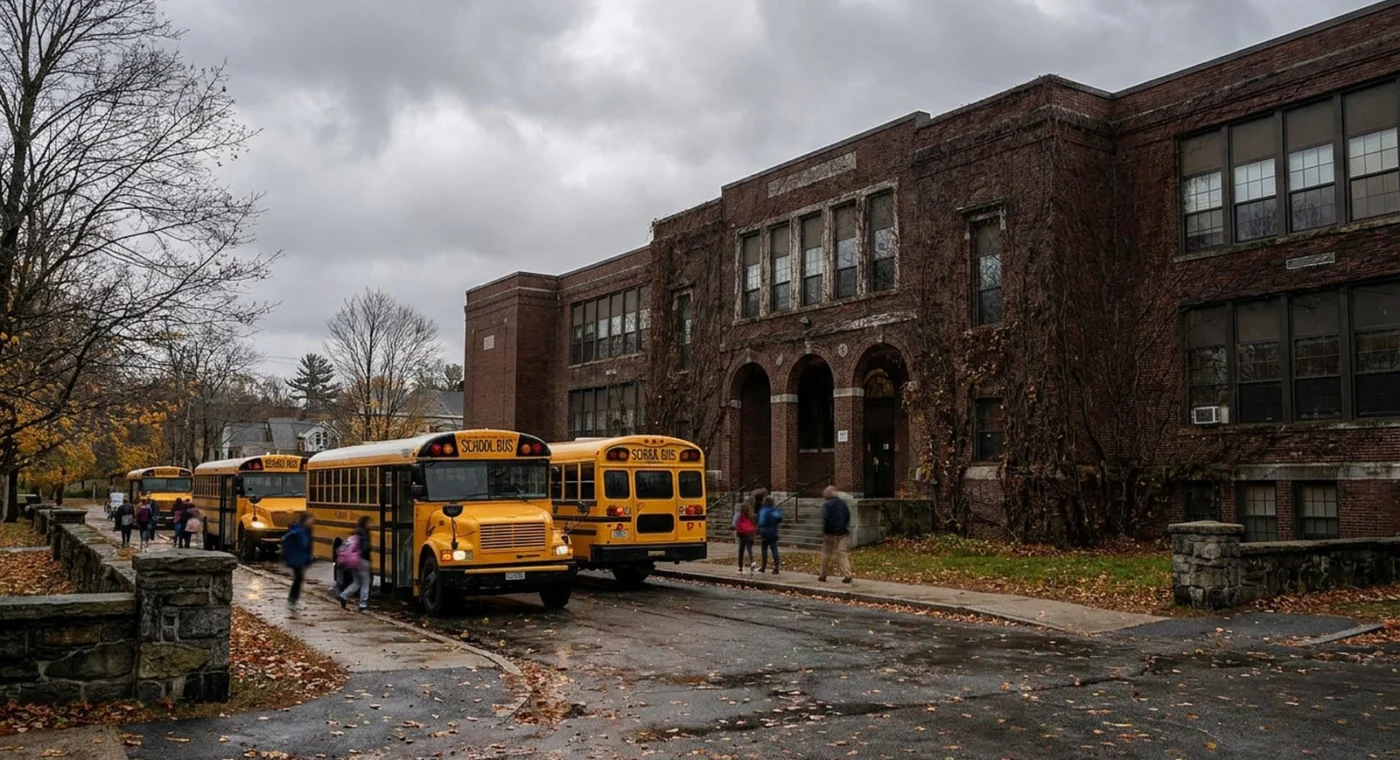
New Hampshire Public Radio reported in April 2024 on what happened to Kamren Munz, an art teacher at Elm Street Middle School who had been the district’s art teacher of the year in 2017 and who came out as transgender and nonbinary in 2018. On the first day of classes in September 2021, with Poska nine months into the principalship, Munz gave students a get-to-know-you questionnaire that asked about interests, self-description and pronouns, and whether it was all right to share a student’s pronouns with family. A parent, Erin Prowker, complained to the district after her daughter brought it home.
According to NHPR, Poska responded with a memo to teachers that included a suggested script for discussing pronouns and the instruction: “Do not require students to fill out a survey regarding their preferences.” Munz kept using the questionnaire on the ground that it was not required. A second Prowker daughter received it later that year. In April 2022 Prowker demanded a meeting with the teacher and district leaders; administrators asked Munz to meet with her, Munz objected that the message felt hostile, and the meeting never happened. That month Education Commissioner Frank Edelblut published an op-ed and a 68-page compilation of classroom materials parents had flagged, which included Munz’s introductory slideshow with the teacher’s face blacked out. A department misconduct investigator reviewed the complaints without opening a formal case. Munz resigned a few months later, citing post-pandemic student behavior, scrutiny of their gender identity from parents and politicians, and frustration with the administration.
Poska told NHPR the situation was “a perfect storm.” That is his only quoted comment in the piece. New Hampshire’s 2017 law barring required “non-academic surveys” without parental consent, and the commissioner’s view that it could reach introductory forms, framed the dispute; the Legislature was then debating bills to require schools to tell parents a child’s gender identity.
The episode sits at the intersection of two things a Massachusetts superintendent now faces regularly: state rules on parental notice, and the handling of a staff member who becomes a public target. The NHPR account does not accuse him of anything, and the memo language is reasonable on its face; it does not describe his handling of the teacher after the commissioner’s op-ed. Wilmington’s committee did not raise the episode on November 25, 2025, and nothing in the recording suggests they knew of it.
The rest of the Nashua record
The resume’s other Nashua claims are the kind that can be checked against district documents and were partly checked here. He was listed on the district’s negotiating team in the 2025-2029 teachers’ agreement and the 2025-2028 paraeducators’ agreement, both posted by the City of Nashua. District redistricting committee minutes from December 2022 and January 2023 list him as assistant superintendent of secondary schools. The new Brian S. McCarthy Middle School opened in the fall of 2024 and Elm Street closed in June 2024, under a successor principal, Katrina Esparza. His 2021-22 salary as principal was $108,400 by the state’s count; the state’s 2023-24 file lists Nashua’s two assistant superintendents at $119,995 and $123,600 without names.
What the Nashua schools’ test results did during his years there, and how they compare with the record of the two finalists Wilmington passed over, is the subject of Part 6.
The Justice Department’s December 19, 2024 letter is here; the NHPR report is here.