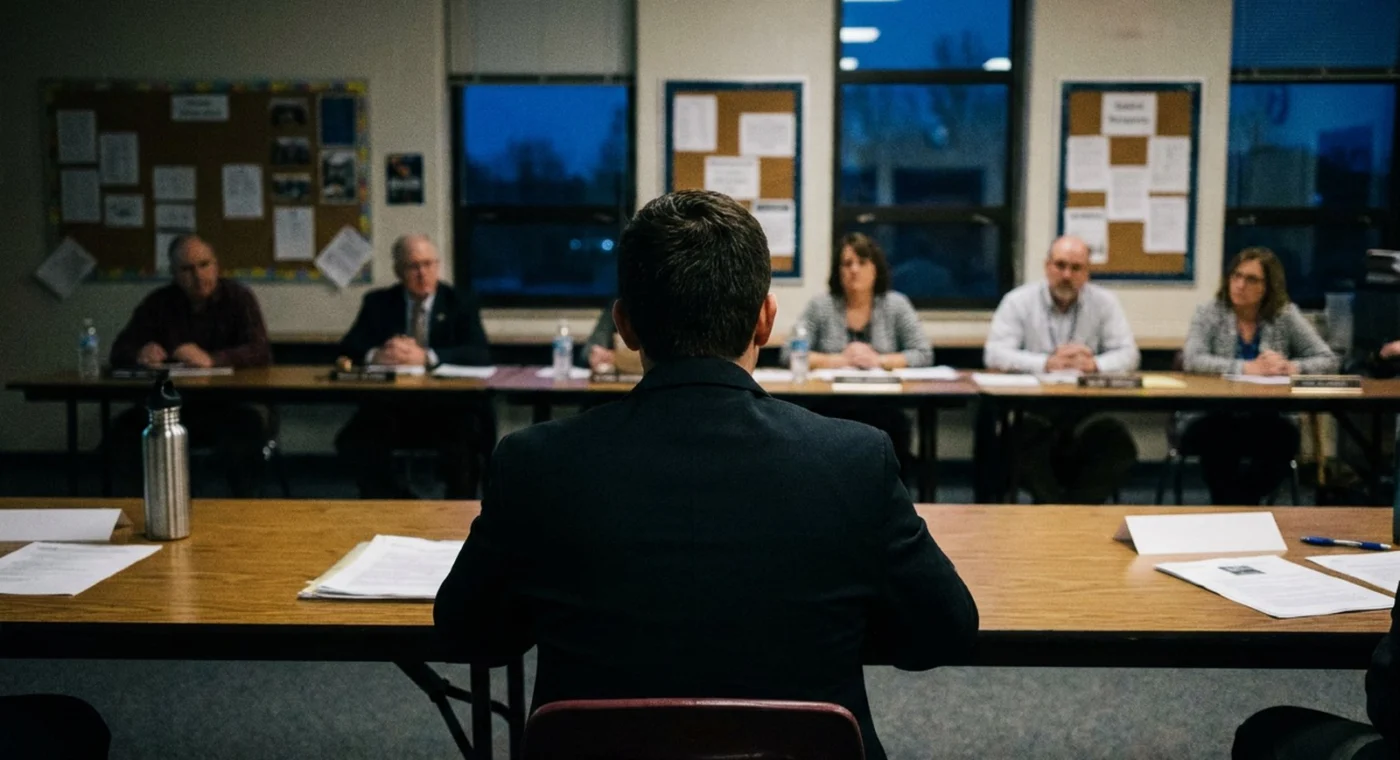
Matthew Poska’s finalist interview with the Wilmington School Committee took place on the evening of November 19, 2025 in the high school’s Large Instruction Room, at the end of a 12-hour day of school visits, with the parent-teacher night bell ringing in the background. The district posted the video on its search page. This article is drawn from a transcript of it; quotations are his words, lightly trimmed of false starts. The questions came in a fixed order from all seven members. His answers are the fullest public account of how he thinks, and the committee’s deliberation six days later, covered in Part 2, turned on how members read them.
On why he applied
Asked to summarize his career and his interest, he gave the line he had given earlier in the day: “I was asked a similar question earlier, you know, why Wilmington? And my retort was, why not Wilmington?” He cited assessment scores “above the state average,” which he said showed “curriculums are in place that are aligned to the standards,” the town’s commitment to building projects, parent involvement, and budgets that had been “very consistent and relatively smooth” in recent years. “Everyone’s about to enter some certainly challenging times, but I think the body of work that’s been shown here has been tremendous.”
On what drives student success
To David Ragsdale’s question about the primary driver of student success, he answered with relationships: “belief and faith in students.” He described telling the director of Nashua’s adult education program that “your job is to provide hope,” and said the middle school years are where students are lost: “We lose students at the middle school level, you lose them and they’re at risk for dropouts.” The answer was about belonging rather than instruction; Nicholas Golden would say in the deliberation that he found some answers “insufficient or lacking detail.”
On trust
To Michael Mercaldi, on building trust with staff and parents, he promised visibility: “boots on the ground in a district such as this size,” classroom visits, “rolling up your sleeves with the principals.” On parents: “I don’t think this is just a job that you punch in late and you’re punching out at four. I think this is a job that’s year-round.” He added a reading of the day’s school visits: the principals “saw an opportunity to be a little bit better,” a phrase he would repeat in nearly every answer.
On the new elementary school
Stephen Turner’s three-part question on the 2028 elementary school and the consolidation of the Wildwood, Woburn Street and North schools drew his longest answer and his most specific anecdote, from the 2018 move into the new Beverly Middle School. He had kept telling staff “we just can’t pick up our classroom, move it to a new location and continue to teach and learn the same way,” until a teacher he respected told him in August, in the new room, “everyone’s sick and tired of hearing it,” but “as of right now, I finally understand what you mean.” His principle for the construction years: “It is about the teaching and learning. We want to maximize that. Those students who are in those classrooms have one opportunity for that experience.” On the North Intermediate School, which will share its site with the construction, he said the principal had walked him out back to visualize it; the neighbors would need “communicating,” and recess space was “probably not going to look the same for a period of time.” Jennifer Bryson would cite the “maximize teaching and learning” line as the answer that separated him on this question.
On special education
To Rebecca Lord, he reframed the question as one of budget discipline: “In these days of challenging budget conversations, really need to maximize your efficiency.” He proposed “some type of overview or audit of your special education process to make sure that the goals that you’re recommending for students is aligned and the data supports what those needs are,” a focus on “the least restrictive environment,” and the question his Nashua team asked itself, “What is special about special education?” He added: “When the student is making progress, how do we gradually pull away in some of those supports?” Lord, a special education consultant, would name the other two finalists her top choices and say they gave “the best guidance” on specifics.
On safety and inclusion
To Golden, he put physical safety first: “Without that, all the teaching and learning we’re talking about is for naught.” He described two years of tabletop exercises in Nashua with first responders and said parents who raise concerns should get a meeting or a call: “There’s a reason why they’re reaching out to you.” He did not address the inclusion half of the question beyond “making sure we’re an accepting community for everybody,” which came in a later answer.
On the middle school
To Bryson, on the middle school’s program review with the Association for Middle Level Education, he said he had used the AMLE survey in both Beverly and Nashua: “Once you triangulate all that data, the data is the data. It shouldn’t be offensive to anyone.” He had discussed the survey with the middle school principal that day and spoke of equitable teaming and grading “whether it be on-team or off-team.”
On unions
To Ragsdale: “Have we always agreed on everything? Absolutely not.” He described settling Nashua’s teachers’ and paraprofessionals’ contracts in 2025 against the backdrop of the Massachusetts strikes: “I don’t think everyone was thrilled, which probably means it was probably a pretty good contract for both parties.” He said he would meet union leadership weekly “so we don’t have surprises,” and noted the labor market: “There’s not a line of staff trying to get through that door to become teachers right now.”
On evaluation
To Bryson again, he gave the Tom Brady line: “He wasn’t perfect 16 games in a row. The evaluation process, it should be a collage.” He said he had opened a recent professional development day by telling staff “WMUR is not going to be here talking about these breaking strategies,” and asking them to “self-reflect” and “get a little bit better.” “No one here is a finished product.”
On the budget
To Mercaldi, on cost drivers, he listed contracts, federal mandates, transportation, special education, utilities and curriculum as fixed, then: “There’s not an infinite money tree out in the backyard.” He said Nashua’s curriculum budget is “probably just under a million dollars” and “the bulk of that is all about some curriculums.” His prescription was transparency: “They might not agree or appreciate the decision, but at least they can understand the why behind it.” He did not name a cost driver he would cut. Turner’s later reference call with Nashua’s chief operating officer reported that his share of the Nashua budget “is really pretty small.”
On bullying and test scores
To Golden: bullying “should not be something that you turn the other cheek” and must be addressed “promptly”; he pointed to Wilmington’s responsive classroom, PBIS and MTSS work. On MCAS: “I think we always think we can do a little bit better. But I think it’s not the end-all, be-all as well,” and he cited the art rooms, the spring art show, theater and fall athletics. “If we all scored 100 percent, we’re not canceling school the next day.”
On hiring
To Chair Jesse Fennelly: the test is “what is the value add that they are bringing,” and “you can’t settle.” He said that twice in his career he had stopped a search rather than hire the available candidate, “and I look back on the two instances I’ve done that, it’s been successful.” He said the principals he met that day wanted “someone who will be able to, when questions arise or concerns come up, to be able to bounce these ideas off of,” because “this chair can be very, very lonely, just as a building principal chair can be lonely.” And: “I certainly think I’m a better assistant superintendent today, right now today, than I was four years ago.”
On working with the committee
To Lord: his examples were Nashua’s policy committee, where he said 26 state-mandated policies had to be processed over one summer, a pending policy on students arriving at kindergarten not toilet trained, and the hard conversation of adding staff for special education and English learners while enrollment declines: “Yes, our enrollment is declining, but due to some of our high needs we have to add staff.”
On improvement systems
To Mercaldi: he said he missed Massachusetts school improvement plans, which Nashua does not require, “and that’s coming from a building principal who was doing that for 15 years and I can’t tell you I went smiling to all those meetings.”
On the first 30 days and six months
To Bryson: learn the community, meet “building leaders, principals, instructional coaches, secretaries, custodians,” and establish relationships with the town manager, police chief, fire chief and DPW. “If you see my resume, it shows I’ve been there for an extended period of time. It’s just not usually a one and done. I want to become part of a community.” Thirty days “is enough to say hi,” he said; the relationships take 90 days, six months, a year.
On teacher stress
To Turner: “I come from a family of educators, both my parents were educators.” His father’s advice when he went into administration: “never forget what it’s like in the trenches.” He described Nashua raising starting pay to recruit, the city studying conversion of old buildings into affordable housing for staff, and the idea of district-run child care: “Creating, thinking outside the box. I don’t know if that’s going to answer everyone’s, but those are concerns people have.” Golden called this his best answer; Fennelly and Bryson cited it as evidence of a “solutions-oriented” leader.
The close
Fennelly asked what he wished they had asked. “This has been a gauntlet, and it’s been a wonderful gauntlet,” he said. “I hope it came out of how genuinely happy I am to have this opportunity.”
Reading the interview against the vote
Three members who voted for him heard directness and a town-facing, coaching temperament; the member who voted no and the member who abstained heard generalities where they wanted specifics on instruction and money. Both readings are supportable from the transcript. The interview is strongest on culture, communication, buildings and labor relations, and thinnest on curriculum, elementary education and the budget, which is the same map the committee drew on November 25.
The interview video is linked from the district’s search page, here. Part 4 of this series covers his entry plan and first months in the job.