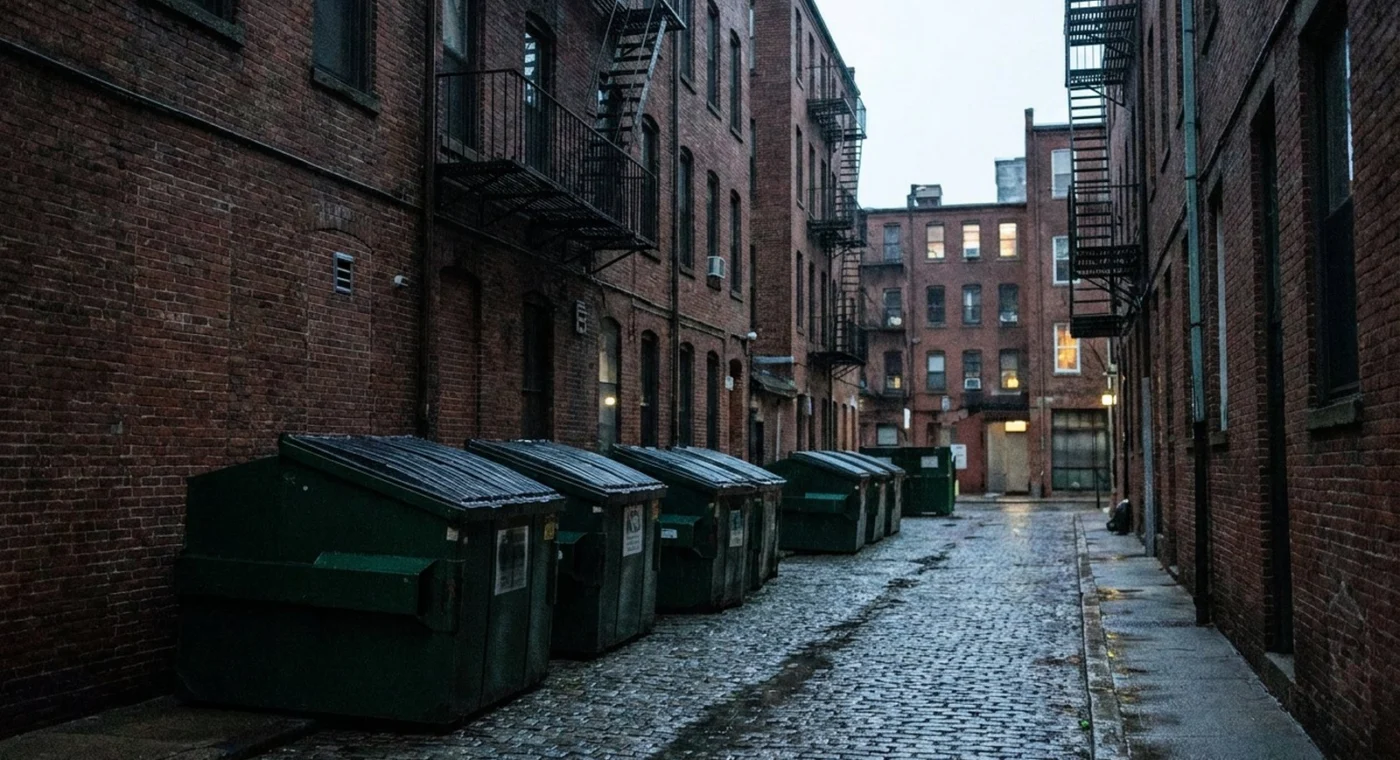
Somerville has 603 dumpsters licensed or in the licensing process and 14 known dumpsters still operating without a license, down from 69 in early August, the city’s public health division director told a City Council committee this month. Fines for a violation are capped at $300, which he said may not be enough to stop repeat offenders.
The figures are in the minutes of the Public Health and Public Safety Committee meeting of Tuesday, November 10, which the city has now posted along with the minutes of the Traffic and Parking Committee meeting of Monday, November 9. Both committees met by Zoom. Between them they took up rats, the winter warming center at the Cummings School, displaced Alcoholics Anonymous meetings, a proposed daytime-only parking permit, school drop-off traffic and paving on Highland Avenue. This report is drawn from the two sets of minutes: Public Health and Public Safety and Traffic and Parking.
Dumpsters and rats
The dumpster item was an order from Councilors Ben Wheeler, Emily Hardt and Naima Sait asking, “in view of the proliferation of rats in the city,” for a report on dumpster licensing and enforcement.
Public Health Division Director Colin Zeigler said enforcement is driven mainly by complaints. The division audits businesses that have not renewed a license or have been reported as possibly unlicensed. Notices go out once a year, more notices follow, and ticketing begins in the middle of July. Since July 1, he said, code enforcement officers have been focused primarily on dumpster compliance.
To comply, a dumpster needs a properly fitted lid, no way in for rodents, an accessible drain plug and no damage, and it cannot be left overflowing. Zeigler said the goal is compliance and education. The practices he recommended were regular cleaning with a solution of one part bleach to nine parts water, more frequent pickups, replacing damaged dumpsters and keeping up regular pest control. The division is also writing consistent enforcement guidelines.
Ward 4 Councilor Jesse Clingan wanted to know how businesses learn the rules. Zeigler said new applicants receive written materials and that businesses applying for a food license are told about the dumpster license at the same time. Clingan suggested requiring a photograph of the dumpster at each renewal. Zeigler said the division can look at technology of that kind to speed up audits.
Answering Councilor at Large Wilfred Mbah, Zeigler said audits are largely reactive because of staffing and the inspectors’ existing workloads.
Wheeler, who is not a member of the committee, raised dumpster designs with ridges or gaps that let rodents in and suggested passing the common design problems on to the haulers. Zeigler welcomed that and said the division usually deals with the businesses, not the haulers. On why problems persist, he pointed to the $300 cap and to the time it takes an inspector to investigate and write up a violation. Wheeler also suggested publishing the city’s internal map of dumpsters that have been out of compliance for a long time. Somerville meets monthly with Cambridge in a working group on rodents, Zeigler said.
Warming center: a new staging area and $400,000 from the state
Director of Emergency Management Bill Fisher presented the after action report on last winter’s warming center at the Cummings School, taken up together with a resolution from Councilor Kristen Strezo about street harassment reported by abutters and pedestrians on Prescott Street and School Street, and written comments submitted by Barbara Phillips.
Fisher said the center has a new security company and more capacity. Nearby residents reported slightly lower satisfaction last season, he said, while clients reported high satisfaction, particularly with how helpful the staff were. The city used a 10-year temperature study to set this year’s operating dates.
The main change is where people wait. The staging area moves to the School Street parking lot, set slightly apart from neighbors and the roadway, which Fisher said is expected to reduce harassment and noise. On suggestions that the city discourage early lines, he said clients are often anxious to be sure of a place for the night. The city is working on benches for the lot, which neighbors requested, and has added transportation, including a shuttle to a transit hub so clients can get around during the day.
Fisher urged neighbors to bring concerns to the city, to call 911 for an immediate safety risk, and to address the behavior of specific individuals instead of making assumptions about everyone who uses the center. Information is at somervillema.gov/warmingcenter and warmingcenter@somervillema.gov.
Health and Human Services Director Karin Carroll said the city had to wait for money to be appropriated before signing vendors. She said the state awarded $400,000 toward part of the center’s operation, which lowers the city’s share, and that she expected no trouble having vendors ready. Two days later, on November 12, the full council approved the warming center transfers and accepted the state grant, listed on that agenda at $410,037, as reported in our account of that meeting.
Committee Chair Matthew McLaughlin of Ward 1 said he was surprised the city was considering moving the site, since most of Somerville is residential. The visibility of unhoused people should not be treated as a problem to be solved, he said, while harassment and crime should be taken seriously.
AA groups moved from the Ralph and Jenny Center
Intergovernmental Affairs Director Amanda Nagim-Williams reported that four Alcoholics Anonymous groups used to meet at the Ralph and Jenny Center on Washington Street. After the city acquired the building, staff worked to move them to St. James Episcopal Church. Three have a space there. The fourth is still looking because the church was not free at the hour it needed. She said keeping the center open after hours would have taken extra staff to open, close and secure the building, and that the moves were timed so no group missed a meeting.
Clingan said he was concerned that the groups were displaced and that such spaces are getting scarce. Mbah raised libraries and schools as possible alternatives. Nagim-Williams said those raise the same questions of staffing, access and cleaning. Clingan suggested the Cummings School, which may already have staff on site in the evening, and she agreed to follow up.
McLaughlin also asked Nagim-Williams to report back on the planned removal of the McGrath footbridge and changes to nearby side streets, raised in comments from the Gilman Square Neighborhood Council. A resolution asking for monthly updates on homelessness was kept in committee. The other items were recommended to be marked work completed.
No daytime-only parking permit
At Traffic and Parking the night before, Wheeler made the case for two resident permits: the standard 24-hour permit, and a cheaper one for residents with driveways that would allow street parking by day and evening but not overnight, and not during street cleaning or snow emergencies. He said he had worked with the Somerville Alliance for Safe Streets on ideas from the 2022 curb study, with the aim of freeing up parking for seniors and people with disabilities and possibly making room for more housing.
Director of Traffic and Parking Suzanne Rinfret said such a system would add administrative and enforcement burdens. It would be hard to establish who has a driveway, she said, and parking control officers now tell permits apart by color. Checking license plates would slow them down and take more staff, and overnight staffing between midnight and 8 a.m. is limited. Wheeler suggested a visual marker such as a dot on the permit and said the risk of a ticket would bring compliance without heavy enforcement. Rinfret answered that the curb study recommended raising permit prices for residents with driveways, and that the city’s wider goal is less dependence on cars. The item was recommended to be marked work completed.
Kennedy School, school zones and Highland Avenue
Three resolutions from Sait, who chairs the committee, on the streets around the Kennedy School were closed out. Director of Transportation and Infrastructure Brad Rawson said the contractor has finished all pavement markings, including the bike lane markings on Elm Street, and installed narrower flexposts that had been held up by supply problems. Cherry Street has new pick-up and drop-off signs and more curb space for quick stops. Rawson said the Kennedy has 30 bike parking spaces, the most of any K-8 school in the city, that more are needed, and that staff plan to add them in 2027.
On an order from Mbah and Hardt about traffic around schools, which Mbah said grew out of an incident in which two vehicles passed in opposite directions while children were crossing, Rawson described monthly Safe Routes meetings among departments. Engineering Division Director Brian Postlewaite said his staff work with builders near schools to limit construction hours at drop-off and pick-up. Police Chief Shumeane Benford said the department relies on crossing guards to encourage voluntary compliance, that demand will always exceed resources, and that officers go first to known problem spots and complaints. Lt. Michael Holland said officers add help at the start of the school year and in snowstorms. Benford said Broadway at McGrath Highway is under state jurisdiction and that he is aware of the safety concerns there.
Highland Avenue will not get temporary paving, Postlewaite said, because the street is in the five-year paving plan for permanent reconstruction. Public Works Commissioner Eric Weisman said the Streets and Sidewalks Division will use milling and overlay for the first time on streets with serious pothole problems. The city is in the second year of a three-year survey of road and sidewalk conditions: the west side was assessed last year, the center this year, and the east side comes next.
The Traffic and Parking Committee voted 3 to 0 on its minutes, with Wheeler, Mbah and Sait present. Public Health and Public Safety did the same, with Mbah, Clingan and McLaughlin present.