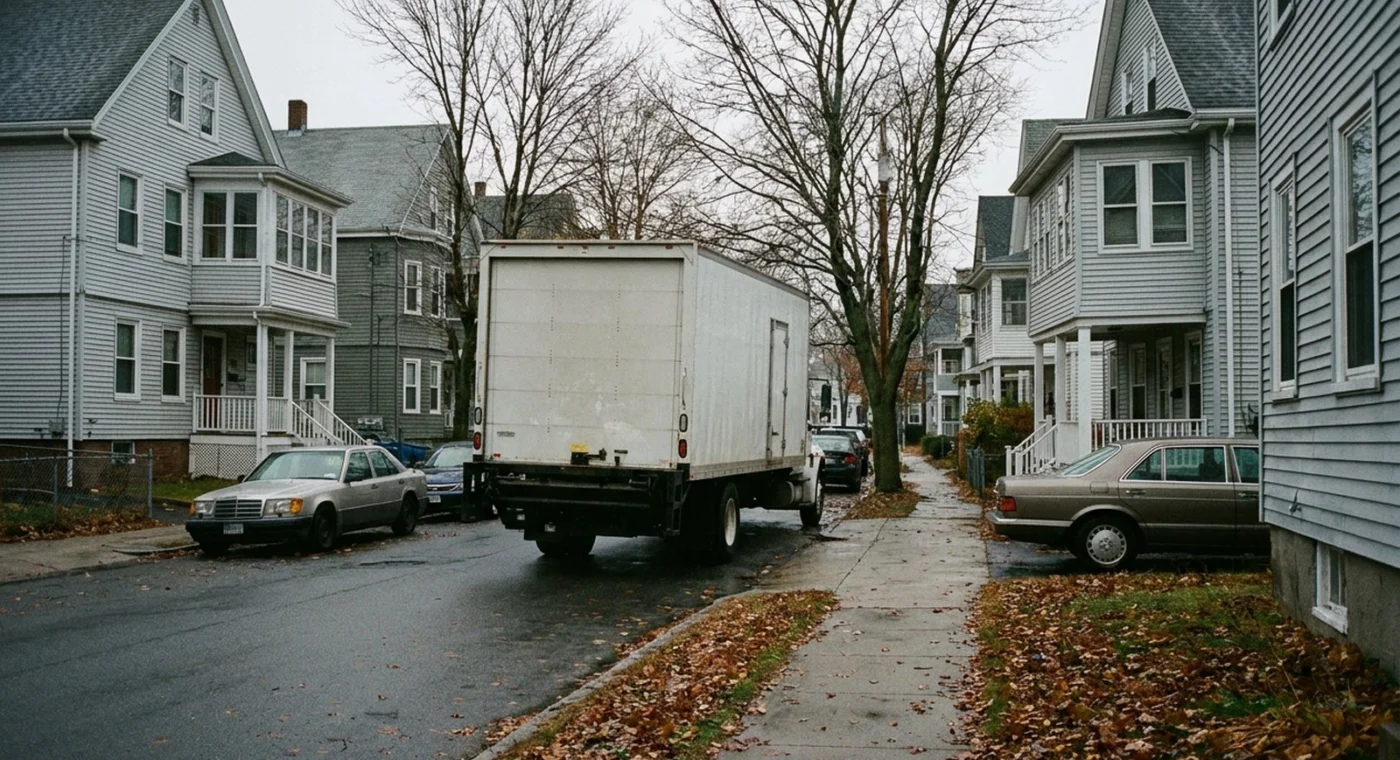
A Medford City Council committee voted 5 to 0 on Wednesday, November 18, to send a draft plan for keeping heavy trucks off residential streets to the Traffic Commission and the Department of Public Works, with a response requested by January 31 and another meeting to follow in the new year.
The Public Works and Facilities Committee met for 23 minutes on a single item: a resolution from Councillors Justin Tseng and Anna Callahan that the council “explore solutions to reduce incidents of heavy trucking on neighborhood streets lacking the capacity, including heavy commercial vehicle exclusions and home rule petitions.” The paper carries a 2025 docket number, 25-095, and stays in committee. No street was restricted and no money was spent.
Nobody from the city administration, the Traffic Commission or the public spoke. Callahan, who chairs the committee, said she had asked the Traffic Commission for a list of streets that already have truck exclusions and of any requests that were denied, and had not yet received it. The meeting is on the city’s recording.
What a truck exclusion takes
Callahan opened with a short presentation on what state law allows. She said the city cannot post a heavy truck exclusion on its own: the Massachusetts Department of Transportation has to approve it, and the application requires an engineering study.
By her summary, the exclusions generally apply to trucks rated above 10,000 pounds, are meant mainly for residential streets, and can be limited to nighttime hours. Trucks must be left a suitable alternate route. Numbered routes cannot be closed to trucks, and trucks making local deliveries generally stay exempt.
She said the state’s standards recognize three grounds for an exclusion: heavy commercial vehicles making up a set share of the traffic, deteriorating pavement, and protecting a residential street at night.
The study itself, she said, has to document vehicle counts, the alternate truck routes and how far and how suitable they are, the width of the road, the pavement structure, the condition of the sidewalks, nearby schools, playgrounds, homes and businesses, existing traffic controls, the hours proposed, and the city’s commitment to signs and enforcement.
Callahan also listed what the city already has on its books: Chapter 78 of the city ordinances, the Traffic Commission’s own regulations, zoning rules in Chapter 94 that can restrict commercial vehicle parking in residential districts, and a 2014 special act, Chapter 163, that widened the Traffic Commission’s authority over public off-street parking. The last two concern parking, she said, but they bear on whether trucks end up on residential streets.
Short of an exclusion, she said, the city could look at enforcement, redesigned intersections, traffic calming, managing construction trucks, signs that direct trucks to the right routes, and asking GPS and navigation companies to route trucks elsewhere.
A draft action plan
Callahan circulated a document of proposed steps. She described them as getting the list of Medford streets that already have commercial vehicle exclusions, identifying the streets that qualify under state rules, and identifying the streets that the Traffic Commission, the engineering department, the Police Department or residents think would benefit. From those she hopes to build a list of target streets, and to look at quicker measures for the highest priority ones while a study and a state approval are pending.
Councillor Matt Leming said the natural first step is a cost estimate from the DPW for the engineering study, which he said would most likely be done by an outside firm. After a study, he said, come the basics: signs, and notifying routing companies such as Google of the new restrictions. “The very first thing that would need to come out of this meeting, at the very least, is just getting an estimate from engineering on the cost of the study,” he said.
Which streets
Councillor George Scarpelli, joining remotely, asked whether calls about particular streets had prompted the item. Callahan said she had heard about trucks from residents of the Hillside and the College Avenue area, and from a group of Ward 5 residents working on traffic there, some of them on Bonner Avenue and Alexander Avenue, which she called cut-throughs.
Scarpelli said he supports the idea, and tied it to the council’s recent discussions of private ways, where residents pay for roads that diverted trucks then wear down. He cautioned against moving quickly. “When we move traffic one place, it shifts to another,” he said. He said he did not want residents to think the committee was about to make big changes that night, and that the job for now is to get the right people in the room and gather data.
Leming said the complaints he hears come on and off and follow no pattern. Often, he said, they involve a small private way, and he gave the example of one in Glenwood with an industrial site at its end, where trucks ran back and forth and the road crumbled because the city does not maintain private ways. Other cases are temporary, he said, such as a street that is the only way to a construction site. He said a study should aim at streets with “a clear, systematic and long-term issue” that will not end without the city stepping in, and that the answer differs for state roads, city streets and private ways.
Council President Zac Bears said he was in a similar place to Scarpelli. He recalled complaints about Harvard Street five or six years ago and said they appear to have spread to Bonner, Alexander and Willis avenues. Harvard Street, he said, is one of the only truck routes between Interstate 93 and Somerville because trucks cannot use Route 16. “We’re getting a ton of cut-through heavy truck traffic because that’s the only road that they can use,” he said.
Tseng, who is not a voting member of the committee, joined by Zoom late in the meeting after audio trouble. He said Bonner and Alexander are the places he has heard about as well, that little can be done without city staff and residents present, and that councillors can meanwhile collect the names of streets they want monitored. He called Callahan’s document “a really, really promising action plan.”
The vote and what comes next
Bears moved to keep the paper in committee, refer Callahan’s document to the Traffic Commission and the DPW, request a response by January 31, and meet again in the new year. Leming seconded. The roll call was Bears, Vice Chair Emily Lazzaro, Leming, Scarpelli and Callahan, all yes.
Bears said the next meeting on the subject should include the DPW, the Traffic Commission and the residents who have raised it.
The committee is next scheduled to meet on Wednesday, December 9, at 6 p.m. The full council, which set the tax shift on November 17, meets next on Tuesday, December 1, at 7 p.m., and holds its Ward 2 neighborhood meeting on Wednesday, December 2, at 7 p.m. Written comments to the council go to ccmembers@medford-ma.gov.