The Salem School Committee voted unanimously Monday, November 9, to oppose Pioneer Charter School of Science II’s request to grow from 858 seats to 1,224, adopting a resolution drafted with the Salem Teachers Union that says charter schools already draw nearly $10 million from the district this year. The same meeting opened a review of the four Salem police officers assigned to the schools, during which members learned that the memorandum of understanding with the police department has not been signed by both sides since 2022, passed a ban on smart glasses and other covert recording devices on first reading, and put a borrowed crossing gate on a school bus as a low-cost alternative to camera enforcement.
Mayor Dominick Pangallo chaired. Vice Chair Beth Anne Cornell was in Hanover at the girls soccer playoff game and took no part; the student representative was absent. The account below comes from Salem Access Television’s recording and the 46-page meeting packet, which is linked at the end.
Charter resolution: “siphoning off nearly $10 million”
Ann Berman, president of the teachers union, told the committee during public comment that the proposed expansion would affect Salem, Lynn, Peabody, Saugus, Danvers, Revere, Chelsea and Everett, the sending districts for the two Pioneer charters, and that the American Federation of Teachers’ state affiliate is helping the districts push back. The resolution, which runs two pages in the packet, says charter tuition costs Salem nearly $10 million this year, $8.3 million after state reimbursement; that the school is asking for a 43 percent increase while more than 20 percent of its current seats are unfilled; that it has had conditions placed on its charter repeatedly for enrolling large shares of out-of-district students; and that 26.3 percent of Salem’s students have disabilities against 8.9 percent at the charter, with 57 percent of Salem students low-income against 43 percent. It asks the state Department of Elementary and Secondary Education to weigh the resolution when it reviews the application. Member Megan Stott thanked the union for the draft, “especially without their seats being full.” Member Veronica Miranda moved it, Member AJ Hoffman seconded, and it passed without a dissenting vote.
School resource officers: four principals, one lapsed agreement
Superintendent Welch, four months into the job, framed the discussion as the first of several. He recapped the August 6 safety summit, which drew about 100 people from every school, and listed the assignments: one officer who circulates among the elementary schools with Derby, the department’s comfort dog; Officer Van Loon at Collins Middle School; Officer Ryan at Salem High School; and Sergeant Sano supervising the team. He read the state law’s limits aloud: resource officers “cannot serve as school disciplinarians, enforce ordinary school rules, replace mental health professionals or use police powers to address traditional disciplinary issues.” Member Mary Manning said she sat on the committee that picked the first two officers years ago, when only a handful of applicants showed up, and that the program later grew to four. No one at the table could say when the first agreement was signed or why the number doubled.
The four principals spoke in turn. Bethann Jellison of the Sarah Parker Remond School said the elementary officer reads to kindergartners, decorated a trunk for trunk-or-treat, checked the traffic pattern on the first day of school and, with two school employees, visited the home of a child who would not come to school and was there with the dog on the morning he returned. When a middle schooler at her building brought a BB gun to school, she said, the officers who responded already knew him, “and the kid was like, I’m so sorry, I didn’t realize it was going to be such a big deal.” Gavin Softic of Collins said the officers are the school’s liaison to what happens over weekends, that Van Loon was the first responder when a student had a seizure, and that he helped a student on the autism spectrum who was leaving the building get to mobile crisis and then into a daily routine. Jamaal Camah of New Liberty Innovation School said police in his previous district did not have relationships with students and the result was “fuel to the fire,” while in Salem students are excited when the cruiser pulls up. Glenn Burns of Salem High said the officers plan security for graduation and for wrestling meets that fill the field house with 3,500 people, are often the school’s first word that a parent has died, and during the last swatting call were able to search the perimeter so that the school avoided a lockdown. He said the high school and Sergeant Sano are building a database, at parents’ request, so that officers responding to calls involving graduates with severe disabilities know who they are dealing with.
The questions were sharper. Hoffman asked what happens before an officer is involved and why elementary schools need one; Welch said he would research the history. Stott asked whether the summit and the district safety team, which she was told has about 40 members, have written operating procedures; the administrator who runs the program said the agendas exist and a standard procedure is being written. A parent from Flying Cloud Lane had said during public comment that police in schools create “an atmosphere of intimidation,” risk “the criminalization of children’s behaviors,” and weigh differently on students of color and immigrant families. Miranda said she had sent the committee discipline data showing racial disparities and asked for a special meeting on the officers rather than a crowded regular agenda; Hoffman asked that families and students of color be invited to speak. Miranda then said that from what she could find, no memorandum of understanding has been signed by both the schools and the police since 2022, “which puts us out of compliance with the state,” and asked that any new language proposed by Police Chief Miller be discussed in public before it is adopted. Welch said state law requires him to deliver the updated agreement and a year of statistics by August 1; Stott said the committee should not wait until then. Pangallo said a committee of the whole or special meeting will be scheduled and that he would check whether any part could lawfully be in executive session; Miranda said she would prefer it all be public.
Bus cameras: a crossing gate first
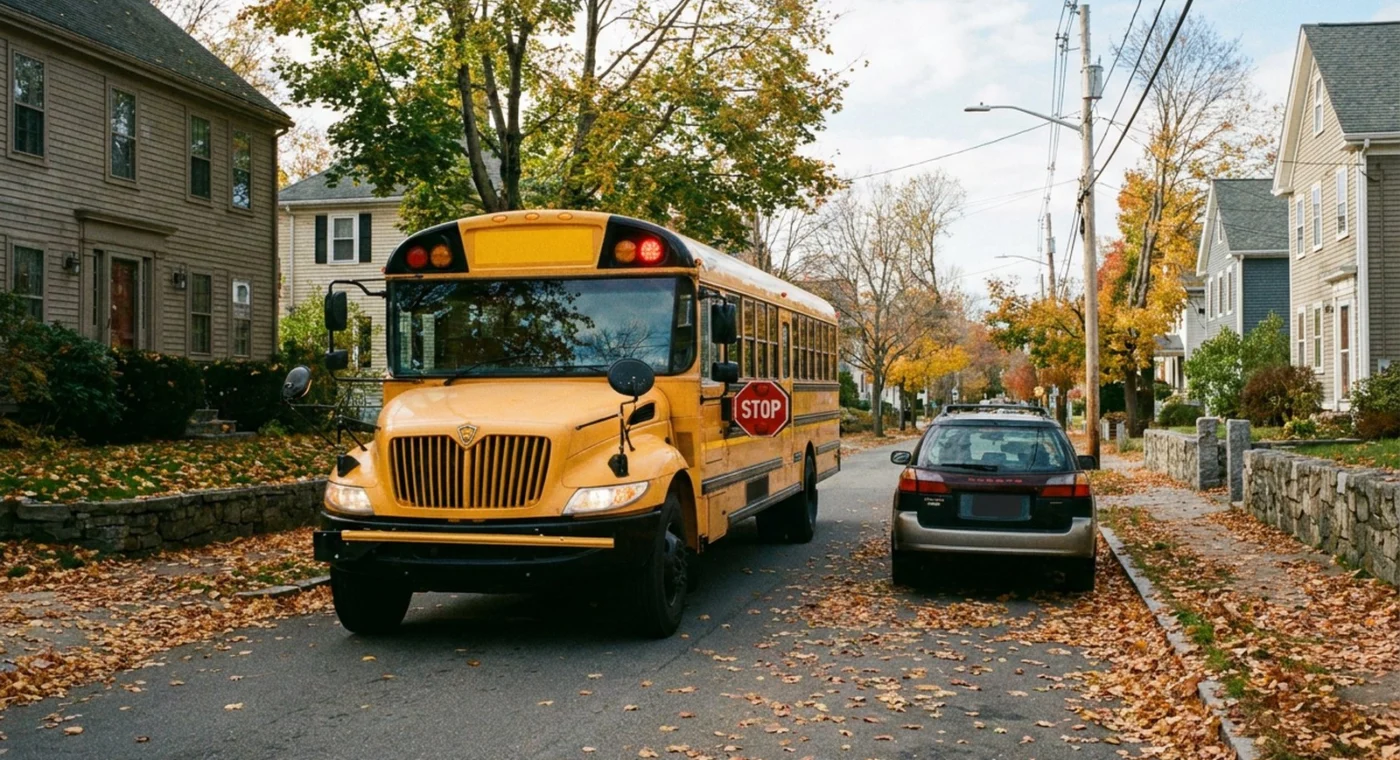
The stop-arm camera proposal, under which a vendor would photograph cars passing stopped buses and police would review each image before a $250 fine is issued, is headed for a separate committee of the whole meeting that has not been scheduled. In the meantime, Welch said, a company called BusGate shipped the district a free crossing gate, the roughly ten-foot arm that swings out from a bus’s front bumper, and it is being installed on one of the two buses the district owns, since the gate cannot go on a contractor’s bus without the contractor’s agreement. Stott looked up the price during the meeting: $600 to $700 a gate. Hoffman asked that the test bus run a heavily traveled route. Miranda asked for data on the traffic enforcement that followed the late 2024 camera pilot, which recorded 3,371 suspected violations, and on whether Salem buses could stop in the travel lane rather than pulling to the curb, as they did where she grew up in Illinois. Member Yamily Byas asked when the pilot starts; Welch said this week if it has not already. The assistant superintendent, who was away, will report at the next meeting.
Transportation: 12 buses and three playoff teams
Standing in for Assistant Superintendent Elizabeth Pauley on the finance report, Welch said the new five-year contract with Healey gives the district exclusive use of 12 buses at $490 a day each, with monitors extra, and charges $103.50 an hour with a three-hour minimum for athletics; there were 62 athletic trips between August 28 and October 31. The buses must finish afternoon drop-offs before they can carry teams, which means pickups rarely happen before 3:45 p.m., and in fall, he said, “there’s been stories of our kids literally getting off the bus and running to the start of their track meet.” Two weekend trips were missed this fall, one for the band’s competition in Lynnfield, which parents and a staff member rescued, and one for a sports event; he attributed both to miscommunication. For the volleyball team’s first-round playoff game in Pittsfield the district hired a coach bus. Miranda said parents’ emails suggest the problem predates Healey; Stott asked whether the contract would bar the district from buying a large bus of its own. Welch said the district’s one 14-passenger bus, used mostly for New Liberty internships, is a safety valve but “not for a team of 15.”
Also Monday
Stott reported that the Policy Subcommittee, meeting October 22, endorsed a new policy on wearable recording devices drafted by counsel at the mayor’s recommendation. The subcommittee rewrote the list of banned devices so it would not go stale, naming smart glasses but adding “wearable AI voice recorders, recording pins or similar devices or other wearable devices capable of covertly recording audio, video or images,” with exceptions for documented educational needs approved by the superintendent or a designee. Miranda’s amendment replacing “his” with “their” in the exceptions section passed, and the policy passed first reading unanimously. Stott said the subcommittee will ask the Massachusetts Association of School Committees for help turning the handbook language on artificial intelligence and responsible technology use into a formal policy.
Welch’s building update covered the former Carlton School, now shared by Salem Prep High School on the second floor and New Liberty on the first, with a gym, a cafeteria and the kitchen where the district’s scratch-cooking program bakes for every school. He described New Liberty’s grants: Barr Foundation money for an evening program for over-age, under-credited students and for biotechnology, business, engineering and advanced manufacturing pathways; Innovation Career Pathways support for a business and finance pathway the school hopes to have designated by 2027-28; and Read Trust funding for eight paid 100-hour internships. Byas, who attended the school’s open house, said one student told her it was “really nice not to have to step over someone in the morning,” and asked that Salem Prep get its own update at a future meeting.
Byas, reporting for Buildings and Grounds, said the Horace Mann playground will likely be built in summer rather than now to protect the equipment warranty, that the Horace Mann gym floor will be replaced over the December break with the high school’s portable floor going to Bates, and that the district is reviewing a hybrid geothermal and air-source heat pump system for Horace Mann that would replace the rooftop units and gas boilers, with a new generator and a solar-ready roof. Fiscal 2028 budget requests come to the committee in January. The consent agenda, approved unanimously, included the basketball team’s trip to Orlando January 15-19 and warrants of $892,622.43 and $1,417,430.02. In announcements, Welch said the marching band placed third at the NESBA championship at Harvard, a fraction of a point out of second, with the color guard taking the top caption award for the third straight time; the girls volleyball team won its first playoff game in team history, 3-0 at Taconic in Pittsfield, before losing to the No. 2 seed; the girls soccer team won its first playoff game in 13 years on penalty kicks; and the boys lost to Belchertown on penalty kicks. The career and technical education open house for middle schoolers is Saturday, November 14, at 8:30 a.m. at the high school.
The meeting packet, including the charter resolution and the transportation slides, is on the city’s AgendaCenter. The recording is on YouTube. The City Council’s own Thursday agenda is previewed here.