The Winthrop Town Council’s regular meeting on Tuesday, October 20 ran four public hearings in its first hour and finished only one of them. The council voted 9 to 0 to amend the Solid Waste Enterprise Fund budget for fiscal 2027 after the fund closed fiscal 2026 with no retained earnings, continued the proposed tree ordinance to its next meeting on its fourth draft, closed a hearing on Center Business District zoning changes after a resident and the town attorney agreed the legal notice did not meet the state zoning act, and continued the fiscal 2027 tax classification hearing to November 10. The town also learned it has a $100,000 congressional earmark for trees.
Council President James Letterie presided, with all nine members present: Vice President Suzanne Swope and Councilors Patrick Costigan, Kim Dimes, Joseph Romano, Paul Reardon, Martin Finn, Kurt Millar and Max Tassinari. Town Manager Anthony Marino was not at the meeting; his report was distributed in writing and the assistant town manager took questions. This account comes from the WCAT recording and the agenda packet. The recording’s automatic captions are rough, and where a speaker’s name could not be confirmed we have left it out.
The trash fund
Tassinari, chairing Finance, presented the manager’s motion to amend the Solid Waste Enterprise Fund for fiscal 2027: a $40,000 reduction in operations and maintenance, the tipping fee line, matched by a $40,000 reduction in retained earnings as a revenue source, “because the Solid Waste Enterprise Fund ended FY26 with a fund balance of zero.” The amended budget is $896,973 for personnel and benefits and $1,767,324 for operations and maintenance, $1,864,297 in direct costs plus $58,593 in indirect costs, funded by $1,442,890 in user fees and a $480,000 subsidy from the general fund.
Tassinari told the council the fee does not cover the cost of hauling and disposal, and that the general fund subsidy will “very likely” have to go up again later in the year after free cash is certified. The town has two contracts with Capitol Waste, he said: roughly $900,000 for collection, and then the disposal fees, billed monthly by weight. When the contract began, trash cost about $87 a ton to dispose of and recycling about $30. Trash is now about $150 a ton and recycling has climbed past $100, costs the town does not control. Five years ago, before the user fee, the general fund appropriation for trash was $1.2 million, he said, and the cost has since grown to about $2 million a year. His stated goal is a fund in which user fees pay for household collection and the town and the schools are billed for their own trash. No one spoke at the hearing. The roll call was unanimous.
Tree ordinance: fourth draft, private trees still the sticking point
Swope, who has carried the tree ordinance, said it began as a question about what developers owe in landscaping and grew into a 38-page document. She said she, the town attorney and a colleague met the day before, and the town attorney’s view was that the draft is “in good shape except for the part about private trees.” That part, she said, is the point: “We cut down more trees, as the tree warden said, than we plant,” and the town will never reach its canopy goal without rules for private property. She cited a lot she visited where seven or eight trees came down and the owner put in concrete blocks and parks cars there. The committee is looking at Brookline and Newton ordinances, with Needham about to adopt Newton’s. She said the hearing had not been properly advertised in any case because the draft is still changing, and it was continued to the next meeting.
Members of the Tree Committee used the hearing to make their case. Kim Whitehouse of Precinct 6 said Winthrop’s canopy is under 10 percent, “only half to three quarters” of what a healthy community has, and asked for a replacement program covering public and private trees, a forestry program with a dynamic tree inventory, and money for planting and maintenance. Joan Gillman of Precinct 6 described the committee’s three amendments, one of them a permit requirement for removing any tree six inches or more in diameter at breast height on private property, with exceptions, fines, appeals and hearings, and named Brookline, Cambridge, Lexington, Newton and Somerville as towns with such rules. “Property rights are never absolute,” she said; residents already accept wetlands and building rules, “you can’t raise chickens,” and a mature tree can be destroyed in a day. Drew Stock, speaking on Zoom for the committee, argued for the inventory software provision: the town has no record of where its ash trees are as emerald ash borer kills them, no record of its Norway maples as spotted lanternfly weakens them, and no record of who planted a young red maple that died at a school site because the root wire was never removed.
A resident asked the town to consider hiring a certified arborist, noting a branch big enough to kill someone had fallen in the middle of Bartlett Road the night before. Another resident, a former tree planter, said the young trees on Revere Street branch at two feet instead of eight to ten and will not survive to shade anything. A Precinct 6 resident who said he has handled tree disputes asked how the ordinance squares with case law allowing a property owner to cut an overhanging branch at the lot line.
Center Business District: hearing closed, to be re-advertised
Costigan explained his package of zoning changes for the Center Business District: cutting the share of required parking a developer can buy out from 50 to 10 percent, limiting building height, and moving special permit authority to the council if the Planning Board does not act within 60 days. “I don’t think we need four-story buildings” downtown, he said, citing fire safety, traffic and parking, and said the district sits in the town’s MBTA Communities zoning area. The agenda packet included Town Attorney James Cipoletta’s October 10 memorandum concluding that the 60-day transfer “conflicts with the state zoning enabling act” because Chapter 40A, Section 9 sets a 90-day constructive grant period and does not allow a town to hand a pending special permit to a different body, and recommending that the amendment “in its present form, be withdrawn.”
A Precinct 6 resident then objected to the hearing itself under Chapter 40A, Section 5. The notice in the Winthrop Transcript, he said, described only a general review of business district zoning rather than the amendments; it appeared once, on October 8, twelve days before the hearing, where the statute requires publication in two consecutive weeks with the first at least 14 days out; and the Planning Board had not held its required hearing or reported. He asked that the hearing be stopped and his objection entered in the record. He also noted that Winthrop studied the downtown from about 2013 to 2016 and that consultants concluded more housing was the center’s only route to survival.
Cipoletta agreed on the procedure. He said he could find only the one legal notice, that Section 5 requires the text of the amendments to be specific enough that a reader “clearly knew what was proposed,” and that the matter must go to the Planning Board, which has 65 days to hold its hearing. He said he had no problem with the substance of most of the package, only with the transfer of special permit authority addressed in his six-page memo, “and there’s probably another way to get there.” The Planning Board’s hearing was set for November 16, and Cipoletta said he would draft one legal notice that both bodies can use. Letterie closed the hearing. A week later, at the October 27 special meeting, the council sent the Center Business District changes to the Planning Board.
Tax classification: single rate, continued to Nov. 10
The town assessor opened the annual classification hearing by explaining that Winthrop has chosen a single tax rate for more than 20 years. Less than 6 percent of the tax base is commercial, she said, and a split rate would cost the average small business $500 to $600 more a year while saving the average residential taxpayer $10 to $15. No one spoke. The hearing was continued to the November 10 meeting with a presentation to follow and a referral to Finance. Because the hearing has to be re-advertised, Letterie confirmed it will be published again.
Rules committee, AI ban: both pushed to Oct. 27
Millar, reporting for Rules and Ordinance, said the committee met October 8, reviewed the council’s rules and procedures, asked the town attorney for an opinion on the proposed Center Business District changes, and voted separately on Romano’s motion to dissolve the committee for six months, with “no favorable recommendation.” When Romano moved the dissolution under old business, Letterie ruled the motion was being considered for the first time and that his ruling followed Rule 9B; Romano appealed the chair. Dimes read her motion for a temporary prohibition on council use of artificial intelligence tools, including ChatGPT, Copilot, Gemini and Claude, until the town adopts a policy, saying “if AI-generated content is used in official government business, residents have a right to know what standards, what oversight and who is accountable.” Two residents who work in information technology, Rob DeMarco of Precinct 6 and Max Correa of Precinct 3, said the ban should be reworded because Copilot is already built into the town’s Microsoft Exchange email and Google search returns AI answers, while supporting a policy with training on hallucinations and data handling. Both motions were taken up at the special meeting on October 27, where the committee was dissolved 5 to 3 and Dimes withdrew the AI motion.
3A litigation and a $100,000 earmark
Asked by Swope for a status report, Cipoletta said the attorney general’s office had held a Rule 9C conference with him and told him it will file a petition for a declaratory judgment that Winthrop is subject to all of Section 3A, the MBTA Communities law, and is not in compliance. He said the parties “agreed on zero” of the attorney general’s proposals, that he expects to be served within a week and has begun the town’s answer, and that the Superior Court judge has not ruled on the motions argued August 25. The assistant town manager said the town, with the town attorney and a representative from state Rep. Jeffrey Turco’s office, had met the Executive Office of Housing and Livable Communities to ask whether a proposed 3A plan could get a preliminary approval before going to the Planning Board, and got no signal either way.
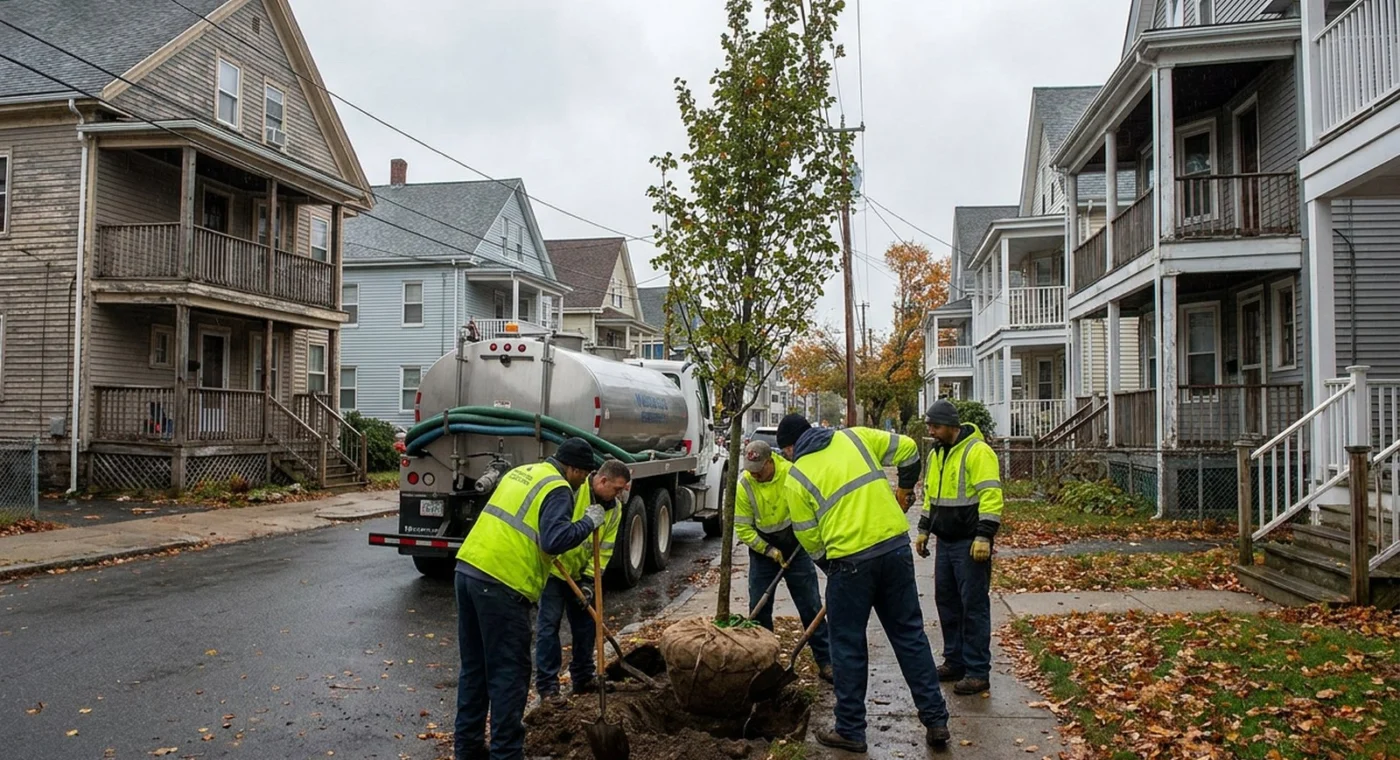
The assistant town manager also reported that after the town lost a cooling corridor grant for trees, she kept raising it with Mystic Valley and Eversource representatives and learned of a congressional earmark the town had applied for. The town has now been awarded $100,000, with fewer restrictions than the lost grant, to be spent over three years on tree planting, with the funder agreeing that part can pay for inventory software. The tree warden reported planting 20 trees across town the prior week with DPW crews and the new watering truck.
Holiday lighting and dates
Letterie announced that the holiday lighting on French Square will again be the day after Thanksgiving, in partnership with the Chamber of Commerce. The lighting contractor has donated a $2,500 residential holiday lighting installation; the town is selling 250 raffle tickets at $30, with the drawing live on WCAT at the November 10 council meeting, and is offering $200 sponsorships of the eight light poles on the square. Early voting ran October 17 to 30 at Town Hall. The council has one meeting in November, on November 10, and Letterie said he would try to pair a Planning Board meeting with a council session on November 16.
During the second public comment period, a Precinct 2 resident said he has watched about 14 people pass through the council over three terms and none seek a second term, and blamed leadership; another resident said people stay away out of fear and because they do not feel welcome. The agenda packet is here and the WCAT recording is here. Our report on the October 27 special meeting is here.