Smart glasses and other wearable devices that can record without being noticed are now barred in the Salem Public Schools. The School Committee adopted the policy on its second reading Monday night by a roll call vote of 7 to 0, with no discussion. Veronica Miranda made the motion and AJ Hoffman seconded it.
The policy passed its first reading on November 9, when the Policy Subcommittee described a list of devices written broadly enough to cover recording pins and wearable voice recorders, with exceptions for documented educational needs approved by the superintendent.
Most of the two-hour meeting at 29 Highland Avenue went to a larger question about technology: how much time Salem students spend on screens, and what the district will and will not let them do with artificial intelligence. Mayor Dominick Pangallo chaired the meeting. All seven members took part, one of them remotely, so every vote was by roll call. The district has not posted minutes; this account comes from Salem Access Television’s recording and the agenda.
Parents ask for rules at every grade
Two parents opened the meeting by asking for district-wide guidelines on classroom technology. The first, the parent of a Witchcraft Heights student, said she had heard of classrooms where children watch videos during snack time instead of talking to each other, where stories are read by a screen and not by the teacher, and where videos come with advertisements. Those things will not show up in data on laptop use, she said. “When a student is in a classroom using a Chromebook or watching a screen, what are they not doing?”
The second, the mother of a third grader and of a sixth grader at Collins Middle School, said her sixth grader told her he had been given detention for setting off a noise monitor: a ball on the teacher’s screen that bounces higher as the room gets louder and trips an alarm. She said the teacher confirmed how it works and the principal told her he did not know it was in use. She also said students at Collins Middle School message each other over school email through the day.
The district’s numbers: 17 and 19 minutes a day
The district’s executive director of instructional technology answered with data. Last school year, he said, Salem’s elementary students averaged 17 minutes a day on school devices and middle and high school students 19 minutes, with 90 percent of that time classified as high educational value. He set that against a national report from a monitoring software company that put the average at 40 minutes a day in elementary school and 50 to 75 minutes in the upper grades, with 70 percent of it high value.
This year’s numbers by school are highest at Bates, Horace Mann and Witchcraft Heights, the three elementary schools that subscribe to a math program that only works if students log a set number of minutes. Two other schools dropped it, he said, and the district stopped paying for subscriptions that were not being used as designed.
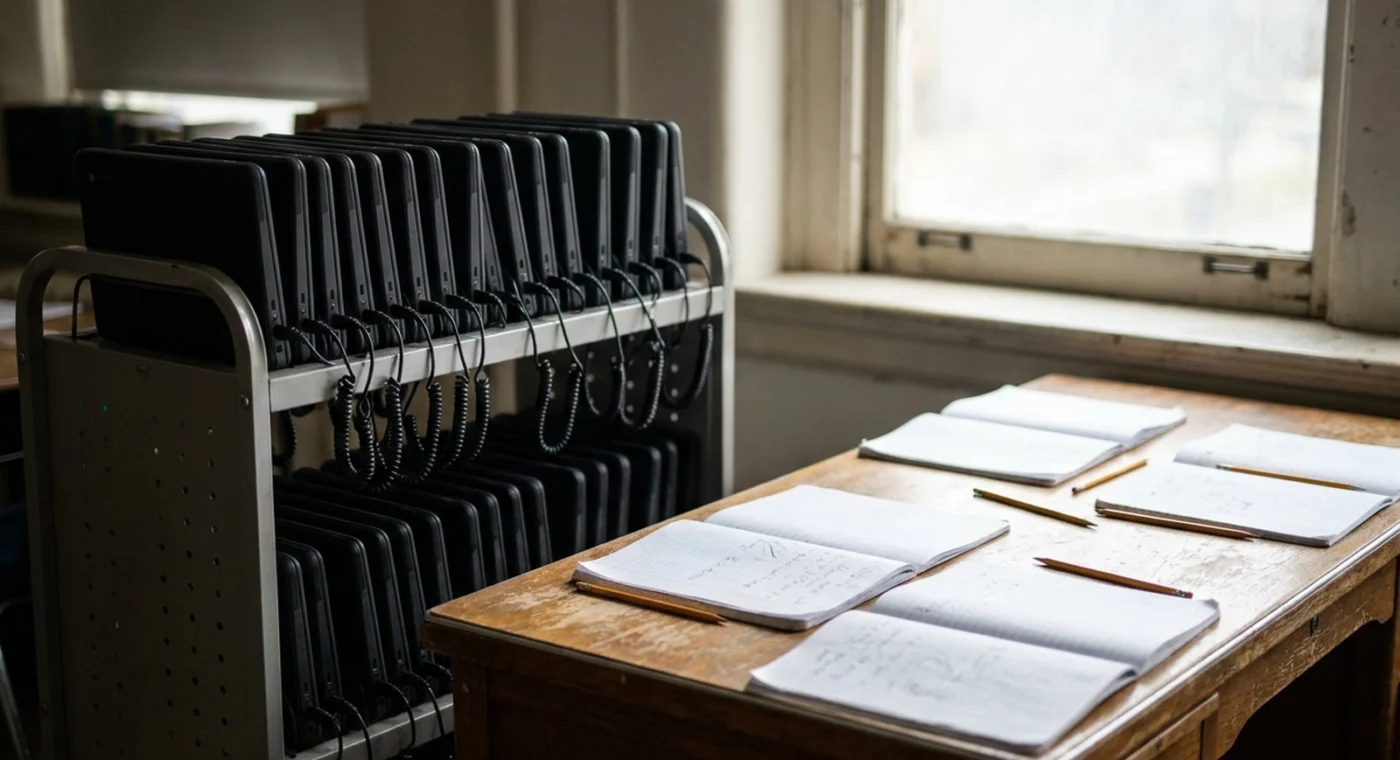
He laid out what students have. Prekindergarten classrooms have four tablets each, locked to a single math application. Elementary classrooms have a set of Chromebooks. Collins students get a device in sixth grade that stays at school overnight. High school students take theirs home. Filters block adult and violent content on every device, and teachers in grades 6 through 12 can use monitoring software to see student screens and limit a class to a handful of sites. Asked by the mayor, he said that software is available but not required and that he did not have a count of how many teachers use it.
On the parents’ examples, he said videos as a reward or a snack-time activity are “not an appropriate use of screen time” and will be listed as such in guidelines the district is writing. A video projected for a whole class is not counted in the district’s figures, he said; only time a student is logged in to a device is. He said the noise monitor was news to him. On advertisements, he said only YouTube can show them and teachers have been told to embed videos in slides, which strips the ads; that guidance will go out again.
No AI tools before sixth grade
On artificial intelligence, he said the district revised its guidance this year: teachers are told not to use AI tools with students at all before middle school. Third graders are introduced to the idea of AI in the spring through the library and digital skills class, and “we’re not having any student touch an AI chatbot or AI tools until sixth grade at the earliest.” From there it is up to each teacher, who is expected to say plainly whether AI is allowed in a class and for what. He acknowledged that is not happening everywhere. All ninth graders received a first lesson on AI in their advisory period on Friday.
A survey done for the district by the Rennie Center and Latinos for Education found that 29 percent of Salem educators do not use AI and that only 21 percent felt prepared for it, he said. Students told the researchers they find AI useful for studying, have trouble telling a learning tool from a shortcut, and are learning about it mostly from friends and social media.
Phones
The director called cell phones “an enormous problem.” Personal devices are not allowed during the school day, he said, and the district has used locking pouches in grades 6 through 12. Megan Stott said she does not believe the pouches are in use at the high school, and the student representative said they were dropped two years ago and that students may now use phones at lunch, a change the student credited with cutting phone use in class. The district and the high school principal are looking at an application that locks a phone to calls, texts and approved functions while it is on school grounds. Students could opt in to it in place of a pouch, and surveys of students and parents come first.
Next steps this year include written guidance and examples for teachers, a checklist for principals on classroom visits, monthly reports to schools on students who are habitually off task, and a public inventory of the tools used at each grade and school, which the director said he hopes to have by the end of the school year. A family workshop on screen habits is set for December 9, with interpretation and a recording. Pangallo asked for screen time by grade level and for the AI guidance for educators to be posted publicly; the director agreed to both. Superintendent Thomas Welch said he expects a follow-up in early January.
A father’s account of the special education bus
The third speaker was the father of a Salem High School student who has Down syndrome and autism and does not speak. He said that on November 17 his son’s ride home from an after-school program took more than an hour, and that on November 19 the bus company called him at 8:35 a.m. to come get his son from a bus that had broken down, 50 minutes after the boy was due at school; he said the school had not been told either. He said he has had five years of such problems with the contractor, asked the committee to require that parents of special education students be notified when a child arrives at and leaves school, and urged the district to end the contract and run the service itself.
Welch said the district’s finance and operations chief will meet with the father on Monday and that the administration is raising transportation problems with both of its bus contractors.
Student representative: grading at Salem High
The student representative, a senior, asked for a schoolwide assembly with a question period on standards-based grading. Students do not know the rules for earning the top mark of 4, for reassessment or for late work, the student said, and teachers in the same department apply them differently.
Vice Chair Beth Anne Cornell said the larger problem is one “the adults in the room” must fix. Advanced Placement classes add a point to a grade point average, she said, and the only honors classes are in career and technical education and the arts, so a student earning straight A’s in standard academic courses ends up behind classmates who know how to build a schedule. Hoffman, whose son attends the high school, said he did not know he could reassess: “I would like it addressed immediately.” Stott said the program of studies lists honors courses in science, history and languages and wanted to know which are really offered; a district administrator said some of those listed do not run. The Curriculum Subcommittee takes up the program of studies on Monday, November 30, at 5 p.m., in a virtual meeting, Miranda said. Welch meets with his student advisory group on December 3.
High school project: site work this summer
Welch and Stott reported on last week’s meeting of the high school building committee. An early bid package for site preparation is going out, and if the schedule holds, work on the grounds and changes to traffic flow begin this summer, with construction of the new building to follow in the fall. Welch said the design calls for roughly 1,700 solar panels on the building and about 5,000 over parking, with a break-even point after 11 years and more than $10 million in electricity savings over 20. The project is aiming for net zero energy, uses geothermal wells and has won a state grant for mass timber construction.
Also on Monday
- The committee rescinded old policies 5711.02 (nutrition), 5711.03 (physical activity) and 5711.04 (social and emotional health), and separately 5711.01 (students with food allergies), each 7 to 0. Stott said replacements were adopted before the school year and the old versions were never formally withdrawn. A food allergy policy remains in force.
- The consent agenda passed 7 to 0: the November 9 minutes, a Salem High trip to the Harvard Model United Nations conference in Boston, January 28 to 31, 2027, and warrants of $471,672.72 (November 5) and $497,629.51 (November 12).
- An update on school resource officers was left off the agenda by mistake, Welch said, and moves to December 7.
- Students from the Bates School will take part in the State House tree lighting on Tuesday, December 1, at 5 p.m.
- Cornell and Miranda will hold a town hall on December 1 at the Community Life Center.
- Twenty-two educators from Japan visited the Horace Mann Laboratory School on November 13.
- Salem hosts Beverly in the Thanksgiving football game Thursday at 10 a.m.
The committee’s next regular meeting is Monday, December 7.