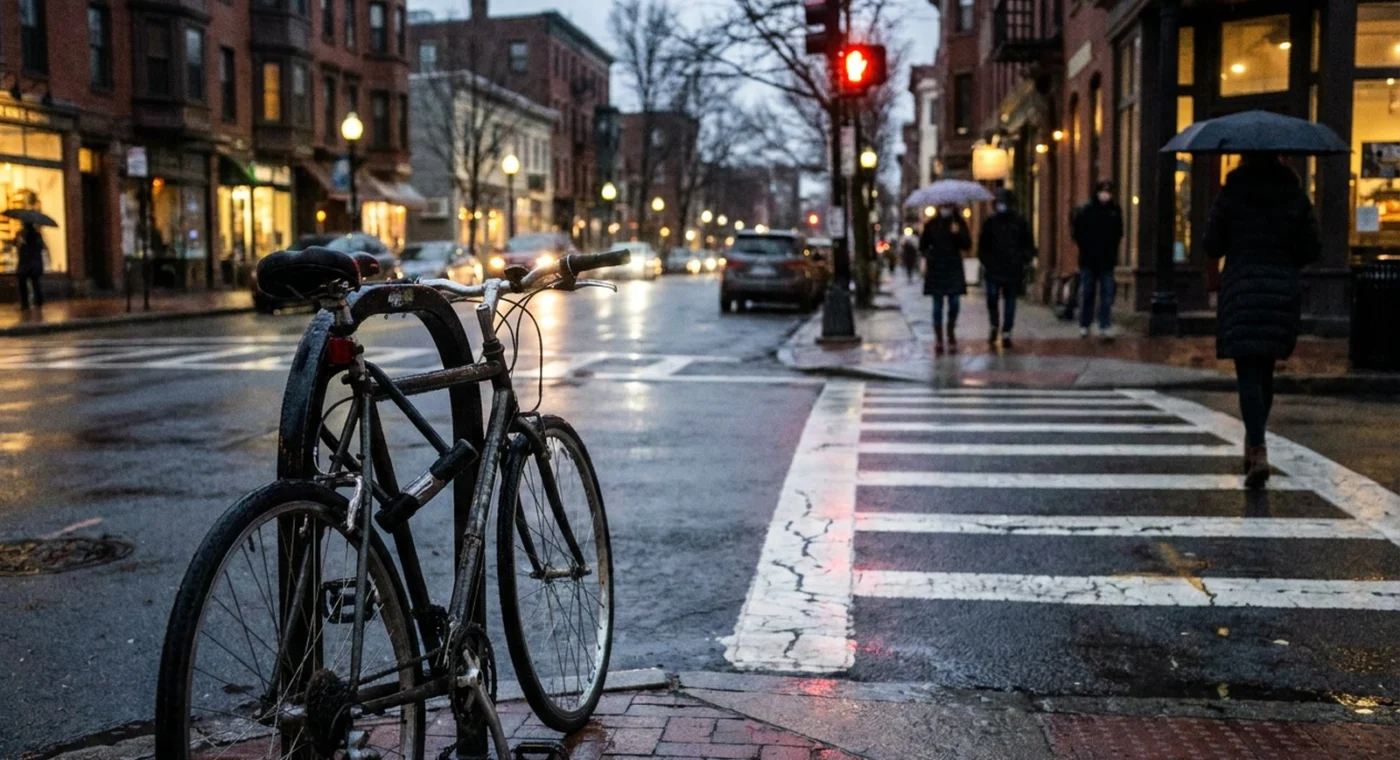
A $60,313.17 state grant that pays Somerville police for extra traffic enforcement did not make it out of the City Council’s Finance Committee last week. After a long exchange about how officers treat people on bicycles, the committee kept the grant in committee on Thursday, November 19, and did the same with the largest item on its agenda, a proposed 20-year tax agreement for a 318-unit apartment building on Block 9 in Assembly Square.
Everything else on the 22-item agenda was recommended for approval, according to the minutes the city has now posted. That includes about $1.47 million in Community Preservation Act appropriations, $850,000 in outside grants for Union Square and Magoun Square street projects, and two sets of pay adjustments for city employees. The committee met by Zoom from 6 p.m. to 9:22 p.m. Chair Ben Wheeler and Councilors Jon Link, Kristen Strezo and J.T. Scott were present. Ward 7 Councilor Emily Hardt was absent, and every recorded vote was 4 to 0.
The committee’s report is on the agenda of the full City Council meeting of Tuesday, November 24, along with the report of the Land Use Committee, which met the same night and sent two zoning amendments forward.
The police road safety grant
The grant comes from the state Executive Office of Public Safety and Security under the Municipal Road Safety Grant Program. Emily Wisdom, the Police Department’s finance and administration director, told the committee the city receives it every year and uses it to pay the Traffic Unit for traffic safety work outside its regular hours: targeted campaigns aimed at drivers and cyclists, and pedestrian and cyclist safety outreach and education.
Link said the council is still waiting for information it requested in an earlier order and that he was not comfortable supporting the grant until it arrives. Scott said that in past years the grant had been used mainly to harass cyclists and that he hoped the council would reject it, as it did in 2022.
Police Lieutenant Michael Holland said officers issued only six warning citations to cyclists under the grant in the past year and that the department’s focus is on safety, not bicycle violations. Wisdom said enforcement is meant to be educational and that the data do not show a high volume of citations to cyclists.
Link described an incident in Union Square in which, he said, a woman who rode through an intersection on a pedestrian signal was stopped by police more than once and left visibly upset and crying. He said his concern was less the citations than which behavior the city is discouraging, because crossing with the pedestrian signal can be the safest way for a cyclist to get through some intersections, and city staff recommended that approach when Washington Street was redesigned.
Strezo supported the grant. She said contact with cyclists should be educational and never harassing, but that some cyclists ignore signals and endanger pedestrians, seniors in particular, and she cautioned against blanket statements about how the money is used. Wheeler described a cyclist stopped after riding through a red light at School Street and Somerville Avenue with no cars or pedestrians present; the man, an immigrant from Israel, told him the stop made him fear for his status in the country even though it ended in a warning. Wheeler said he sees a gap between the language of the grant application and enforcement on the street. Holland said the so-called Idaho stop, in which a cyclist treats a stop sign as a yield, remains illegal in Massachusetts but is not an enforcement priority, and he offered to answer further questions before the next meeting.
Block 9 in Assembly Square
The second item kept in committee was the administration’s request for an Urban Center Housing Tax Increment Financing agreement for 375 Harold Cohen Way, a project first sent to the committee by the council on November 12.
Tom Galligani, executive director of Strategy and Development, said the city’s housing consultants have concluded that medium and large housing projects are not financially feasible in much of Somerville, which means the city could lose the affordable units those projects would have to include. He said the city weighed three tools: changing the inclusionary housing ordinance, upzoning and tax incentives. Given earlier council concerns about the ordinance and the long timeline for upzoning, the city is trying tax incentives.
Economic Development Planner Katherine Wiese said the building would have 318 apartments and a child care space. Sixty-three units would be affordable, two of them reserved for extremely low income households. The vacant parcel now pays about $80,000 a year in taxes. The project is expected to bring in about $3 million in building permit fees, followed by 24 months of full taxation on the rising value of construction before the tax agreement begins. The agreement lets the city collect a share of any returns above projections.
Barry Abramson of Abramson and Associates, the city’s financial consultant on the deal, said the developer puts construction cost at $117 million. He said the excess profit provision, which applies above 2 percent of projected revenue, could be worth several hundred thousand dollars a year depending on how the building performs. The proposal exempts 80 percent of the new value for the first 10 years and less after that, he said, where the 299 Broadway project received a 100 percent exemption for 20 years.
Ellen Shachter, the director of housing stability, said 70 to 80 percent of the people who apply to her office for help have incomes below 30 percent of the area median, and that 581 Somerville families are on the federal public housing waitlist while only eight are placed each year. Housing Director Lisa Davidson said other cities are reducing their inclusionary requirements.
Scott called the approach innovative but drew a line between this project and 299 Broadway, where half the units are affordable; he said he is more willing to subsidize projects that exceed the required share. He noted the Planning Board approved the project in May 2025 and wanted to know when the developer must pull a building permit; Galligani said he would follow up. Wheeler raised the cost of city services, including fire protection, for 318 new households. Galligani said the agreement was built so the city would not end up worse off. Link and Wheeler said that without an agreement the lot could sit empty for years, which they called the greater risk. Abramson said the decision is finally a policy judgment.
Community Preservation Act money
The committee recommended all ten Community Preservation Act items. The largest is $1 million from the open space reserve to finish the renovation of the Kennedy Schoolyard, with a matching $1 million moved into that reserve from the undesignated balance. Alan Inacio, director of finance and administration for Strategy and Development, said the original budget was a preliminary estimate, the custom playground equipment for the all-needs park cost more than expected, and crews found an old underground structure that had to be removed before a stormwater tank could go in. Link wanted to know why landscaping costs fell in the revised budget while other lines rose, and Inacio said he would follow up. Wheeler requested a breakdown of the playground features.
The other appropriations: $230,171 to the Elizabeth Peabody House for exterior restoration of 277 Broadway, plus $23,418.40 to complete structural reinforcement there and permission to redirect $15,154.25 left from a fiscal 2025 siding grant; $109,000 for a historic exterior needs assessment of the Somerville Armory; $45,000 to design a neighborhood green space on the Spring Street traffic island between Summer Street and Somerville Avenue; $38,000 for the Veterans Cemetery, where a contractor found lead paint on a historic fence that then had to be repaired off site; and $25,000 to the Mission Church of Christ for a condition assessment of 130 Highland Avenue. Roberta Cameron, who manages the program, said the Spring Street project is the first time the city will turn a traffic island into a pocket park, and that residents with ideas for city-owned land can email her or use the intake form on the program’s web page.
Union Square, Magoun Square and the rest
The committee recommended accepting a $500,000 federal earmark from the Department of Housing and Urban Development for the first phase of the Union Square Plaza project. Mobility Director Brad Rawson said the work centers on the Prospect Street and Webster Avenue intersection, is at 25 percent design and is estimated at $15 million. Big and Little Newton Streets would be realigned to meet Webster Avenue more directly, shortening crossings.
A $350,000 state grant would go to Broadway in Magoun Square. Rawson said that project is at 80 percent design, will be bid this winter and built starting in the summer. Strezo said several Magoun Square businesses are worried about construction; Rawson said the city is in a month-long public engagement period, is doing three rounds of outreach to businesses and has changed the design in response.
Also recommended: two $50,000 state agriculture grants for the Somerville Mobile Farmers Market and the school-based food markets; a $48,000 state recycling grant, $12,000 of it for food waste drop-off equipment (Recycling and Waste Manager Alexander Cherry said the drop-off bins took in more than 2,000 pounds in their first three weeks); a time extension of the water and sewer bill printing contract with D3 Logic Inc., worth $55,000 a year; $12,075 in salary adjustments for six employees whose duties grew in this year’s reorganization; $25,950 to correct the pay grades of the Police Department’s victim witness advocate and senior crime analyst; and an amended easement at 74 Middlesex Avenue that costs the city nothing.
Land Use: accessory apartments and ground-floor heights
The Land Use Committee met at 6:32 p.m. the same evening with all five members present: Chair Ben Ewen-Campen and Councilors Lance Davis, Jesse Clingan, Naima Sait and Matthew McLaughlin. According to its minutes, it voted 5 to 0 to recommend, as amended, the zoning changes that bring Somerville’s rules on accessory dwelling units into line with state law.
Davis read into the record a comment from Senator Jehlen that raised the question of whether parts of the local proposal conflict with the state law. Dan Bartman, director of Strategy and Development, said the statute lets the state housing office write its own regulations and that developers are unlikely to use state law against stricter local zoning. McLaughlin spoke against any further amendment that would restrict the units. Davis said limits on massing, floor area and story height, plus recent tree provisions, already cover what the committee wants.
The committee also voted 5 to 0 to recommend a second amendment that removes ground story elevation requirements from the zoning ordinance, after substituting a revised text prepared by the council’s land use analyst. The meeting adjourned at 7:17 p.m.