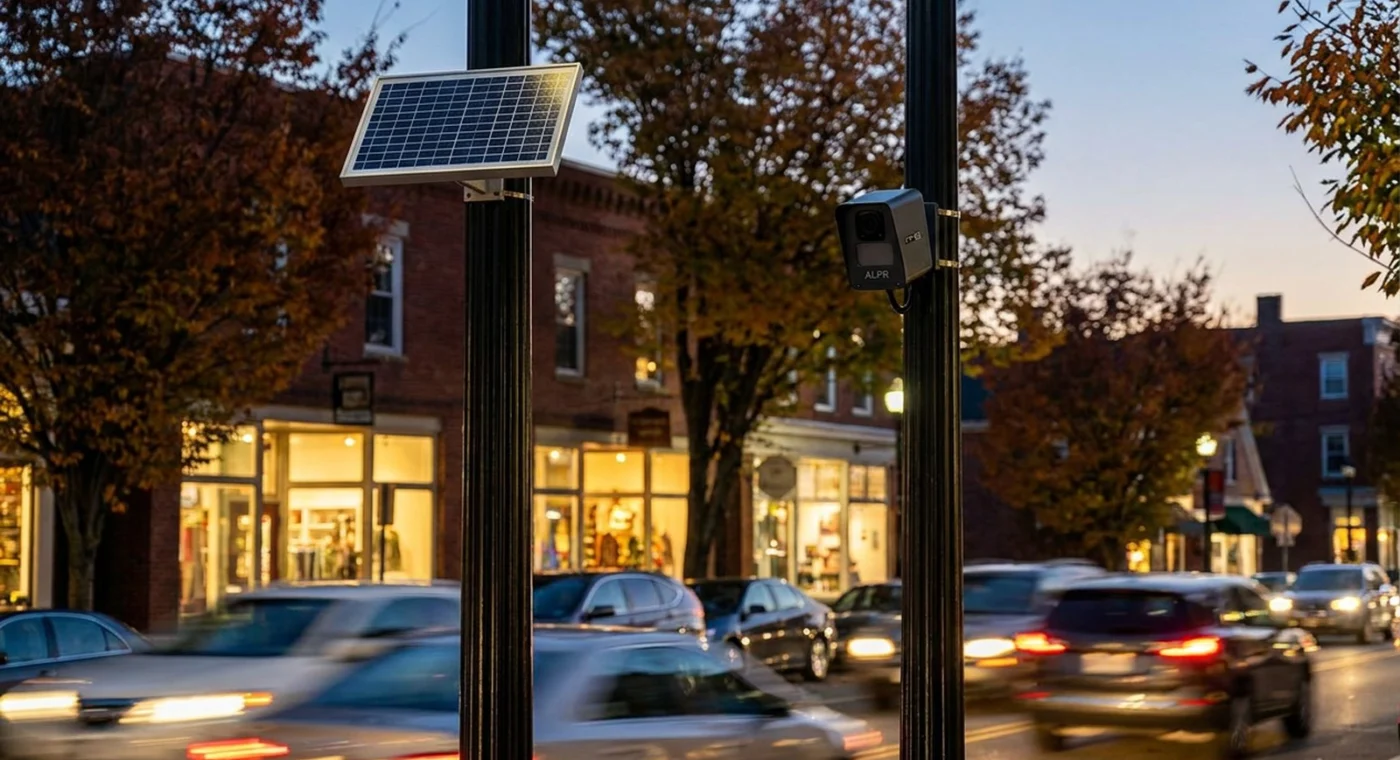
A proposed moratorium on license plate readers in Melrose was referred to the City Council’s Legal and Legislative Committee on Monday, November 16, without debate and without a vote, after one of its co-sponsors told colleagues that the two weeks or more it will take to act is time some residents do not feel they have.
“Our ability to wait another two weeks or another day to make this decision is itself a privilege,” Councilor Maya Jamaleddine said. The ordinance would bar the city, including the Police Department, from using automated plate readers or their data until the state regulates the technology and the council votes to lift the ban. Melrose police operate three Flock Safety cameras on Main Street.
In two committee meetings held before the 7:45 p.m. session, councilors recommended acceptance of nine state grants worth $505,215.52 for paving, traffic safety, the Milano Center, recycling and the city’s 911 operation. The full council accepted a $100,000 state earmark for Memorial Hall and scheduled the fiscal 2027 tax classification hearing for December 7. Ten of the 11 councilors were present. Councilor John Obremski did not answer the roll.
The moratorium: no vote, and a plea for speed
The ordinance is sponsored by Councilor Devin Romanul and co-sponsored by Jamaleddine and Councilors Elizabeth Kowal, Kimberly Vandiver and Ryan Williams. What it would prohibit, what it would still allow and how it would end are laid out in our report on the text.
When Council President Brad Freeman read it into the record, Jamaleddine took the floor on a point of personal privilege. She said she had wanted to move for immediate consideration and had been told by Freeman earlier in the day that he would have to rule the motion out of order, because the ordinance was not filed as an emergency measure and the city charter sets the process.
“I am deeply disappointed that as a city, we have not recognized the urgency of this matter,” she said. “For some members of our community, these cameras are not simply a matter of technology, public safety, or municipal policy. Their presence represents fear, uncertainty, and a very real concern about their safety and the safety of their families.”
She said she respects the process but does not want it to become “a reason for unnecessary delay,” and she urged colleagues to put the ordinance on the earliest agenda possible. “Just because some of us do not feel personally threatened does not mean that the threat is not real to others, to our own neighbors,” she said. “We cannot tell members of our community that their safety matters while asking them to wait another two weeks for us to act.”
No other councilor spoke, and Freeman referred the ordinance to Legal and Legislative. No date for that committee’s review was announced.
The only member of the public to speak all night addressed the same subject. A Florence Street resident, speaking remotely, said he supports a moratorium “on all tools of mass surveillance” and wants the council to go further by reviewing any surveillance technology the city adopts, whatever it costs. He objected to the idea that the trouble with the cameras is the vendor. “Setting up guardrails around mass surveillance is not going far enough, and neither is finding a kinder, gentler mass surveillance company,” he said, adding that there is “no evidence-based rationale” that the technology contributes to Melrose’s safety. Under council rules, members do not respond to public comment.
The council heard from Police Chief Kevin Faller, residents and the ACLU of Massachusetts on the cameras at a special meeting October 15, which is reported here.
Paving, a school traffic study and barrels
The Appropriations and Oversight Committee, chaired by Romanul, voted without dissent to recommend all nine grants on its agenda. They go to the full council for acceptance at its next meeting. Five came from the Department of Public Works and were presented by Director Elena Proakis Ellis.
Grove Street, $160,000. A state earmark for transportation infrastructure will go toward paving Grove Street in 2027, now that the gas main and water main work there is done. Proakis Ellis said the stretch from Lebanon Street toward Swains Pond Avenue will be fully rebuilt curb to curb, at an estimated paving cost of about $260,000, and that the city has agreed with neighbors to add mill and overlay repairs on parts of the block between Main and Lebanon streets, where residents have complained that their houses shake when the bus goes by. Her memo says Chapter 90 and city funds will cover the rest.
Lincoln School traffic study, $20,000. The earmark pays for speed, volume and turning counts on West Wyoming Avenue at the school entrance and at Pleasant Street. Proakis Ellis said the city has also applied for about $210,000 from the state’s Safe Routes to School program to raise the intersection at the school driveway to sidewalk level, add a raised crosswalk and build a curb extension at Wyoming and Pleasant. The counts are a baseline, she said, and doing them the way the Massachusetts Department of Transportation requires could shorten that agency’s design process, which she described as cumbersome. She hopes for construction in 2028. The counts must be taken while school is in session and before snow. She also said that from her own observation and that of the city’s pedestrian and bicycle committee, parents ignoring parking rules cause more unsafe situations at drop-off than commuters do. A reference to Crescent Avenue in her memo, she told Williams, should probably read Cottage Street.
Traffic safety equipment, $30,000. The money will restock barrels, cones and barricades and can buy push-button flashing crosswalk beacons and solar speed feedback signs. The city ran out of barrels this year, Proakis Ellis said, and could not run a planned pilot narrowing an intersection on Summer Street. About half the cones put out for any pilot go missing. The city already owns speed humps and speed tables bought with an earlier state grant.
Milano Center, $50,000. With the roof replaced under budget, the earmark goes toward replacing the most rotted siding and repainting.
Recycling, $16,900. The annual Recycling Dividends grant from the state Department of Environmental Protection is up $1,300 from last year, which the department’s memo credits to Environmental Outreach Coordinator Zack Laflamme. The most Melrose could earn is $29,900. Proakis Ellis said citywide curbside composting paid for by the city would add points but would be a major expense.
Four police grants
Chief Faller presented four grants, none of which requires a city match:
- $95,698.52 from the State 911 Department for the 16 hours of training required of 911 staff: $32,936 for the training vendor and $62,762.52 for officers’ time.
- $90,505 in State 911 support and incentive money, the most a city of Melrose’s size can apply for: $71,815.72 toward the salaries of officers who work dispatch and $18,689.28 for laptops and dispatch equipment.
- $25,000 to reimburse the fee the city pays its ambulance provider.
- $17,112 from the fiscal 2027 Municipal Road Safety program: $9,920 for traffic enforcement overtime and $7,192 for pedestrian and bicycle enforcement, which Faller said will mostly mean crosswalks. The state assigns a focus each month, with impaired driving in December, distracted driving in April and seat belts in May.
Every officer is trained to work 911, though a small group usually staffs it, Faller told Councilor Cal Finocchiaro.
The Protection and License Committee, chaired by Councilor Jason Chen, met for about three minutes and advanced the 2027 renewals of 24 common victualler licenses and two motor vehicle dealer licenses. Chen said the clerk had confirmed the applicants’ payments are in good standing.
At the full council
- Tax classification. On Romanul’s motion, the council set the public hearing on the fiscal 2027 classification of property for Monday, December 7 at 8 p.m. That is the annual vote that decides how the tax levy is divided between residential and commercial property.
- Memorial Hall. The council accepted, by voice vote, a $100,000 state earmark for stage lighting replacement and other capital work at Memorial Hall.
- National Grid. A petition to install 65 feet of underground conduit from a pole on East Emerson Road, as the petition lists it, to 681 Main Street was set for a public hearing December 21 at 8 p.m., on Vandiver’s motion.
- Retirement Board. A request to accept a state local option that raises the annual stipend the treasurer-collector can receive as custodian of the retirement system’s funds from $1,500 to $3,000, paid from the system’s expense fund, went to Legal and Legislative.
- Appointments. Mayor Jen Grigoraitis’s appointments of Joanne Lattanzi of Gibbons Street and Elizabeth Larcano of East Foster Street to the Soldiers and Sailors Memorial Building Trustees went to the Boards and Commissions Committee. They would replace Jason Webb and Lou Izzi, who resigned.
The council meeting itself lasted about 15 minutes. Minutes have not been posted; this report is drawn from MMTV’s recording of the three meetings, the council packet and the committee packet.