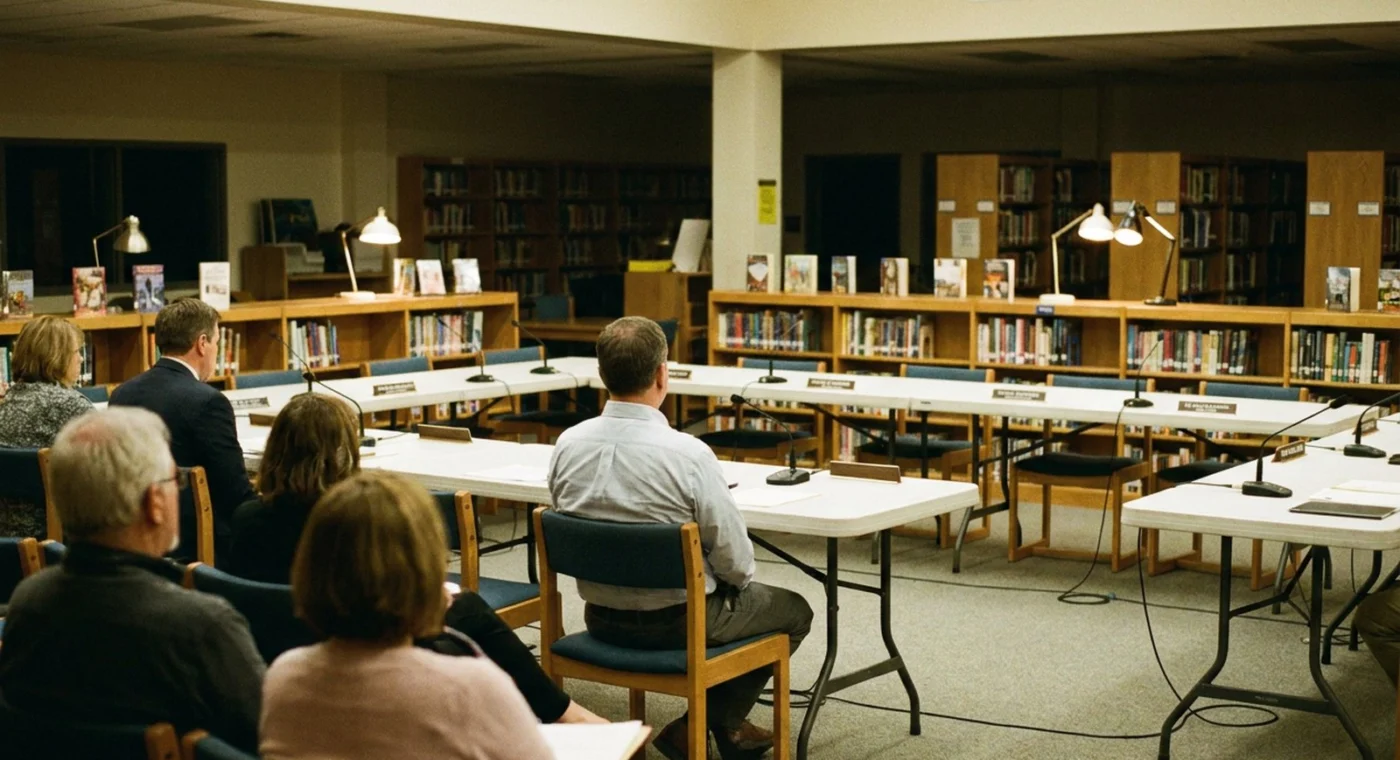
The Beverly City Council voted 5-3 Monday night, November 9, to ask Mayor Michael P. Cahill to raise and appropriate $20,000 for the city’s volunteer Human Rights Committee, after an attempt to instead ask for the return of the city’s diversity, equity, inclusion and belonging director failed on a 4-4 tie. The council also gave a first, unanimous vote to a moratorium on data centers that would run until November 30, 2027.
Eight of the nine councilors were present in the Beverly Middle School library. Councilor at Large Keith A. Sonia was absent. This account is drawn from the BevCam recording of the meeting, which carries no captions, and from the council packet; minutes have not been posted.
Order 213: what the council voted on
Order 213 was filed in September by Ward 4 Councilor Scott D. Houseman and came out of the Committee on Finance and Property with a referral to the full council for discussion. It is a request, not an appropriation. As the city solicitor told the council, only the mayor can submit a supplemental appropriation, and a public hearing has to be held before the council can vote on the money itself. Houseman called Monday’s action “a sense of the council vote” that is “not binding on the mayor.”
The background is the budget the council passed in June. That night, by a 5-4 vote, the council cut the DEIB director position from the fiscal 2027 budget. Ward 6 Councilor Matthew J. St. Hilaire, the council’s vice president, reminded his colleagues Monday that he had offered 12 amendments to cut $2.7 million in spending and that the DEIB cut “was the only one that passed.”
Houseman said the mayor, who could not attend, had authorized him to tell the council that if it approved Order 213 as written, the mayor “commits to” submitting an order to raise and appropriate the full $20,000. He also laid out the calendar. The tax rate is projected to be set December 7, and a supplemental appropriation within the budget has to be heard and voted before then. Asked by Ward 2 Councilor Danielle M. Spang why the vote had to happen that night, Houseman agreed the money could be found later, but it would then come out of free cash.
The amendment: bring the position back
Houseman told the council that a different idea had come up in committee, and Councilor at Large John J. Mullady put it on the floor: amend the order to ask the mayor to fund the position at the amount originally in the fiscal 2027 budget, a figure both men put at about $62,120. The amendment was seconded.
Mullady, who teaches history, said the June vote “showed how close we were” and that councilors had since had time to hear from residents. He argued that the gap between the two requests was roughly $40,000, “which is roughly a Subaru Crosstrek,” set against a deficit measured in the millions. He also questioned handing the work to volunteers. “Are we putting a responsibility on a group of civilian volunteers where we are not taking on that responsibility ourselves?” he asked, comparing it to school districts that once supplied classrooms and later left that to parent groups.
St. Hilaire said his position had not changed. “We’ve got a budget deficit again. We’re about to start financial forecasting,” he said. He said more than $1 million had been spent on diversity work between the schools and the city with “no tangible results to show for that money,” and closed one exchange with, “We don’t have the money.” He also asked what the mayor, the chief of staff, the human resources director and the constituent services director were doing on the subject, and said he would like to hear from the administration.
Ward 5 Councilor Kathleen M. Feldman, who chairs Finance and Property, said her June vote reflected frustration with how the position was structured, not with the work. She said she would like to see it return in the next budget cycle “under HR in a different form” and was not comfortable restoring it as it was on a short timeline. Ward 3 Councilor Steven M. Crowley said he agreed with Feldman and St. Hilaire and could not support the full amount, “but potentially the lesser of two.”
Council President Julie R. Flowers handed the gavel to St. Hilaire so that she could speak in favor of the amendment. She said the June cut was less than one half of 1 percent of the budget and so did little for the city’s finances, but that residents told her afterward it “made them question how safe they are living in Beverly.” With the difference between the two requests now so small, she said, “this is not a financial argument.”
The amendment failed on a voice vote that the chair announced as 4-4. Members were not polled by name.
The $20,000 request passes
Houseman defended the original order as a different way to do the work. He cited a projected deficit of $1,560,000 for the next fiscal year, said he expects staffing cuts, and warned that a restored position could be “right back here a year from now.” Funding the committee, he said, is “a pilot project” without a salary, health benefits or a pension, and it would be aimed at community events, not at city staffing.
The chair of the Human Rights Committee, invited to the podium, told councilors that parts of the city “are not talking to each other.” He said the committee wants to support events with organizations already doing the work, named the Pride flag raising, the Martin Luther King Jr. breakfast and a Juneteenth event, and said the money could help reach residents without internet access, transportation or child care. He said he was still reviewing the spending rules with the solicitor. The solicitor said any spending would be subject to state procurement law and would go through the city’s normal financial review.
St. Hilaire pressed the question of control, saying the money would sit in the mayor’s budget and be the mayor’s to direct. Houseman answered that ideas would start with the committee and the mayor would say yes or no. Mullady said he would not support the order as written because “we should be doing more.” Order 213 then passed on a voice vote announced as 5-3.
Data center moratorium: 8-0 on first reading
The council opened its 7:30 p.m. public hearing on Order 250, which would add a section to the zoning ordinance barring the city from accepting, processing or approving any application for a data center until November 30, 2027. Planning Director Darlene Wynne said the pause gives the city time to study water and electricity demands and decide whether, where and at what scale to allow the use. She said she modeled the language on moratoriums in Stoneham and Lowell, that Salem has prohibited data centers, and that state guidance is expected at the end of the year. The Planning Board’s 7-0 recommendation to adopt was read into the record.
Houseman raised Salem’s experience with a proposal that would have filled only part of a building and asked whether Beverly’s definition covers that; Wynne said the wording could be tightened. Spang asked whether a year is enough, and Wynne said an extension is possible. Two residents spoke, one in support and one suggesting that any future data center be treated as a public utility. The Committee on Legal Affairs recommended adoption 3-0, and the full council approved the order 8-0 on its first vote. A second vote and final passage are scheduled for November 23.
Also Monday
The council adopted, 8-0, a resolution honoring Finance Director and Treasurer Bryant Ayles, who is leaving city service. It set a public hearing for November 23 at 7:50 p.m. on $107,614 in Community Preservation Act money for design and permitting of the Lynch Park seawall. It accepted four grants, including $100,000 from the state for a hard-to-recycle materials facility and $9,022.43 in fire safety education grants.
All 8-0, the council gave first votes to handicapped parking spaces at 21 Pond Street and at Charnock and Cabot streets, approved a Class 2 dealer license for the Landmark School’s automotive program and a taxi and livery license, renewed a group of motor vehicle dealer licenses, and granted a National Grid petition for work on Bow, Wallis, Cabot and Abbot streets with conditions that include curb-to-curb repaving. Hearings on underground fiber conduit petitions were set for December 7 starting at 7:30 p.m. On Order 301, Ward 1 Councilor Todd C. Rotondo said the Cash Point pawnbroker license is in compliance and that the business will be invited to a future meeting.
During public comment, a Ward 3 resident asked for a moratorium on surveillance technology and an ordinance requiring council approval of it, and said residents had received an email from the mayor’s office that day saying the city would let its Flock license plate camera contract lapse. That email has not been published by the city and could not be confirmed for this report.
What happens next
The mayor must file the $20,000 request before the council can set a hearing. The Financial Forecasting Committee meets November 17, November 30 and December 10 at 6:30 p.m. in the police station community room. The council’s next regular meetings are November 23 and December 7.
The recording is on BevCam’s channel. Our preview of the agenda is here.