A Swampscott police officer has resigned after an internal affairs investigation concluded that he searched Lynn’s Flock Safety license plate reader system for personal reasons without authorization, lied about it, and violated the terms of the paid leave he was placed on while the inquiry ran. Police Chief Ruben Quesada announced the resignation of Officer John Cassidy in a statement the town posted Monday, November 9.
The chief has sent the completed investigation to the Massachusetts Peace Officer Standards and Training Commission, which can suspend or revoke a police officer’s certification, and to the Essex County District Attorney’s Office, which the statement says is conducting a criminal investigation. The statement does not say whether any charge has been filed. A charge, if one comes, is not a conviction.
How it started in Lynn
According to the statement, Cassidy was placed on paid administrative leave on August 18, 2026, after the Lynn Police Department told Swampscott about anomalies it had found in a recent enhanced audit of its own camera system.
Swampscott has no Flock cameras of its own. Under an arrangement between the two departments, Swampscott officers could search the plate reads collected by Lynn’s cameras, but only detectives assigned to the Swampscott Criminal Investigation Division were allowed in. Cassidy, the statement says, was not among the personnel authorized to use the system.
Lynn’s audit was the same one that set off a larger controversy in that city. Lynn police said in August that they had turned on Flock Safety’s Audit Assist tool on August 12, that the tool flagged anomalies in searches, and that a closer review found what the department called a concerning pattern in some of them. Two Lynn officers were placed on paid administrative leave while an internal affairs investigation began, and access to the system was cut back to supervisors at the rank of lieutenant or higher, according to a Boston 25 News report at the time.
The Swampscott statement adds a detail that had not been public: after that audit, the City of Lynn terminated the Swampscott Police Department’s authorized access to its Flock camera system altogether.
What the investigation found
Once Lynn notified the town, Quesada directed the department’s executive officer to conduct what the statement calls a comprehensive internal affairs investigation. It determined that Cassidy had accessed unauthorized law enforcement computer systems.
The investigation sustained seven findings against him: conduct unbecoming an officer, unauthorized use of the automated license plate reader system for personal use, untruthfulness, conflict of interest, violation of a direct order, violation of the written provisions of his administrative leave, and harassment.
The statement does not describe who or what Cassidy searched for, what the conflict of interest was, or who was harassed. It also does not say when he resigned or whether the department had moved to discipline him before he left. Quesada said the town and the department will not comment further on the underlying details because other agencies with jurisdiction are still reviewing the matter.
The department had acknowledged in September that an employee was on paid leave in connection with the Lynn audit, without naming the officer or describing the allegations. Monday’s statement is the first time the town has identified him or listed the findings.
The chief’s response
“Technology can be an important tool in supporting public safety, but its use carries significant responsibilities,” Quesada said in the statement. “Our officers are entrusted with access to sensitive information, and that access must be used only for legitimate law enforcement purposes. We take violations of that trust seriously and remain committed to appropriate oversight, accountability, and maintaining the confidence of the community we serve.”
He went further on the privacy question. “The civil liberties and privacy of our citizens must never be compromised by those who are sworn to protect them,” he said. “We will ensure those responsible are held accountable and have implemented a full and extensive review of all departmental user access to outside law enforcement computer systems.”
That review covers every outside database Swampscott officers can reach, not only the Lynn cameras. The statement does not say whether it has turned up other problems or when it will be finished.
What the POST Commission can do
The Peace Officer Standards and Training Commission was created by the 2020 police reform law and certifies every sworn officer in Massachusetts. When a department refers an internal affairs file, the commission can open its own review and, if it finds misconduct, suspend or revoke the officer’s certification. An officer whose certification is revoked cannot work as a police officer anywhere in the state. Cassidy’s resignation ends his employment in Swampscott but does not by itself end the commission’s review of his certification.
The district attorney’s investigation is separate. Unauthorized access to a law enforcement database can be a crime under state computer and records laws, but the statement does not say what, if anything, prosecutors are examining, and no charge has been announced.
Flock cameras across the North Shore
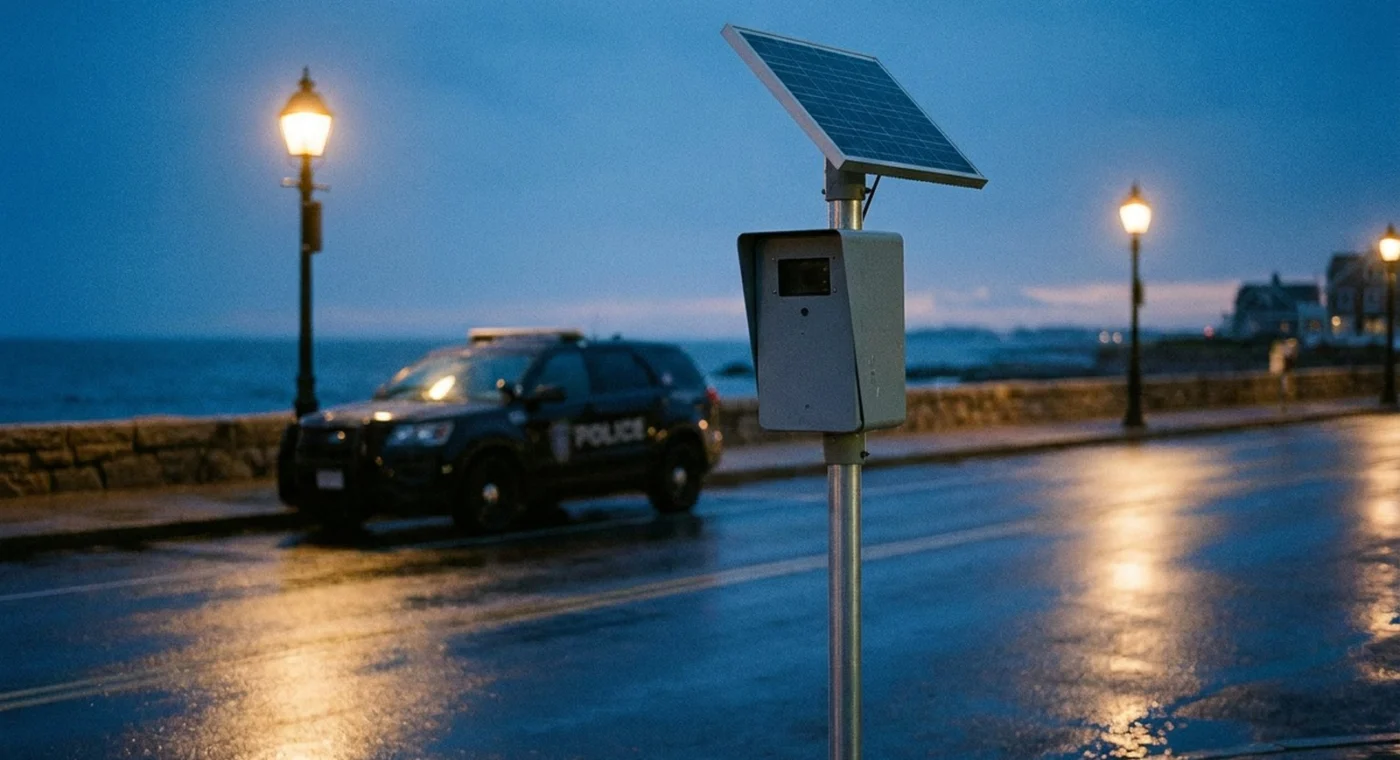
License plate readers made by Flock Safety photograph every passing car, read the plate, and store the record in a searchable database shared among subscribing departments. The Lynn audit has fed a regional debate over who can search that data and for how long it is kept.
In Malden, the City Council ordered a review of the city’s cameras in September, and in October police told councilors that 37 employees could search the system and that data is kept for seven days. In Melrose, residents demanded the cameras be removed at a special council meeting while the police chief defended them and the mayor asked for a pause. Beverly’s council heard Flock complaints from residents in October.
Swampscott’s case is different from those debates in one respect. The town never bought the cameras. Its exposure came through a data-sharing arrangement with a neighbor, and the statement shows how that arrangement worked in practice: a limit on paper to a handful of detectives, an officer outside that group who got in anyway, and a breach that the town learned about only when Lynn’s new audit software caught it.
The Swampscott Police Department is at 531 Humphrey Street. The statement lists Quesada as chief and Joe Kable as captain. Residents with questions about the department’s data-access review can contact the department at 781-595-1111.