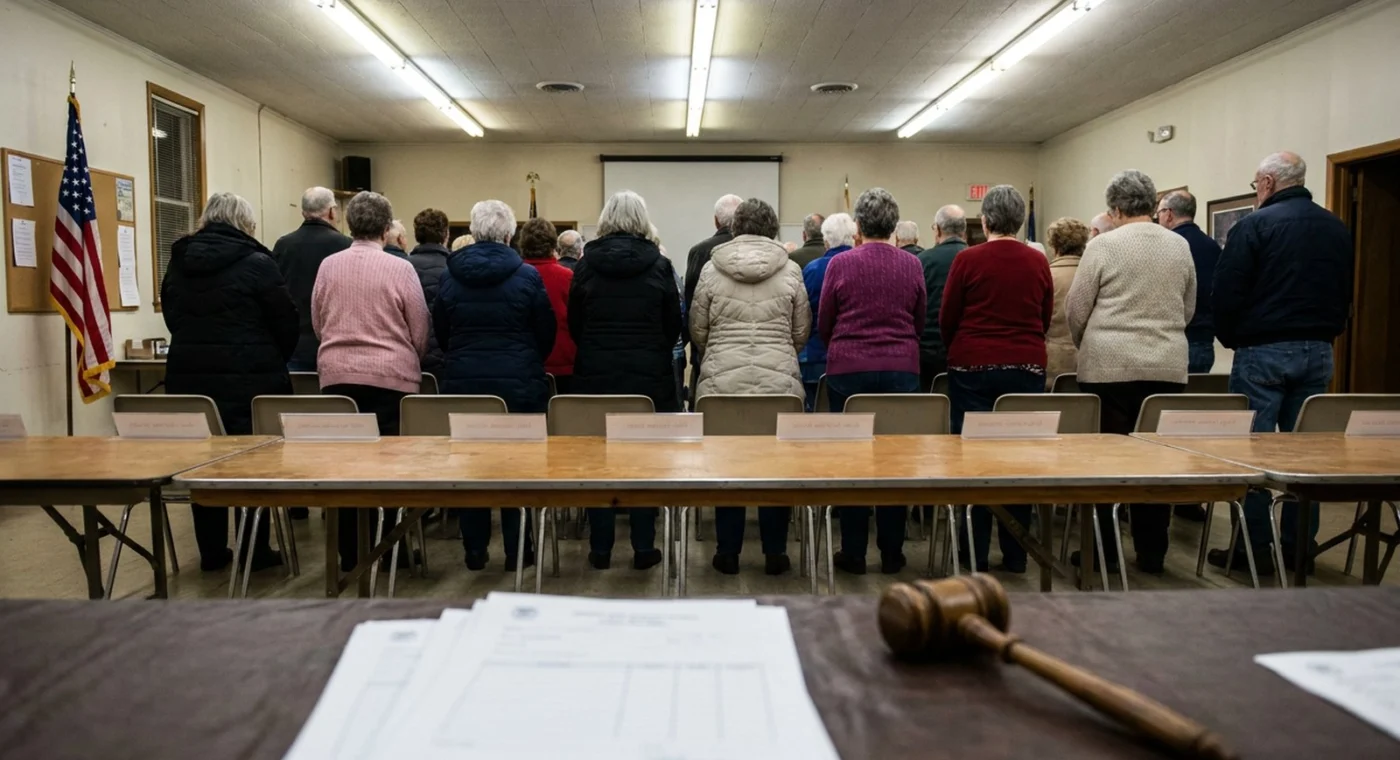
The Winthrop Town Council spent an hour and a half Monday night, November 16, hearing four Open Meeting Law complaints read aloud one at a time, then handed all four to Town Attorney James Cipoletta to answer in writing. The council took no votes. The responses are due to the state attorney general’s office by November 27, a deadline the town had already extended once, which Council President Jim Letterie said is why the review could not wait for the next regular meeting.
Three of the complaints were filed by resident Mark Sennott and concern the October 20 council meeting and a Finance Committee meeting the same day. The fourth, from resident Brian Martynowicz, concerns the notice for the October 27 special meeting at which the council dissolved its Rules and Ordinance Committee for six months. All nine councilors attended the session at the DeLeo Senior Center. There was no Zoom link.
Letterie read the attorney general’s checklist into the record before starting: a public body must review a complaint in a meeting, may then authorize its chair, an administrator or its lawyer to respond, and is not required to debate the merits. Clerk Denise Quist read each complaint, councilors commented, and Cipoletta said he would draft the answers from the transcript, his notes and the documents. Letterie said councilors who disagree with a draft may be able to file a dissenting response.
Complaint one: the golf course and the agenda
Sennott’s first complaint says Letterie raised the idea of zoning the Winthrop Golf Course as an MBTA Communities overlay district on October 20, and described a meeting with the state housing office, when neither subject was on the agenda. The complaint asks that Letterie take more Open Meeting Law training and apologize at a regular meeting.
Letterie said the agenda was finished the Thursday before. He, the town manager and state Representative Turco met with the Executive Office of Housing and Livable Communities on Monday, October 19, the afternoon before the council met, with the manager joining remotely from a seminar out of state. The manager’s written report was already done. Letterie said he brought the meeting up during the manager’s report because the public would otherwise have asked why it was kept quiet for two weeks. “I did not ask for deliberation. I did not ask for debate,” he said, and he denied telling anyone the item was in the written report.
Precinct 2 Councilor Kim Dimes said the law requires a notice to list the topics the chair reasonably anticipates, not every update given at a meeting, and noted that no motion was made and no action taken. Councilor at Large Kurt Millar said he had read the agendas of 30 other communities and that Winthrop’s one-line listings are within what the law accepts.
Precinct 1 Councilor Patrick Costigan said neither the golf course nor the state meeting was on the agenda or in the manager’s report, that no councilor had been told the meeting took place, and that more residents would have come had they known. He said he was dismayed and called it another case of the council learning things “at the 11th hour.” He pointed to Randolph, where he said the agenda carries a standing line that lets any councilor offer a motion.
Vice President Suzanne Swope said the council has to apply the same rules to everyone. “We’ve got to stop the we, they stuff,” she said. “I’m tired of this.”
Complaint two: the Finance Committee vote
The second complaint says the Finance Committee’s October 20 agenda listed “Amending Solid Waste Enterprise Fund FY27” under discussion and that the committee then voted a favorable recommendation. It calls that “intentionally deceiving.”
Councilor at Large Max Tassinari, who chairs the committee, said everything Finance reviews has already been posted on a full council agenda and referred by the full council, and that the committee’s recommendations bind no one; the matter returns to the council for a public hearing and a vote. “I don’t understand the complaint,” he said. Cipoletta agreed that a committee that only recommends is held to a looser standard of specificity than a body adopting an ordinance or a budget.
Dimes called the accusation of intentional deception “unacceptable.” Swope asked her to consider why residents keep raising the same concern.
Complaint three: the tree ordinance hearing
The third complaint says the public hearings listed for October 20, on a tree ordinance, Center Business District zoning and the tax classification, were described too broadly, that the tree ordinance draft had not been made public, and that Sennott had his hand raised when hearings were closed.
Letterie agreed on the tree ordinance. “I 100 percent agree that that was not properly advertised,” he said. He said he stopped the hearing once it was clear the draft under discussion was not the one that had been advertised, and that he probably should have caught it sooner. The ordinance will be advertised again and given a new hearing when a final draft exists. Cipoletta said that is the remedy.
On the tax classification, Letterie said the agenda used the same listing it uses every year and that the assessors’ package arrived late. Cipoletta said classification is an administrative function that may be advertised generically, and suggested the town’s answer describe a fix the attorney general often looks for: internal deadlines for submitting agenda items and legal advertisements so that nothing is rushed.
The discussion drifted into the classification itself, which the council settled on November 10. Swope said the assessors’ figures on single-family sales make the town look healthier than its condominium market is. Letterie said the presentation was about one question only: with about 4 percent of the tax base commercial, a split rate would save the average homeowner roughly $20 and cost the average small business more than $500.
Complaint four, and a fight over special meetings
Martynowicz’s complaint says the October 27 notice listed only “Motions related to CBD Ordinance Changes” and “Motion for Town Council Rule and Procedure Changes,” while the council took up separate proposals on special permit authority, payments in place of parking, ground-floor residential use and building height. It asks the council to examine when the notice was posted and when the proposals were first anticipated. It states that he does not allege intentional misconduct.
Letterie invited one of the four councilors who called that meeting to answer. The councilor who did called the complaint a technicality, like the other three, and said the council has every right to offer zoning motions.
Millar said special meetings are for urgent, time-sensitive business, such as Monday’s deadline, and that calling them to move ordinary motions is an abuse of the device. Swope answered that she proposed a planning session last November and it has not happened, and that the charter lets four councilors call a meeting when they believe business is not moving.
Costigan went further. “If it comes to having to call a special meeting every other week, I’ll do so,” he said, citing deep frustration among several councilors. “If people don’t like that, then strike it from the charter.”
Tassinari said that amounted to using the tool with no regard for colleagues or residents. “Our rights as councilors don’t matter. Their rights matter,” he said, adding that government moves slowly in order to protect the public. Costigan replied that no one is trying to slip anything past residents and that open debate on what goes to Rules and Ordinance, where he said items sit for months, serves transparency.
Letterie said most recent motions “don’t do anything” for residents and contrasted them with the $980,000 lead water line borrowing now in Finance. “When we are sitting and stuck in minutiae, I think the town just laughs at us, and I don’t blame them,” he said. He also asked that the town’s answer record that he never received written notice of the October 27 meeting at his door.
Cipoletta said the fourth complaint can be answered quickly because its points on publication, notice and specificity overlap the others. He said Martynowicz’s request to preserve and inspect posting records is one any resident may make, called the complaint neither accusatory nor malicious, and said he and the clerk will assemble the documents for him and for Sennott.
How the meeting was called
In public comment, Sennott argued Monday’s meeting was itself improper, reading the charter section that requires written notice of a special meeting to be delivered to each councilor 48 weekday hours ahead. A councilor who raised a point of order also said no written notice arrived and that the posting came less than 48 hours before.
Cipoletta said the charter provides two routes. The council president may call a special meeting, as Letterie did by announcing it in open session at the November 10 meeting; four councilors acting on their own must sign a motion and deliver it with the agenda to the others. He said he had checked that Monday’s meeting was posted and that, in his view, it was properly held.
Six other residents spoke. Several asked why the October 27 meeting was treated as urgent. One Precinct 1 resident urged the council to restore the Rules and Ordinance Committee, and another speaker offered to run a pilot project on reaching residents who cannot attend evening meetings.
The October 20 meeting at the center of three complaints is covered here. The recording of Monday’s meeting is on WCAT’s YouTube channel.