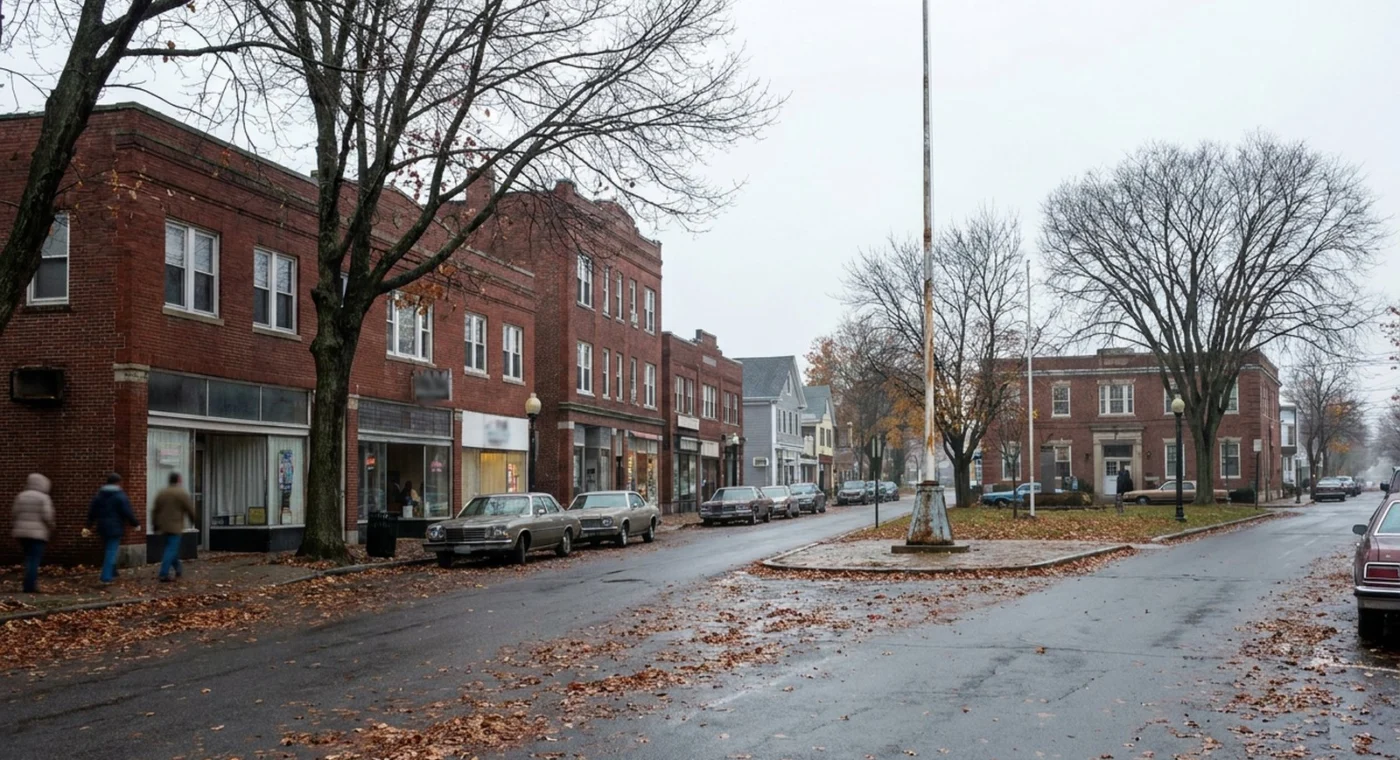
The Winthrop Town Council meets Tuesday, November 10 at 6:30 p.m. at the DeLeo Senior Center to set the town’s property tax rates for fiscal 2027, take up five zoning changes for the Center Business District that the chairman of the Planning Board has asked it to reject or defer, authorize $980,000 in borrowing to replace lead water service lines, and review four Open Meeting Law complaints filed against the council president, the council as a body and the Finance Committee chair. The agenda says there is no Zoom option for this meeting.
The details below come from the 33-page agenda package posted on the town’s AgendaCenter, a scanned document that includes the motions, the Planning Board chairman’s letter, the complaints, the town attorney’s e-mails and the town manager’s October 20 report.
Four firefighters and the tax rate
The meeting opens with the swearing in of firefighters Harry Benson, Nathan Rich, Adam Lundbergh and Jason Rich, and a citation. Then Nate Kramer and Deputy Assessor Kathy Hickey present the fiscal 2027 tax classification, which returns under old business for the vote “to establish the local property tax rates for the upcoming fiscal year.” The classification hearing was opened at the October 20 meeting, where our earlier report, linked below, described how a resident took apart the notice for the downtown zoning hearing. The package does not include the assessors’ presentation or proposed rates.
Downtown zoning: five motions from Councilor Romano
Precinct 3 Councilor Joseph Romano filed five motions dated November 5, all listed under old business as items for “Town Council review.” The council sent the same package to the Planning Board at its contested October 27 special meeting; the Planning Board must hold its own hearing before the council can act.
- Special permits: amend Chapter 17.50 of the zoning bylaw so the Town Council, “in place of the Planning Board,” becomes the special permit granting authority for the Center Business District, revising sections 17.50.120 and 17.50.130.
- Payments in lieu of parking, version one: cut the share of required parking a developer can pay for instead of building from 50 percent to 10 percent, and raise the one-time fee per space from $20,000 to $25,000, “the approximate cost of a structured parking space.” Requests to spend money from the downtown parking reserve would have to be filed with the Town Council.
- Payments in lieu of parking, version two: strike section 17.50.210(d) entirely, ending the program. The two parking motions are presented as alternatives, joined by the word “OR.”
- Height: eliminate footnotes 14 and 15 of the dimensional table and set a flat maximum of 35 feet in the Center Business District. Footnote 15 now lets buildings on lots over 100,000 square feet next to a residential district rise from 35 feet at the setback to 48 feet with an extra foot of setback for each extra foot of height.
- Ground-floor apartments: delete subsection C of 17.12.040, which lets the Planning Board allow dwelling units on the ground floor by special permit when street frontage exceeds 100 feet and the units take up no more than 75 percent of it.
The chairman of the Planning Board wrote to the council October 27, the night of the special meeting, “to formally express my opposition” to moving special permit authority away from the board. The letter, written in his own capacity and copied to state Senator Lydia Edwards, Town Attorney James Cipoletta and Town Manager Anthony Marino, argues that the board is “composed of dedicated volunteers with professional experience in planning, architecture, design, development, and zoning,” that setting zoning policy and applying it to individual projects “are fundamentally different functions,” and that “no compelling justification or demonstrated public benefit has been presented for removing this responsibility from the Planning Board. Nor have deficiencies in the Board’s administration of special permits been identified.” He cites Chapter 41, Sections 81A and 81D, and Chapter 40A, Sections 5 and 9, and asks the council to “decline to support the proposed transfer” and defer the parking, height and ground-floor changes “until the appropriate statutory review and planning evaluation have been completed.” He also asked the town attorney to clarify whether the October 27 motions started the amendment process or sought final adoption. Vice President Suzanne Swope’s proposed tree ordinance is also listed for review under old business.
$980,000 for lead pipes
Marino’s motion TCM27-004 asks the council to appropriate $980,000 “to pay costs of replacing lead water service lines” under Contract 14 and to authorize the treasurer, with the manager’s approval, to borrow the money from the Massachusetts Water Resources Authority’s lead line replacement program under Chapter 44, Sections 7(1) and 8(5). Any grants received before bonds or notes are issued would reduce the borrowing. The money goes to the water and sewer lead line replacement capital project fund.
Four Open Meeting Law complaints
Under new business the council reviews four complaints filed with the town on the Attorney General’s form, which requires a public body to meet on a complaint and respond in writing within 14 business days. All four are in the package.
Mark Sennott of Girdlestone Road filed three. The first, received October 21, is against Council President Jim Letterie and says that at the October 20 meeting Letterie “introduced the council to an idea to zone the Winthrop Golf Course as a 3A Overlay district” and reported on a meeting with the state Executive Office of Housing and Livable Communities, neither of which was on the agenda. Sennott writes that Letterie said the subject was in the town manager’s report, “which is just not true,” and attaches the report; it covers the Revere Street project, the fire station retaining wall, the McKinley School dispatch center, Grandview Avenue riprap, the Yirrell Beach dune and a $100,000 tree planting earmark, and does not mention the golf course or 3A. Sennott also says his hand was up during multiple public hearings and the president closed them without calling on him. He asks for a public apology at a regular meeting and for Letterie to take Open Meeting Law training.
Sennott’s second complaint, signed November 3, is against Finance Committee Chair Max Tassinari. It says the committee’s October 20 agenda listed “Amending Solid Waste Enterprise Fund for FY27” only as a discussion item, yet the committee voted that night to give the motion a positive recommendation, which he calls “intentionally deceiving.” The committee’s posting, included in the package, lists the item under “Discussion.” His third complaint, received November 5, adds that the October 20 council agenda’s public hearing listings were too vague: the tree ordinance hearing concerned a draft “that was sent to certain people” and never shared publicly, only Tree Committee members and one audience member were called on, the Center Business District hearing was closed while his hand was raised after a resident pointed out the hearing had not been properly advertised, and the tax classification hearing came before any proposal had been introduced. He calls it “a malicious attempt by the Council President to discourage meaningful public input.”
Brian Martynowicz of Strandway filed the fourth complaint, received October 29, against the council as a body over the October 27 special meeting. He argues that the notice headings “Motions related to CBD Ordinance Changes” and “Motion for Town Council Rule and Procedure Changes” may not have described the subjects specifically enough under Chapter 30A, Section 20(b), given that the meeting took up special permit authority, parking payments, ground-floor housing, height limits and detailed council rules. He notes that the motions in the packet are dated October 26, says he does not allege late posting or intentional misconduct, and asks the council to examine the original notice and its timestamps and, if a violation is found, to redo the deliberation with proper notice. Cipoletta’s October 21 e-mail to Romano, also in the package, confirms the council must meet before responding and says the response to the first complaint should come from Letterie “or in his behalf,” since he is the only member named.
Also on the agenda
- Artificial intelligence: Letterie moves to create a seven-member temporary Artificial Intelligence Policy Subcommittee, appointed by the council president, with one councilor, the town manager or a designee, the superintendent or a designee and four residents, to review state and municipal AI governance and report recommendations at the April 20, 2027 meeting. A proposed ban on councilors using AI was withdrawn at the October 27 meeting.
- Election recap: a review of the town’s current voting tabulators.
- Rules and Ordinance: review of information referred to the committee before the council dissolved it for a six-month trial.
- Minutes of October 20 and October 27; committee reports; the school department report; the town manager’s report.
- Upcoming: the Veterans Day celebration November 11 at 11 a.m., and Holiday Lights and Victorian Nights in French Square on November 27 from 3 to 6:30 p.m.
The council: President Jim Letterie; Vice President Suzanne Swope, Precinct 4; Patrick Costigan, Precinct 1; Kim Dimes, Precinct 2; Joseph Romano, Precinct 3; Paul Reardon, Precinct 5; Martin Finn, Precinct 6; and Max Tassinari and Kurt Millar at large. Earlier coverage: the October 27 special meeting and the October 20 regular meeting.