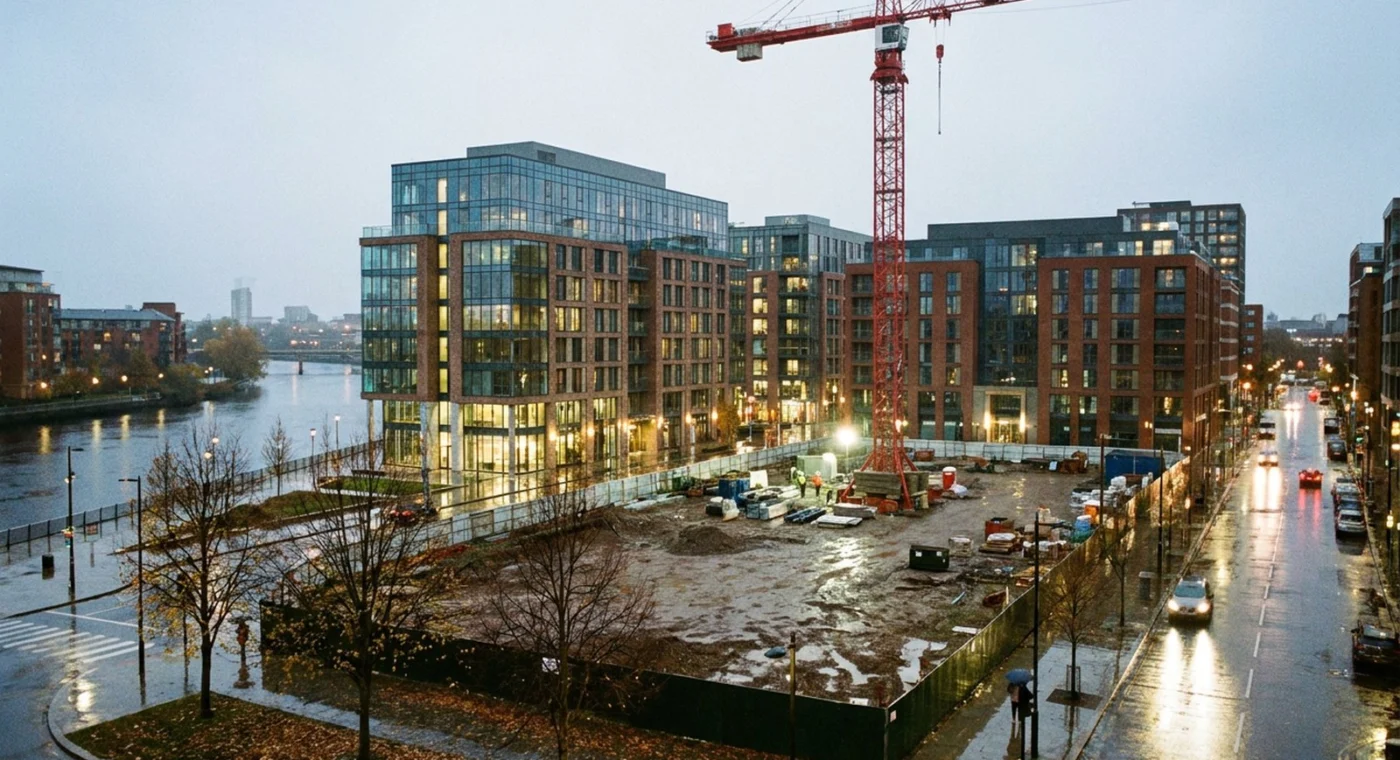
The Somerville City Council meets Thursday, November 12 at 7 p.m. with the first project-specific deal under the tax increment financing zone it approved for Assembly Square in September: a 20-year exemption worth an estimated $28.1 million for a 318-unit apartment building on Block 9, the vacant lot at 375 Harold Cohen Way. The same agenda carries the fiscal 2027 tax classification hearing, with the assessor recommending the maximum shift to commercial property and the 35 percent residential exemption the council has adopted for 12 years running, and a package of transfers totaling about $320,000 to run this winter’s warming center. The details below come from the nine-page agenda published November 9 and the backup documents posted on the council’s Legistar site.
Block 9: $25.8 million paid, $28.1 million forgiven
Mayor Jake Wilson’s request, item 26-1611, asks the council to approve an Urban Center Housing Tax Increment Financing agreement with CDNV Land LLC, the Federal Realty Investment Trust entity that owns Block 9. The program, run by the state housing office, lets a city exempt part of the new taxes a project would generate on the increase in value from a vacant lot to a finished building. The council created the zone covering Assembly Square and East Somerville on September 15.
The November 6 memo from Strategy and Development Executive Director Thomas Galligani, Economic Development Director Rachel Nadkarni and planner Katherine Wiese describes a fully permitted project, approved at site plan review in May 2025, with 318 apartments, 63 of them income-restricted, and 13,000 square feet of retail space intended for a child care center, steps from the Orange Line. The lot now pays $81,628 a year in taxes. Under the draft agreement, the owner pays full taxes during the two construction years, then for ten years pays taxes on the base value plus about 21 percent of the increment, an average of just under $500,000 a year. In years 11 through 20 the exemption steps down until the owner pays 100 percent, an average of almost $1.9 million a year over that decade. The memo’s table puts the total over 20 years at $25.8 million in taxes paid and $28.1 million in taxes forgone, with the first full-tax year after the agreement ends estimated at $3.57 million.
Staff say the deal does three things the base program does not. It takes two of the inclusionary units that would have been priced for households at 110 percent of area median income and prices them for households at 30 percent, which the memo calls a first for an inclusionary project in the city, with a possible third unit if the project’s linkage fee is spent on site. It includes an “excess profit adjustment,” added at councilors’ request during the zone debate, that returns part of the subsidy in any year the owner’s return on cost exceeds the projection. And it guarantees that the taxes paid each year cover the roughly $400,000 in added municipal costs that staff estimate the 318 households and the retail space will generate. The memo also counts about $3.5 million in building permit fees when construction starts, with a foundation permit expected in summer or fall 2027. A third-party reviewer, Abramson and Associates, examined the developer’s pro forma and found the subsidy necessary to make the project feasible, according to the memo. A public hearing will be scheduled; comments go to publiccomments@somervillema.gov.
The tax rate: single-family bill up $597
Chief Assessor Francis J. Golden’s classification presentation for item 26-1616 puts the city’s total taxable value at $25.8 billion, down slightly from last year as commercial values fell 10.3 percent while condominiums rose 3.5 percent and single-family homes 1.2 percent. The maximum levy is $291.4 million: last year’s limit plus 2.5 percent, $5.0 million in new growth and $6.7 million for the high school debt exclusion. New growth “slowed down for Somerville the last two fiscal years,” the slides say, blaming interest rates, “the collapse of the life science market” and construction costs.
The board recommends what the council has done every year since 2008: adopt the minimum residential factor, 84.15, which shifts the levy as far toward commercial property as the law allows, and accept the 35 percent residential exemption for owner-occupied homes. With both, the commercial rate works out to $19.77 per $1,000 and the residential rate to $11.58, against a single rate of $11.29. The exemption, worth $419,741 of value on an average $1,199,260 home, saves an owner-occupant $4,856 and goes to 9,108 properties; the break-even point, above which an owner pays more because of the exemption, is $2,338,214. The slides put the average tax change at $320 for a condominium, to $4,262; $597 for a single-family house, to $9,064; $673 for a two-family, to $9,212; $687 for a three-family, to $12,311; and $1,669 for a four- to eight-family building, to $18,421. The high school debt exclusion accounts for $207 of a single-family bill and $97 of a condo’s.
Warming center: $730,000 program, $320,000 from the city
Five mayoral papers assemble the city’s share of the fiscal 2027 warming center: $155,768 from free cash, $92,795 from the emergency response stabilization fund, $69,192 repurposed from the COVID-19 small business stabilization fund and $1,939 more from the same fund. The one-page budget attached to the free cash request puts the 16-week program at $729,732, with a state housing grant covering $410,037 for ten weeks and the city $319,695 for the other six weeks plus costs the grant does not cover: $37,872 in outside security, $24,000 for a shuttle, $10,000 in outside cleaning and $1,800 for a portable toilet for the line outside. The daily cost is $6,515. The largest lines are direct care staff and a supervisor, about $300,000 together, and food at $128,889.
The rest of the mayor’s list
The mayor asks the council to repeal Section 5-45 of the city code, the three-member medical panel of the mayor, city solicitor and an appointed physician that decides whether the city will cover hospital and medical bills of police officers and firefighters injured on duty; the ordinance text strikes the section in full and gives no replacement, and the Legislative Matters Committee’s October 27 report is on the same agenda. He asks for $2,383,850 from parking meter receipts to reduce the tax rate, the annual use of that reserve. From Community Preservation Act money he seeks $1 million to finish the Kennedy School playground at Sartwell and Cherry, on top of a $3 million grant last year, which the Community Preservation Committee recommended 6-2 on October 28; $230,171 and $23,418 for the Elizabeth Peabody House at 277 Broadway; $109,000 for a historic exterior study of the Somerville Armory; $45,000 to design a green space on the Spring Street traffic island; $38,000 to restore the veterans cemetery; and $25,000 for a condition assessment of the Mission Church of Christ at 130 Highland Avenue.
Grants to accept include $500,000 from the federal housing department for the first phase of Union Square Plaza, $350,000 from the state’s Downtown Initiative, $60,313 for police road safety, two $50,000 agriculture grants for the mobile farmers market and school food programs, and $48,000 for food waste containers and recycling. The mayor also asks the council to confirm Lydia Warren as director of arts and culture, to approve $46,270 for a hazardous materials mitigation plan update, $140,831 for street repair, and salary corrections of $25,950 for the police department’s victim witness advocate and senior crime analyst. Four zoning amendments carried over from October, on parking maximums, ground-story elevation, principal entrances and the terms used for affordable units, are up for ordainment.
Councilors’ orders: AI purchases, air rifles, Emergency Streets
Councilor Link asks the finance director to start collecting data on every product or service the city buys that is marketed as artificial intelligence or bought for its AI features, a step toward the AI ordinance the council took up in October, reported in the story linked below; a resident’s written comment urging adoption of that ordinance is on the agenda. Link also asks the mobility director to adopt an Emergency Streets protocol, a five-page draft framework under which a fatal crash triggers a rapid review and temporary safety measures at the site within 48 to 72 hours. Councilor Hardt asks the council to authorize Secured Environments Pest and Wildlife Services to use air rifles for rodent control in Ward 7, a step the code requires. Councilor McLaughlin wants a count of one-story buildings in mid-rise zones and how much housing upzoning them to six stories would add, a list of every inspectional services complaint filed through 311 this year, and art on rotaries and speed bumps. Councilor Mbah asks the mobility director to clarify who has the right of way at mid-block crossings where cyclists join the community path. Council President Davis asks to move the annual caucus to December 10. Twenty-five residents filed comments supporting the accessory dwelling unit amendment that would align the city with state law.
The council’s October 22 meeting is reported here. The agenda is on Legistar, the Block 9 memo is here and the classification presentation is here. The meeting is in the council chamber and on Zoom.