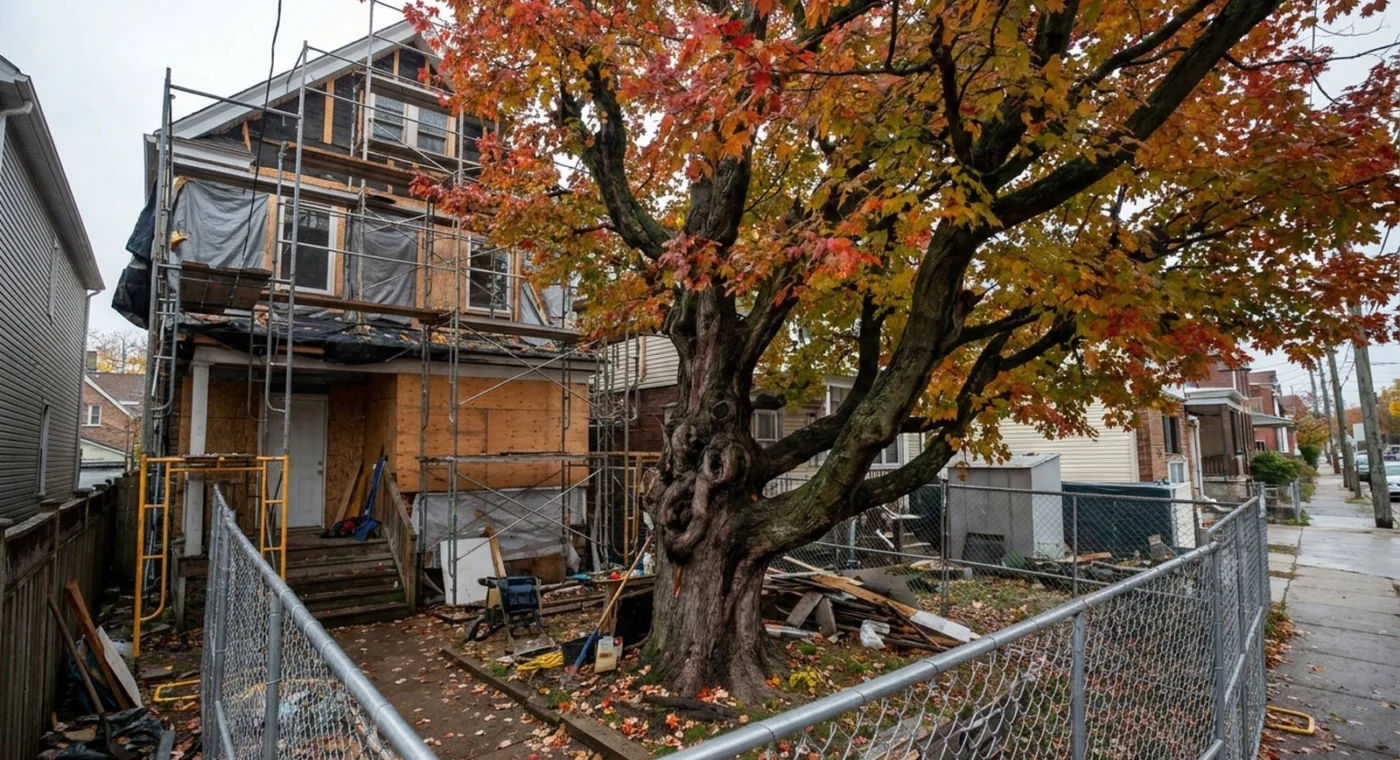
Builders in Somerville would have to protect large trees near a construction site, including a neighbor’s, under an ordinance amendment that a City Council committee recommended last week. The same committee finished its rewrite of the city’s pay-to-play ordinance, which governs city contracts and financial assistance for people and organizations that make political contributions.
Both measures came out of the Legislative Matters Committee on Wednesday, November 18. Two days earlier, a second committee recommended Dr. Lydia Warren as the city’s director of Arts and Culture, along with three appointments to city boards. The city has now posted the minutes of both meetings, and the committee reports are on the agenda of the full City Council on Tuesday, November 24.
Trees next to construction
The tree measure, filed by Ward 5 Councilor Naima Sait, amends Section 12-111.1 of the city code “to protect private significant trees during construction.” According to the committee’s minutes, Dr. Vanessa Boukili, the city’s senior urban forestry and landscape planner, said the latest wording makes clear that the requirement does not reach every tree on or next to a lot, only the trees in the area around the construction.
A significant tree, she said, is one at least eight inches in diameter. Answering Ward 6 Councilor Lance Davis, Boukili said the industry standard is a chain-link or similar fence around the tree with a radius of one foot for every inch of trunk diameter. Requirements would be set case by case, she said, but that would be the general rule. Species differ in how much root pruning they tolerate, and the standard is meant to protect a tree’s structural roots and let it recover from any cutting that cannot be avoided.
Councilor Kristen Strezo wanted to know how long the city’s review would take. Boukili said the timeline was left flexible on purpose because her office does not have the staff to review every building permit. If a project is flagged, the provision lets the office require a review of the plan. Her office reviews Green Score applications within two weeks and follow-up documents within one, she said, and a similar pace could be expected.
Councilor Ben Ewen-Campen raised the case of construction that has to happen right on a property line. Boukili said state law already lets an owner trim branches that hang over the property but bars actions that would kill or seriously damage the tree, such as cutting all the roots on one side.
Chair J.T. Scott said the fence radius for a big tree could be hard to fit on a small lot. Boukili said a building permit could still be issued in that situation, but the owner would need a separate tree removal permit, which requires a payment to the city, and neighbors whose trees are damaged may have recourse under state law. Scott said projects that remove trees already need that permit, so the amendment should not add much to her workload, and she agreed. Answering Councilor Wilfred Mbah, she said the tree warden is writing a guidebook on protection measures.
The committee adopted the new text and recommended the ordinance as amended, 5 to 0, with Davis, Mbah, Ewen-Campen, Strezo and Scott in favor.
Pay to play: disclosure in place of an exemption
The other ordinance is the mayor’s request to amend Chapter 15, Article III of the code, which the committee’s documents call the pay-to-play article. The open question was what to do about nonprofit groups that apply for city grants when one of their board members has donated to a local campaign.
Scott presented his own amendments. An earlier draft would have changed the definition of financial assistance so that grants awarded by multi-member bodies were exempt. That change has been removed, he said, and a new Section 15-77 creates a waiver instead. He told Ewen-Campen the effect is that Community Preservation Act grants could go forward even when a board member’s contribution would otherwise create a conflict, but the contribution would have to be disclosed. When Strezo wanted to know how the matter would come before the City Council, Scott said he expects it to be handled in a single meeting, with a vote that night and no referral to committee.
Assistant City Solicitor Jason Piques said both Scott’s version and the earlier one are legally sound and the choice between them is a matter of policy. Asked by Mbah about a four-calendar-year lookback added to Section 15-72(e)(5), Piques said the ordinance already has lookback periods for contract and financial assistance applications and a four-year look forward. The disclosure becomes part of the application, he said, and would not by itself block a grant.
Strezo said the process could add red tape and bureaucracy. Davis said that if the point of the ordinance is to keep elected officials from being influenced by campaign money, there is a concern in having those same officials grant the waivers. Scott called that a valid point and said his aim is transparency through public disclosure. Ewen-Campen noted that the contributions of a board’s members are added together, so a large board could reach a $500 total through small individual gifts, and he said it could be uncomfortable for the council to judge whether contributions were made in good faith. Davis said the threshold could be revisited and that the city’s ongoing review of all its ordinances will offer other chances to improve the article.
The minutes record the item as recommended for approval as amended.
A new arts director
The Confirmation of Appointments and Personnel Matters Committee met on Monday, November 16, with Chair Mbah and Councilors Emily Hardt, Jon Link and Ewen-Campen present and Ward 1 Councilor Matthew McLaughlin absent. Its minutes show it recommended four of the mayor’s appointments.
Anne Gill, the director of people operations, introduced Warren as someone who has directed a museum, published widely, won grants and served on boards. Warren told the committee she grew up in Franklin, that Davis Square was one of the first places she played music and made recordings, and that her dissertation research was about equity in the arts, economic equity in particular.
Warren said Somerville’s Cultural Council grant program is more robust because of funding from Encore, but that the city could do more outreach so residents know the grants exist. Her priorities, she said, include advocating for the Cultural Trust; a strategic plan for the Arts and Culture division, its first since 2008, to be done with a consultant; and the Armory, which she said has to stay functional, sustainable, economically viable and open to both artists and the public. She wants internships for Bunker Hill Community College students to become regular. Answering Link, she said residents who want to put on their own events often lack the know-how or the resources, and the city should make its events easier to scale and copy.
Assessors and the Condominium Review Board
The committee recommended Christopher Gaeta for the Board of Assessors. Francis Golden, who chairs the board and is the city’s chief assessor, said Gaeta has nearly 12 years in assessing, eight of them as director of assessing for the city of Lynn, and earlier worked for an affordable housing developer. The board has three members, the seat is part-time and pays $10,000 a year, and its busiest months are January through May, Golden said. Gaeta said he tries to walk people through the process and point them to exemptions they may qualify for.
Two renters, Gary Rogers and Fatima Climaco, were recommended for the Condominium Review Board, which staff liaison Lauren Chapman said has two vacancies reserved for residents who rent. Rogers told the committee he has rented in Somerville for nearly three decades, has been through the eviction process himself and has been active in tenant advocacy. Climaco, a lifelong resident who is bilingual in English and Spanish, said she has lived in affordable housing and would not have been able to afford a home for herself and her children without it.
Two items stayed in committee without recorded discussion: the appointment of Ashley Tienken to the Affordable Housing Trust and an order by Mbah on hiring practices in the City Council and City Clerk offices.
One garage license
The Licenses and Permits Committee met for seven minutes on November 18. With Chair Hardt and Councilor Ben Wheeler present and Davis absent, it recommended a new garage license for Toucan Auto Center Inc. at 619 Somerville Avenue: 39 vehicles inside and one outside, for auto body work, spray painting and a tow operation, open weekdays from 8 a.m. to 6 p.m. and Saturdays until 2 p.m. Hardt said the business already exists and that neither the city clerk nor the ward councilor had concerns. No one spoke at the public hearing.